Undergrad Confusion over what exactly constitutes the ecliptic

Click For Summary
The ecliptic is the Sun's annual path through the stars, defined by the Earth's orbit around the Sun and tilted at 23.5° to the celestial equator. It is distinct from the Sun's daily movement across the sky, which is a result of the Earth's rotation. The daily motion does not represent the ecliptic, as both the Sun and stars appear to move together due to this rotation. The ecliptic also serves to define the zodiac constellations, which become visible or obscured throughout the year. Understanding the ecliptic involves recognizing these two separate movements: daily rotation and annual orbit.
thebosonbreaker
Messages
32
Reaction score
5
TL;DR
How does the path of the Sun across a year compare to its path across a day?
When first introduced to the concept of the ecliptic, I was under the impression that the ecliptic was the path taken by the Sun across the sky over the course of a day. That is to say, the rising in the east and setting in the west, due to the Earth's (daily) rotation from west to east. (Image below).
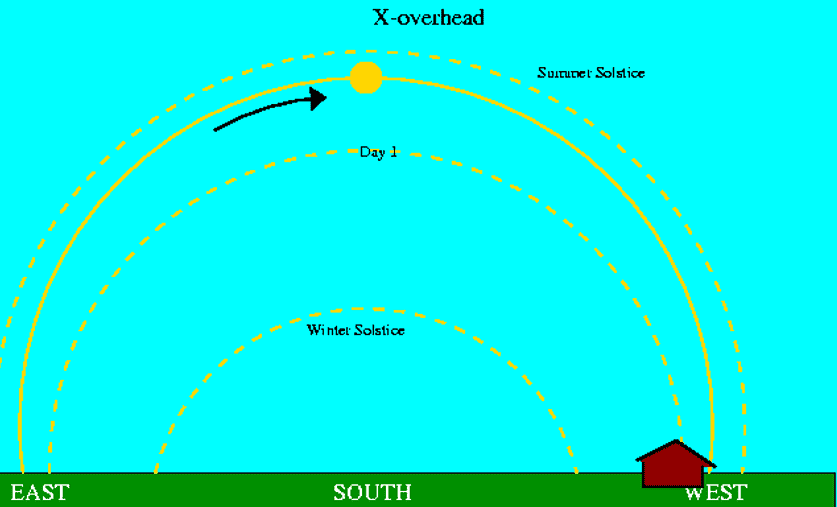
Picture1.png

However, I have since read that the ecliptic is the Sun's path over a year, describing an "ecliptic plane" that is at a 23.5° angle to the celestial equator due to the Earth's axial tilt. (Image below), and that the ecliptic is used to define the zodiac constellations, as different constellations become apparent, while others are obscured as they lie behind the Sun, over the course of a year.
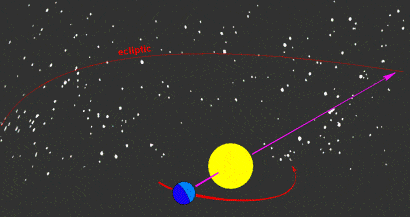
Ecliptic_with_earth_and_sun_animation.gif

I also understand that it is us that is actually doing the moving as we orbit the Sun, creating the illusion that the Sun moves (relative to us). However, I am still slightly confused over what exactly constitutes the ecliptic.

Is the daily movement of the Sun the portion of the ecliptic we see on that day? Am I describing two different movements?

I would be grateful if someone could explain/clear this up for me.
Many thanks.
 
Astronomy news on Phys.org
thebosonbreaker said:
Is the daily movement of the Sun the portion of the ecliptic we see on that day? Am I describing two different movements?
No, the daily motion of the sun across the sky is not the ecliptic. Note that the stars also rise and set, so the daily motion of the sun relative to the stars is very small. If you could see the sun and the stars at the same time (you can't, because the sun is too bright), you would see them move together across the sky. This is a consequence of the Earth's daily rotation. The ecliptic is the sun's path through the stars over the course of the year, which is a consequence of the Earth moving in its orbit around the sun. It is also the plane of the Earth's orbit projected onto the celestial sphere. These are two ways of saying the same thing. Because the other planets and the moon have orbital planes which are close to being in the same plane as the Earth's orbit, the moon and planets stay near the ecliptic as they move thorugh the sky, but not exactly on it.
 
  • Like
Likes stefan r and thebosonbreaker
thebosonbreaker said:
Is the daily movement of the Sun the portion of the ecliptic we see on that day? Am I describing two different movements?

You can go outside and experiment. Use an object around head height. A stop sign or a bush will work. Pick a small area like the point where the bottom of the sign touches the post. Walk in a circle around the target object. As you orbit the sign the objects that are eclipsed by the sign will change. A house north of the sign will be behind it during part of the walk and a house south of the sign will be blocked in another part.

In contrast stand in one location and spin around. The sign will be on your left, then in front of you, then to the right, then behind. At all of those times the sign post will be eclipsing (blocking the view of) the same house (or background). The house rotates around at the same rate as the sign post.

You could also consider the view from a figure skater like this video. The stairwell behind the word "paris" changes position over the course of a few seconds. If she was orbiting the stairwell the movement would represent much less than a month equivalent. Because she is spinning she also sees the same stairwell pass three times. The area eclipsed by the judge in pink will make a shape like a pizza slice. This slice is in the Judge's ecliptic plane. The skater is not orbiting the judge so don't take the analogy too far. The similarity comes from the fact that the skater is both spinning and moving so the skater sees the position of the pink judge change in more than one way.
 
thebosonbreaker said:
Summary: How does the path of the Sun across a year compare to its path across a day?

However, I am still slightly confused over what exactly constitutes the ecliptic.
I imagine that the plane of the ecliptic was originally a term used in the Aristotelian Universe (the plane that the Sun moves in, relative to the Earth) because it was used primarily for navigation and time keeping. So it probably doesn't have ( or need) a proper definition as it will have been used differently over the years if you are not actually doing calculations with it then the definition is not very relevant.
 
Hi, I saw someone with an avatar on a different forum that turns out to be the sombrero galaxy. AI says, too distant to know much about, aside from billions of starts, potentially tons of planets, and a supermassive black hole in the center. I find that setup fascinating, despite knowing close to nothing about the universe. So I ask: could anyone point me in the direction of, or provide information about this galaxy? I do not trust AI beyond general information, and I like to go pretty...

Similar threads

  • · Replies 2 ·
Replies
2
Views
2K
  • · Replies 142 ·
5
Replies
142
Views
133K
Replies
4
Views
3K
  • · Replies 3 ·
Replies
3
Views
4K
  • · Replies 5 ·
Replies
5
Views
3K
  • · Replies 5 ·
Replies
5
Views
6K
  • · Replies 0 ·
Replies
0
Views
2K
  • · Replies 4 ·
Replies
4
Views
2K
  • · Replies 3 ·
Replies
3
Views
4K
  • · Replies 1 ·
Replies
1
Views
2K