Conservation of energy - elastic potential energy and k.e.

Click For Summary

Homework Help Overview

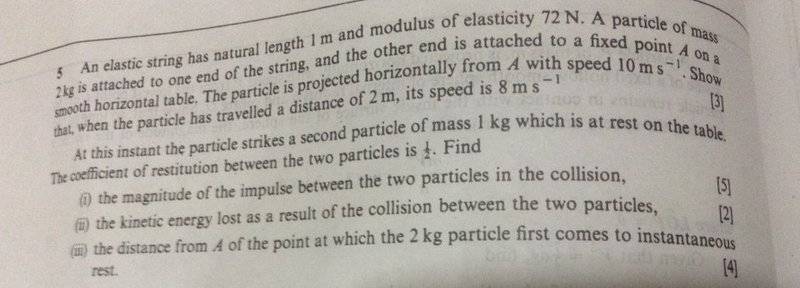
The discussion revolves around the conservation of energy in the context of elastic potential energy and kinetic energy, specifically focusing on a scenario involving a 2 kg particle and its interactions with a string after a collision.

Discussion Character

  • Exploratory, Assumption checking

Approaches and Questions Raised

  • Participants explore the application of conservation of energy principles, questioning the omission of elastic potential energy related to the string after the collision. There is a discussion about potential misunderstandings in the provided solution and the accuracy of the original poster's portrayal of the problem.

Discussion Status

Participants are actively engaging with each other's reasoning, with some expressing agreement on the equations used. There is an acknowledgment of possible discrepancies in the solutions referenced, and a suggestion to verify answers against a textbook is made.

Contextual Notes

There is mention of a potential misunderstanding of the solution provided, as well as a note on the format of the solution being inconsistent with the problem statement.

Janiceleong26
Messages
276
Reaction score
4
1. Homework Statement
image.jpg

For part (iii) , I used the principle of conservation of energy,
K.E of the 2 kg particle after collision + E.P.E = K.E of the 2 kg particle at the furthest distance away from A + E.PE,

But the solution for this question did not include the E.P.E of the string after collision (in bold), why? Shouldn't there still be tension in the string?
 
Physics news on Phys.org
Janiceleong26 said:
1. Homework Statement
View attachment 97599
For part (iii) , I used the principle of conservation of energy,
K.E of the 2 kg particle after collision + E.P.E = K.E of the 2 kg particle at the furthest distance away from A + E.PE,

But the solution for this question did not include the E.P.E of the string after collision (in bold), why? Shouldn't there still be tension in the string?
Based on the information you have provided, I would agree with you. But this leaves the possibility that you have misunderstood something in the solution provided and therefore not portrayed it accurately.
As a way of checking, what answer did you get and what answer does the book get?
 
haruspex said:
Based on the information you have provided, I would agree with you. But this leaves the possibility that you have misunderstood something in the solution provided and therefore not portrayed it accurately.
As a way of checking, what answer did you get and what answer does the book get?
image.jpg


I did this :
1/2 (2)(0)2 +1/2 (72) (x)2 = 1/2 (2) (4)2 + 1/2 (72)(1)2
 
Janiceleong26 said:
I did this :
1/2 (2)(0)2 +1/2 (72) (x)2 = 1/2 (2) (4)2 + 1/2 (72)(1)2
I agree with your equation.
I note that the wrong solution is monospaced type, as from an old typewriter, whereas the problem statement is a page from a book.
 
Yeah it is
Thanks for your help !
 

Similar threads

  • · Replies 12 ·
Replies
12
Views
3K
Replies
3
Views
1K
Replies
21
Views
3K
  • · Replies 22 ·
Replies
22
Views
4K
Replies
1
Views
1K
  • · Replies 3 ·
Replies
3
Views
2K
  • · Replies 4 ·
Replies
4
Views
2K
  • · Replies 6 ·
Replies
6
Views
2K
Replies
55
Views
6K
Replies
7
Views
4K