Constraint equations in mechanics

Click For Summary
SUMMARY

The discussion centers on analyzing the acceleration of two blocks, with masses of 5 kg and 10 kg, connected by a string over massless pulleys under various upward forces (F) of 100N, 300N, and 500N. The user initially derived the equation F=4T, where T is the tension in the connecting string, but encountered negative acceleration values, indicating a miscalculation. Key issues identified include the incorrect assumption that the mass center of the two blocks accelerates at the same rate as the upper pulley and the omission of the cord's anchoring to the floor in the force equation.

PREREQUISITES
  • Understanding of Newton's laws of motion
  • Familiarity with free body diagrams (FBD)
  • Knowledge of constraint equations in mechanics
  • Basic principles of tension in strings and pulleys
NEXT STEPS
  • Review the derivation of constraint equations in mechanics
  • Learn how to correctly apply Newton's second law to systems with pulleys
  • Study the impact of anchoring points on tension and acceleration in pulley systems
  • Explore examples of free body diagrams for multi-mass systems
USEFUL FOR

Students and professionals in physics, mechanical engineering, and anyone studying dynamics involving pulleys and constraint equations.

Kushal Chakrabarti
Messages
4
Reaction score
5
1. The problem: Two blocks of mass m=5kg and M= 10kg are connected by a string passing over a pulley B. Another string connects pulley B to the floor and passes over pulley A. An upward force F is applied at the centre of pulley A. Both pulleys are massless. Find acceleration of the blocks if F is:
a) 100N, b) 300N, c) 500N
Take g=10 ms-2
I have attached an image of the problem.

Attempt at a solution:
Well I drew an FBD in the frame of pulley A, thus using a downward pseudo force. Also, I found using constraint equations that F=4T, where T is the tension in the thread joining the two masses. Thus it gave me two equations ( one for each mass) but solving them, I found out that both the accelerations are turning out to be negative. Where did I go wrong?
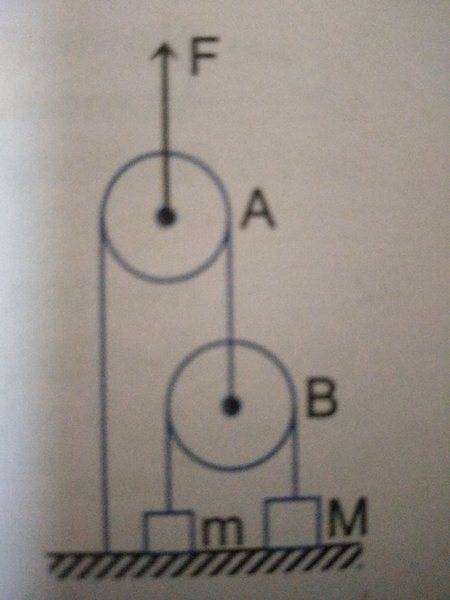
15320104568961692308584.jpg
 

Attachments

  • 15320104568961692308584.jpg
    15320104568961692308584.jpg
    24 KB · Views: 776
Physics news on Phys.org
Kushal Chakrabarti said:
Thus it gave me two equations ( one for each mass) but solving them, I found out that both the accelerations are turning out to be negative. Where did I go wrong?
How are we going to have any chance to answer that if you do not show us your calculations?
 
Orodruin said:
How are we going to have any chance to answer that if you do not show us your calculations?
I'm very sorry sir I'll put my attempt too
 
15320118790831916162559.jpg
 

Attachments

  • 15320118790831916162559.jpg
    15320118790831916162559.jpg
    39.5 KB · Views: 1,194
Orodruin said:
How are we going to have any chance to answer that if you do not show us your calculations?
I've now added my attempt too, sir
 
Kushal Chakrabarti said:
Please take the trouble to type working. Images are for diagrams and textbook extracts.
If you must post as images, please number equations for reference.

The line F=(M+m)a omits that a cord is anchored to the floor. It is also wrong in supposing that the mass centre of the two masses accelerates at the same rate as the upper pulley.
 
The book claims the answer is that all the magnitudes are the same because "the gravitational force on the penguin is the same". I'm having trouble understanding this. I thought the buoyant force was equal to the weight of the fluid displaced. Weight depends on mass which depends on density. Therefore, due to the differing densities the buoyant force will be different in each case? Is this incorrect?

Similar threads

  • · Replies 6 ·
Replies
6
Views
5K
  • · Replies 2 ·
Replies
2
Views
2K
  • · Replies 5 ·
Replies
5
Views
1K
  • · Replies 18 ·
Replies
18
Views
2K
Replies
4
Views
835
  • · Replies 12 ·
Replies
12
Views
1K
  • · Replies 8 ·
Replies
8
Views
3K
  • · Replies 22 ·
Replies
22
Views
1K
  • · Replies 3 ·
Replies
3
Views
2K
  • · Replies 2 ·
Replies
2
Views
1K