Constraint equations in mechanics

Click For Summary

Homework Help Overview

The problem involves two blocks connected by a string over a pulley system, with an upward force applied at one of the pulleys. The objective is to determine the acceleration of the blocks under different force conditions, while considering the effects of gravity.

Discussion Character

  • Exploratory, Assumption checking, Problem interpretation

Approaches and Questions Raised

  • The original poster attempts to use free body diagrams and constraint equations to analyze the system but encounters negative acceleration results. Participants question the clarity of the calculations and the assumptions made regarding the system's setup.

Discussion Status

Participants are actively seeking clarification on the calculations and the assumptions involved in the problem. There is a focus on ensuring that all steps are documented clearly, and some guidance has been offered regarding the need for detailed workings to facilitate further discussion.

Contextual Notes

There is an emphasis on the importance of showing calculations rather than relying solely on images, as well as a note that the assumptions about the acceleration of the mass center may need to be reconsidered.

Kushal Chakrabarti
Messages
4
Reaction score
5
1. The problem: Two blocks of mass m=5kg and M= 10kg are connected by a string passing over a pulley B. Another string connects pulley B to the floor and passes over pulley A. An upward force F is applied at the centre of pulley A. Both pulleys are massless. Find acceleration of the blocks if F is:
a) 100N, b) 300N, c) 500N
Take g=10 ms-2
I have attached an image of the problem.

Attempt at a solution:
Well I drew an FBD in the frame of pulley A, thus using a downward pseudo force. Also, I found using constraint equations that F=4T, where T is the tension in the thread joining the two masses. Thus it gave me two equations ( one for each mass) but solving them, I found out that both the accelerations are turning out to be negative. Where did I go wrong?
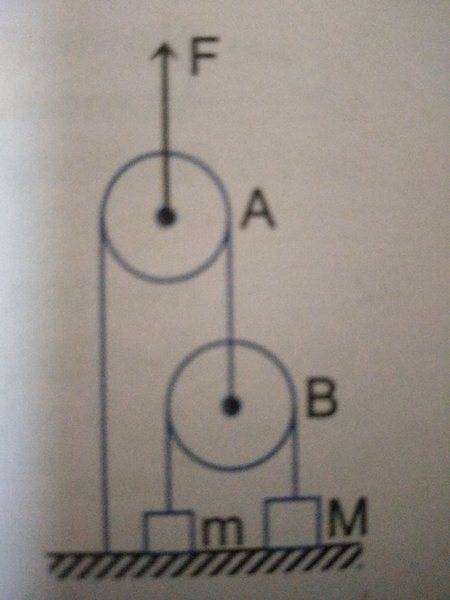
15320104568961692308584.jpg
 

Attachments

  • 15320104568961692308584.jpg
    15320104568961692308584.jpg
    24 KB · Views: 788
Physics news on Phys.org
Kushal Chakrabarti said:
Thus it gave me two equations ( one for each mass) but solving them, I found out that both the accelerations are turning out to be negative. Where did I go wrong?
How are we going to have any chance to answer that if you do not show us your calculations?
 
Orodruin said:
How are we going to have any chance to answer that if you do not show us your calculations?
I'm very sorry sir I'll put my attempt too
 
15320118790831916162559.jpg
 

Attachments

  • 15320118790831916162559.jpg
    15320118790831916162559.jpg
    39.5 KB · Views: 1,209
Orodruin said:
How are we going to have any chance to answer that if you do not show us your calculations?
I've now added my attempt too, sir
 
Kushal Chakrabarti said:
Please take the trouble to type working. Images are for diagrams and textbook extracts.
If you must post as images, please number equations for reference.

The line F=(M+m)a omits that a cord is anchored to the floor. It is also wrong in supposing that the mass centre of the two masses accelerates at the same rate as the upper pulley.
 

Similar threads

Replies
13
Views
986
  • · Replies 6 ·
Replies
6
Views
5K
  • · Replies 2 ·
Replies
2
Views
2K
  • · Replies 5 ·
Replies
5
Views
1K
  • · Replies 18 ·
Replies
18
Views
2K
  • · Replies 12 ·
Replies
12
Views
2K
  • · Replies 8 ·
Replies
8
Views
3K
  • · Replies 22 ·
Replies
22
Views
2K
  • · Replies 3 ·
Replies
3
Views
2K