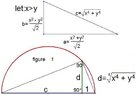
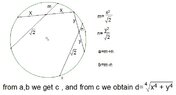
Thanks Albert for participating...I think your solution works, if we're allowed to use the calculator to compute the values for both $a$ and $c$ and since there is no restriction to the problem, you've successfully cracked the problem!:)
A solution proposed by other:
Note that $x^4+y^4=(x^2+\sqrt{2}xy+y^2)(x^2-\sqrt{2}xy+y^2)$, hence, we then have
By applying the law of cosines, we can construct segments of lengths $\sqrt{x^2\pm\sqrt{2}xy+y^2}$ using triangle of sides $x$ and $y$ with the angle between them $45^{\circ}$ and $135^{\circ}$.
Note also that if we are given two segments of lengths $a$ and $b$, we can construct a segment of length $\sqrt{ab}$ as the altitude $PD$ in a right triangle $PQR$ ($\angle P=90^{\circ}$) with $QD=a$ and $RD=b$. These two steps combined give the method for constructing $\sqrt[4]{x^4+y^4}$.
Isn't it a very beautiful geometry problem that deserves the best of applause?(Clapping)(Sun)
Thanks Albert for participating...I think your solution works, if we're allowed to use the calculator to compute the values for both $a$ and $c$ and since there is no restriction to the problem, you've successfully cracked the problem!:)
A solution proposed by other:
Note that $x^4+y^4=(x^2+\sqrt{2}xy+y^2)(x^2-\sqrt{2}xy+y^2)$, hence, we then have
By applying the law of cosines, we can construct segments of lengths $\sqrt{x^2\pm\sqrt{2}xy+y^2}$ using triangle of sides $x$ and $y$ with the angle between them $45^{\circ}$ and $135^{\circ}$.
Note also that if we are given two segments of lengths $a$ and $b$, we can construct a segment of length $\sqrt{ab}$ as the altitude $PD$ in a right triangle $PQR$ ($\angle P=90^{\circ}$) with $QD=a$ and $RD=b$. These two steps combined give the method for constructing $\sqrt[4]{x^4+y^4}$.
Isn't it a very beautiful geometry problem that deserves the best of applause?(Clapping)(Sun)
I don't use the calculator to compute the values for both $a,b$ and $c$
They can be constructed with a straightedge and a compass as below:
Thanks Albert for participating...I think your solution works, if we're allowed to use the calculator to compute the values for both $a$ and $c$ and since there is no restriction to the problem, you've successfully cracked the problem!:)
A solution proposed by other:
Note that $x^4+y^4=(x^2+\sqrt{2}xy+y^2)(x^2-\sqrt{2}xy+y^2)$, hence, we then have
By applying the law of cosines, we can construct segments of lengths $\sqrt{x^2\pm\sqrt{2}xy+y^2}$ using triangle of sides $x$ and $y$ with the angle between them $45^{\circ}$ and $135^{\circ}$.
Note also that if we are given two segments of lengths $a$ and $b$, we can construct a segment of length $\sqrt{ab}$ as the altitude $PD$ in a right triangle $PQR$ ($\angle P=90^{\circ}$) with $QD=a$ and $RD=b$. These two steps combined give the method for constructing $\sqrt[4]{x^4+y^4}$.
Isn't it a very beautiful geometry problem that deserves the best of applause?(Clapping)(Sun)
The solution given by "other" is indeed a beautiful geometric construction. The difficulty I have with Albert's solution is that it requires the use of line segments of length $1$ and $\sqrt2$. The convention in straightedge and compass constructions is that the straightedge is not marked with units. There is no unit of length implied by the initial data, which simply consists of two line segments whose lengths are announced to be $x$ and $y$. There is no means to construct line segments whose length cannot be obtained (using the straightedge and compass) from those of the given initial segments.
The solution given by "other" is indeed a beautiful geometric construction. The difficulty I have with Albert's solution is that it requires the use of line segments of length $1$ and $\sqrt2$. The convention in straightedge and compass constructions is that the straightedge is not marked with units. There is no unit of length implied by the initial data, which simply consists of two line segments whose lengths are announced to be $x$ and $y$. There is no means to construct line segments whose length cannot be obtained (using the straightedge and compass) from those of the given initial segments.
if the length of unit 1 can be determined ,then $\sqrt 2$ can be set easily
now I am thinking a method using segmets x and y to construct a segment xy (can this be