Contact Forces HW Problem with Three Boxes

Click For Summary
SUMMARY

The forum discussion centers on calculating the contact forces between three boxes subjected to a 7.50N force. The masses of the boxes are m1 = 1.30 kg, m2 = 3.20 kg, and m3 = 4.30 kg. The acceleration of the system is determined using Newton's second law, yielding a value of 0.852273 m/s². The contact force between boxes 1 and 2 is calculated as 2.7272N, while the contact force between boxes 2 and 3 is corrected to 6.39205N after considering the combined mass of boxes 2 and 3.

PREREQUISITES
  • Understanding of Newton's Second Law (F=ma)
  • Basic knowledge of force and mass relationships
  • Ability to perform calculations involving acceleration
  • Familiarity with free body diagrams and equilibrium concepts
NEXT STEPS
  • Study the application of Newton's laws in multi-body systems
  • Learn how to create and interpret free body diagrams for complex systems
  • Explore the concept of net force and its implications in dynamics
  • Investigate the effects of friction on contact forces in similar problems
USEFUL FOR

Students in physics, educators teaching mechanics, and anyone interested in understanding dynamics involving multiple objects and contact forces.

physics114
Messages
7
Reaction score
0
Correct? Please let me know if my logic is off. =]

Given Problem
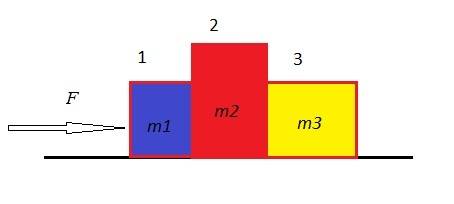
Contact Force with Boxes.jpg

As shown in the figure, a force of magnitude 7.50N pushes three boxes with masses
m1 = 1.30 kg
m2 = 3.20 kg
m3 = 4.30 kg
(a) Find the magnitude of the contact force between boxes 1 and 2. (?N)
(b) Find the magnitude of the contact force between boxes 2 and 3. (?N)

Relevant Equations
F=ma
Strategy?
- Since boxes are in contact, all boxes will have the same acceleration.
- First, find the acceleration given by Newton's 2nd Law. Divide the total horizontal force by the total mass of all three boxes.
- Secondly for (a) and (b) Find individual contact forces by multiplying individual mass with the acceleration found previously.

Attempted Solution
Find contact acceleration
F = ma
a = F/m
a = (7.50N) / (m1+m2+m3)
a = (7.50N) / (1.30kg + 3.20kg + 4.30kg)
a = (7.50N) / (8.8kg)
a = .852273 m/s^2

Part (a)
force between box 1 and box 2
F = ma
F = (3.20kg)*(.852273m/s^2)
F = 2.7272N

Part (b)
force between box 2 and box 3
F = ma
F = (4.30kg)*(.852273m/s^2)
F = 3.66477N

For both parts a and b I was following the example in the book, but don't really understand why we would be multiplying the acceleration with the mass of the box to the right instead of the left. Is this because the force is being applied from left to right and in order to find the contact force (pushing against the overall force) we use the mass of the box exerting the contact force??
 
Physics news on Phys.org
physics114 said:
Correct? Please let me know if my logic is off. =]

Given Problem
View attachment 29202
As shown in the figure, a force of magnitude 7.50N pushes three boxes with masses
m1 = 1.30 kg
m2 = 3.20 kg
m3 = 4.30 kg
(a) Find the magnitude of the contact force between boxes 1 and 2. (?N)
(b) Find the magnitude of the contact force between boxes 2 and 3. (?N)

Relevant Equations
F=ma
Strategy?
- Since boxes are in contact, all boxes will have the same acceleration.
- First, find the acceleration given by Newton's 2nd Law. Divide the total horizontal force by the total mass of all three boxes.
- Secondly for (a) and (b) Find individual contact forces by multiplying individual mass with the acceleration found previously.

Attempted Solution
Find contact acceleration
F = ma
a = F/m
a = (7.50N) / (m1+m2+m3)
a = (7.50N) / (1.30kg + 3.20kg + 4.30kg)
a = (7.50N) / (8.8kg)
a = .852273 m/s^2
'Looks good so far. :approve:
Part (a)
force between box 1 and box 2
F = ma
F = (3.20kg)*(.852273m/s^2)
F = 2.7272N
There's a mistake in the above, part (a). See below for a hint on how to correct it.
Part (b)
force between box 2 and box 3
F = ma
F = (4.30kg)*(.852273m/s^2)
F = 3.66477N
Your part (b) is correct! :approve:
For both parts a and b I was following the example in the book, but don't really understand why we would be multiplying the acceleration with the mass of the box to the right instead of the left. Is this because the force is being applied from left to right and in order to find the contact force (pushing against the overall force) we use the mass of the box exerting the contact force??
There's a couple of ways to go about this, but both have something in common:
o you know the object's (or group of objects') acceleration already.
o you know the object's (or group of objects') mass already.
o you now have enough information to solve for the net force acting on that object (or group of objects).

Let's take block m3. Its mass is given in the problem statement. You've already calculated its acceleration. So apply Newton's second law (F = ma) to block m3 in isolation. You know its mass is 1.3 kg and its acceleration is 0.852273 m/s2, so the net force acting on it must be 3.66477 N. If the net force was anything different, block m3's acceleration would be something different. And since there is only one force acting on block m3 (the force coming from block m2), that must be the force between block m2 and m3.

When measuring the force between block m1 and m2 there are a couple of ways to approach the problem. One way is to temporarily treat block m2 and m3 as one big block. Now just repeat what you did above.

Another option is to take block m2 in isolation. You know its mass (which is given in the problem statement). But now there are two forces acting upon it. There is the force coming from block m3 (which you just calculated) and a different force coming from block m1 (which you trying to solve for). Now here is the important part: You know that Newton's second law is ma = ∑F, where there are two forces to be combined on the right side of the equation. You already know block m2's mass and acceleration. Solve for the remaining force (i.e. solve for the force coming from block m1 -- you've already calculated the force coming from block m3 -- and make sure to treat the forces as vectors).
 
  • Like
Likes   Reactions: GalaxE and Brendan Webb
Since all move together a = F/(m1+m2+m3)

Consider the free body diagram of each block

block 1: equilibrium

F-------> m1 <------ X (unknown force contact between 1 and 2)
<---m1a

sum of forces F- X - m1 * a = 0

So X = F - m1a = (m2+m3) * a

block 3: equilibrium:

Y ----> m3
<---- m3a

So contact force between 2 and 3 is Y = m3 * a
 
Thank you very much!

Made correction to Part B and treated m2 and m3 as a single block:
F = (m2 + m3) * (a)
F = (3.20kg + 4.30kg) * (.852273m/s2)
F = (7.5kg) * (.852273m/s2)
F = 6.39205 N
 

Similar threads

  • · Replies 4 ·
Replies
4
Views
4K
  • · Replies 6 ·
Replies
6
Views
5K
  • · Replies 17 ·
Replies
17
Views
2K
  • · Replies 5 ·
Replies
5
Views
8K
Replies
9
Views
11K
  • · Replies 14 ·
Replies
14
Views
2K
  • · Replies 1 ·
Replies
1
Views
5K
  • · Replies 3 ·
Replies
3
Views
8K
  • · Replies 5 ·
Replies
5
Views
3K
  • · Replies 1 ·
Replies
1
Views
5K