Continous signals as sums of weighted delta functions

Click For Summary
SUMMARY

Continuous signals can be represented as sums of weighted delta functions, specifically using the sifting property of the Dirac delta function. The integral representation of a function x(t) using the delta function, expressed as ∫x(τ)δ(τ-t)dτ, confirms that the delta function acts as an identity element in convolution, allowing for the extraction of specific function values. The discussion emphasizes that the arguments in the integrals are dummy variables, and thus x(τ) and x(t) represent the same function. Convolution is described as a cumulative response of two operations applied to an input signal, integrating their effects over time.

PREREQUISITES
  • Understanding of Dirac delta function and its properties
  • Familiarity with convolution operations in signal processing
  • Basic knowledge of integral calculus
  • Concept of function representation in different domains
NEXT STEPS
  • Study the properties of the Dirac delta function in signal processing
  • Learn about convolution and its applications in systems analysis
  • Explore the relationship between convolution and Fourier transforms
  • Investigate the implications of the sifting property in practical signal processing scenarios
USEFUL FOR

Signal processing engineers, mathematicians, and anyone interested in understanding the mathematical foundations of continuous signals and convolution operations.

LLT71
Messages
73
Reaction score
5
so, continuous signals as sums of weighted delta functions can be represented like this:
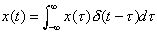
Image26.gif

if you switch order of some variables you get ∫x(τ)δ(-τ+t)dτ, and since,I presume, Dirac delta "function" is even I can write it like this ∫x(τ)δ(-(-τ+t))dτ=∫x(τ)δ(τ-t)dτ=x(t) and we got ourselves a "sifting property". can we visualize it like this:
x(τ) is function in "τ domain". for every τ there is x(τ) such that every x(τ) value represents some function x(t) which can be "extracted" using δ(τ-t) or, generally speaking, function x(τ) in τ domain represents some "family of functions" x(t) and by using sifting property, described earlier, we can sift one particular function x(t) from that family?
if this is right, can described sifting property be some kind of "transformation" like Laplace one (you go from one to domain to another, do some things, and go back to original domain)?

thanks!
 
Physics news on Phys.org
LLT71 said:
so, continuous signals as sums of weighted delta functions can be represented like this:
Image26.gif

if you switch order of some variables you get ∫x(τ)δ(-τ+t)dτ, and since,I presume, Dirac delta "function" is even I can write it like this ∫x(τ)δ(-(-τ+t))dτ=∫x(τ)δ(τ-t)dτ=x(t) and we got ourselves a "sifting property".
Your variable manipulations make no difference to the meaning or interpretation of your expression. With your notation
$$ x(t) = \int_{-\infty}^\infty x(\tau) \delta(t-\tau)\, d\tau \, = \, \int_{-\infty}^\infty x(\tau) \delta(\tau-t)\, d\tau$$
is the definition of the delta function. It says that convolving a function ##x## with the delta function gives you the same function ##x##.

LLT71 said:
... generally speaking, function x(τ) in τ domain represents some "family of functions" x(t) and by using sifting property, described earlier, we can sift one particular function x(t) from that family?
Nope. There is no difference between ##x(\tau)## and ##x(t)##; they are both the same function. The argument is a dummy variable.

Jason
 
  • Like
Likes   Reactions: LLT71
jasonRF said:
Nope. There is no difference between ##x(\tau)## and ##x(t)##; they are both the same function. The argument is a dummy variable.

Jason
so, basically sifting property $$ \, \int_{-\infty}^\infty x(\tau) \delta(\tau-a)\, d\tau = x(a) $$ would give us one particular value of function $$ x(a) $$ since a=const., but
$$ \, \int_{-\infty}^\infty x(\tau) \delta(\tau-t)\, d\tau = x(t) $$ is like picking every value of function (for every t, since t isn't constant [t=time]) using Dirac impulse ("walking Dirac impulse underneath the function" from -inf to +inf) and at the same time summing all of infinitely narrow weighted Dirac impulses (integration) gives you function x(t)? so, that's the idea behind convolution? and dummy variable gives you freedom to escape for a moment variable t and gives you opportunity to manipulate (slide) functions at will? okay, I think I understand at some point significance and meaning of recreating function using Dirac delta impulses but what is the significance behind convolution of any two randomly choosen signals (functions)? I don't understand what convolution, even as plain English word, really means, so maybe it would be helpful if someone give me a proper non-mathemathical definition (and include some analogies) of convolution for a moment. thanks!
 
This just uses the delta function to pick out the single value of the function x at a while ignoring all other values of x. Your rewritten version is such a degenerate example of convolution that I am not sure it illustrates anything significant about convolution in general. (Maybe I just don't have enough imagination to see more significance.)

I wouldn't over-think it if I were you.
 
I'm sorry I used the concept of convolution to answer your question; it was not the best way to explain what you are trying to learn and it is causing more confusion than help.

In all of the equations above, just think of ##x(t)## as the value of the function ##x## at a particular ##t##. Indeed, that is how a mathematician would typically interpret the notation. So all of the integrals above simply are examples of the sifting property of the delta function.

Jason
 
  • Like
Likes   Reactions: LLT71
FactChecker said:
Your rewritten version is such a degenerate example of convolution that I am not sure it illustrates anything significant about convolution in general. (Maybe I just don't have enough imagination to see more significance.)

I wouldn't over-think it if I were you.

well, for me it illustrates an understanding how it works. instead of Dirac function write any function and make it generalised and you get convolution integral, so instead of $$ \, \int_{-\infty}^\infty x(\tau) \delta(\tau-t)\, d\g = x(t) $$, write $$ \, \int_{-\infty}^\infty x(\tau) g(\tau-t)d\g = (x*g)(t) $$ where ##g(τ-t)## can be any function (including Dirac delta "function"). based on Wikipedia illustration on convolution I think my version have at least some sense. you choose one function to be "fixed" ##x(t)## and you choose another one to "walk" from -inf to +inf ##g(τ-t)##.
 
Yes, that a correct understanding of convolution (although saying that one function is "fixed" may be misleading). And the delta function is the identity function for convolution. f*δ = δ*f = f.
 
Last edited:
  • Like
Likes   Reactions: LLT71
FactChecker said:
Yes, that a correct understanding of convolution. And the delta function is the identity function for convolution. f*δ = δ*f = f.
nice! what is an idea of taking convolution of two functions? what is convolution, generally speaking (plain English)? thanks!
 
An application of convolutions that I like to think of is when you have a sequence of two operations, f and g, done in series. The operations f and g have different responses (delays, gains, etc.), to an input at delayed times τ.

Here is a rough, informal description of what I mean. Suppose an input signal I(t) is sent into operations f and then to g to get the output signal O(t): I => f => g => O
Then the output at time t is the integral of all effects of f and g where the total time through is t. So at any time, t, you want the cumulative response of f and g where the delays add up to t: t = τ + (t-τ). That is, you want to determine the combined effects of f and g: C(t) =[∫f(τ)Ig(t-τ)dτ]. Then O = C * I.

PS. This could have been a simpler example:
Consider I => f => O. The output O(tO) at time tO is the cumulative response of f to the input I over all combinations of input time tI and delay time tf that combine to tO. That is all τf where tO = tI + τf. The cumulative response is O(tO) = [∫f(τf)I(tOf)dτf]
 
Last edited:
  • Like
Likes   Reactions: LLT71

Similar threads

  • · Replies 1 ·
Replies
1
Views
2K
  • · Replies 1 ·
Replies
1
Views
2K
  • · Replies 6 ·
Replies
6
Views
1K
  • · Replies 3 ·
Replies
3
Views
2K
  • · Replies 2 ·
Replies
2
Views
2K
  • · Replies 25 ·
Replies
25
Views
4K
  • · Replies 1 ·
Replies
1
Views
3K
  • · Replies 3 ·
Replies
3
Views
3K
  • · Replies 3 ·
Replies
3
Views
3K
  • · Replies 2 ·
Replies
2
Views
3K