Line_112
- 57
- 3
- TL;DR
- I found a discrepancy in the distribution of gamma-ray bursts on the celestial sphere in the figure from the English Wikipedia, and in the figure in the scientific article devoted to gamma-ray bursts.
I previously created a thread here regarding the map of the gamma-ray burst distribution on the celestial sphere, taken from the English Wikipedia article on gamma-ray bursts. It suggests that it is approximately uniform, although not entirely so, as there is still variation in the concentration of points over fairly large areas, which, in my opinion, slightly contradicts the cosmological principle of distribution.
But I was more intrigued by something else: the lack of a decrease in the concentration of points near the galactic equator and the small number of points near the poles. Theoretically, if the bursts are intergalactic, then, as they pass through the relatively dense layers of the galactic disk, the radiation should be strongly absorbed by matter and weaken, which could lead to a decrease in the concentration of points at the equator. At the time, this was just a hypothesis, but now I accidentally stumbled upon confirmation of it, which directly contradicts the caption to the Wikipedia figure.
Quote from the caption to the picture on Wikipedia:
“Positions on the sky of all gamma-ray bursts detected during the BATSE mission. The distribution is isotropic, with no concentration towards the plane of the Milky Way, which runs horizontally through the center of the image.”
Link: https://en.wikipedia.org/wiki/Gamma-ray_burst
Quote from a scientific article that gives a completely different distribution:
“As shown in Figures 3, 4, GRBs are less distributed in the low galactic latitudes. It is very difficult to find GRBs in galactic disk, due to the serious dust extinction, reddening and dense star field in galactic disk. In the high galactic latitudes, there are few transients such as GRB."
Link: https://www.frontiersin.org/journal...nces/articles/10.3389/fspas.2023.1124317/full
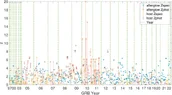
There it is given figure, clearly showing a decrease in the concentration of bursts toward the galactic plane, as expected for an extragalactic origin of gamma-ray bursts. Moreover, there are significantly fewer points there than in the Wikipedia figure, as if authors had selected precisely those that correspond to this distribution. This article is from 2023, meaning it's recent, removing any suspicion of insufficient data.
Perhaps I'm misunderstanding something, but this is a rather amusing situation. Is there a reasonable explanation for this?


But I was more intrigued by something else: the lack of a decrease in the concentration of points near the galactic equator and the small number of points near the poles. Theoretically, if the bursts are intergalactic, then, as they pass through the relatively dense layers of the galactic disk, the radiation should be strongly absorbed by matter and weaken, which could lead to a decrease in the concentration of points at the equator. At the time, this was just a hypothesis, but now I accidentally stumbled upon confirmation of it, which directly contradicts the caption to the Wikipedia figure.
Quote from the caption to the picture on Wikipedia:
“Positions on the sky of all gamma-ray bursts detected during the BATSE mission. The distribution is isotropic, with no concentration towards the plane of the Milky Way, which runs horizontally through the center of the image.”
Link: https://en.wikipedia.org/wiki/Gamma-ray_burst
Quote from a scientific article that gives a completely different distribution:
“As shown in Figures 3, 4, GRBs are less distributed in the low galactic latitudes. It is very difficult to find GRBs in galactic disk, due to the serious dust extinction, reddening and dense star field in galactic disk. In the high galactic latitudes, there are few transients such as GRB."
Link: https://www.frontiersin.org/journal...nces/articles/10.3389/fspas.2023.1124317/full
There it is given figure, clearly showing a decrease in the concentration of bursts toward the galactic plane, as expected for an extragalactic origin of gamma-ray bursts. Moreover, there are significantly fewer points there than in the Wikipedia figure, as if authors had selected precisely those that correspond to this distribution. This article is from 2023, meaning it's recent, removing any suspicion of insufficient data.
Perhaps I'm misunderstanding something, but this is a rather amusing situation. Is there a reasonable explanation for this?
Last edited by a moderator: