Cosine Error: 5mm Ball Tip Stylus at 7.5° Angle

  • Thread starter Thread starter Ranger Mike
  • Start date Start date
  • Tags Tags
    Cosine Error
Join the discussion
Registration is free. Ask a follow-up in this thread, or start your own.
5 replies · 2K views
Messages
2,463
Reaction score
447
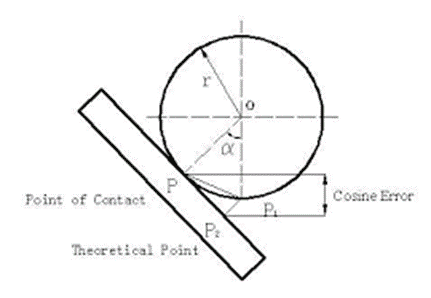
Cosine error of a measured point on the surface is not a simple value, but a vector. If the ball contacts the part surface at a point located a distance from the theoretical or nominal point then the angle between the probe and the normal vector gets larger, P1 P2 will increase. We have cosine error. This error occurs when the part surface varies compared to the CAD nominal. If the angle between the probe actual touch point P and the normal vector P2 gets larger, P1 P2 will increase.

Help..If I have a 5 mm ball tip stylus and can only vector in to the surface at 7.5° how much cosine error will I have?
1679582313705.png
 
Physics news on Phys.org
Ranger Mike said:
Cosine error of a measured point on the surface is not a simple value, but a vector. If the ball contacts the part surface at a point located a distance from the theoretical or nominal point then the angle between the probe and the normal vector gets larger, P1 P2 will increase. We have cosine error. This error occurs when the part surface varies compared to the CAD nominal. If the angle between the probe actual touch point P and the normal vector P2 gets larger, P1 P2 will increase.

Help..If I have a 5 mm ball tip stylus and can only vector in to the surface at 7.5° how much cosine error will I have?

View attachment 323978
For what you have labeled as the cosine error ( call it ##\epsilon##) in the diagram I'm getting:

$$ \epsilon = r \left[ 1-\cos \alpha + \sin \alpha \cos \alpha \tan \frac{\alpha}{2} \right]$$
 
Last edited:
ero, thank you for taking the time to look at this.
error = 5 mm [ 1 - cos 7.5° + sin 7.5° times cos 7.5° times (tan 7.5° /2) ]
 
Reply
  • Like
Likes   Reactions: erobz
Ranger Mike said:
ero, thank you for taking the time to look at this.
error = 5 mm [ 1 - cos 7.5° + sin 7.5° times cos 7.5° times (tan 7.5° /2) ]

Second go, I think a cleaner version is:

$$ \epsilon = r \left( 1- \cos \alpha \right) \left( 1 + \cos \alpha \right) $$

But they should give the same result.

Or even cleaner!

$$ \epsilon = r \sin^2 \alpha$$

Sorry for all the changes...but as I keep looking I keep seeing more simplifications...
 
I checked the first against the last and they are equivalent. Computationally, better to use the last one!

I get ##\epsilon = 5 [\text{mm}] \sin^2 (7.5°) \approx 0.085 [\rm{mm}]##
 
Reply
  • Like
Likes   Reactions: berkeman