Current in RLC Series Circuit: Need Help

Click For Summary
SUMMARY

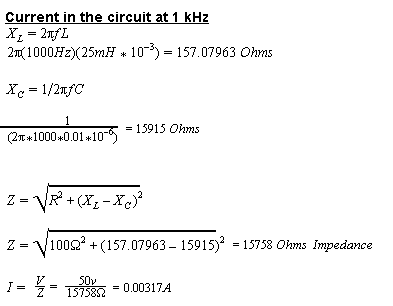
The discussion focuses on calculating the current in an RLC series circuit with specific components: a 100-ohm resistor, a 0.01uF capacitor, a 25mH inductor, and a 50V AC voltage source at 1kHz. Participants noted that the capacitor value significantly affects the impedance, which in turn influences the current calculation. The user expressed uncertainty about the capacitor value, indicating that verifying component specifications is crucial for accurate results.

PREREQUISITES
  • Understanding of RLC circuit theory
  • Familiarity with impedance calculations
  • Knowledge of AC voltage sources
  • Ability to interpret circuit components and their values
NEXT STEPS
  • Research impedance in RLC circuits
  • Learn how to calculate current using Ohm's Law in AC circuits
  • Study the effects of component values on circuit behavior
  • Explore simulation tools for RLC circuit analysis
USEFUL FOR

Electrical engineering students, hobbyists working with RLC circuits, and anyone involved in circuit design and analysis.
IronaSona
Messages
38
Reaction score
7
Homework Statement
.
Relevant Equations
.
So am trying to find the current in the RLC series circuit ,but i think i have done something wrong ,if anyone could tell me where i went wrong ,it would be great ,thank you

Resistor-100ohms
Capacitor-0.01uF
Inductor-25mH
Voltage Source-50v a.c
1kHz
Capture.PNG
 
Last edited:
Physics news on Phys.org
I checked your work and can't spot any mistake. Maybe the mistake is in the given data, are you sure the capacitor value is 0.01uF? Cause that is what makes the impendance big.
 
Delta2 said:
I checked your work and can't spot any mistake. Maybe the mistake is in the given data, are you sure the capacitor value is 0.01uF? Cause that is what makes the impendance big.
o sorry ,i just wasn't 100% sure that it was correct ,just wanted to make sure i have done everything right , thank you
 
  • Like
Likes berkeman and Delta2
The book claims the answer is that all the magnitudes are the same because "the gravitational force on the penguin is the same". I'm having trouble understanding this. I thought the buoyant force was equal to the weight of the fluid displaced. Weight depends on mass which depends on density. Therefore, due to the differing densities the buoyant force will be different in each case? Is this incorrect?

Similar threads

  • · Replies 15 ·
Replies
15
Views
5K
  • · Replies 3 ·
Replies
3
Views
1K
  • · Replies 8 ·
Replies
8
Views
2K
  • · Replies 21 ·
Replies
21
Views
1K
  • · Replies 10 ·
Replies
10
Views
895
Replies
20
Views
2K
  • · Replies 3 ·
Replies
3
Views
3K
  • · Replies 3 ·
Replies
3
Views
2K
Replies
5
Views
3K
  • · Replies 2 ·
Replies
2
Views
2K