Coulomb gauge derivation (static field)

Click For Summary
SUMMARY

The discussion focuses on the derivation of the Coulomb gauge in the context of static magnetic fields. Key points include the use of prime notation for magnetic field density source currents and non-prime notation for specific positions. The divergence of the vector potential is established as zero, leading to the conclusion that both the first and second flux integral parts vanish due to the conditions of static fields and the continuity equation for current density. This highlights the relationship between gauge invariance and electric-charge conservation in electromagnetics.

PREREQUISITES
  • Understanding of vector calculus, particularly divergence and integrals.
  • Familiarity with Maxwell's equations and their implications in electromagnetics.
  • Knowledge of gauge theories, specifically the Coulomb gauge.
  • Basic concepts of static magnetic fields and current density.
NEXT STEPS
  • Study the derivation of the Coulomb gauge in detail using classical electromagnetism textbooks.
  • Explore the implications of gauge invariance in electromagnetics and its applications.
  • Learn about the continuity equation and its role in electric-charge conservation.
  • Investigate vector calculus identities relevant to electromagnetism, such as the divergence theorem.
USEFUL FOR

Physicists, electrical engineers, and students studying electromagnetism who seek to deepen their understanding of gauge theories and static magnetic fields.

kidsasd987
Messages
142
Reaction score
4
Hi, I am a little confused of derivation of Coulomb Gauage.
mfield_h2.png
(2)

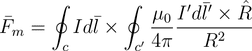
First, prime notation is adopted to describe the magnetic field density source current.
Non-prime notation is for position that we are specifically interested in (ex. the position magnetic force acts on).
mfield15.png
(23)
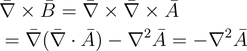
if equation (13) is true, then divergence of vector potential is 0.Hence,
mfield7.png
(13)
vecid1.png
(14)we can use vector indentity (14) to express (13) in another form.

mfield10.png
(15)
mfield11.png
(16)
mfield12.png
(17)
mfield13.png
(18)

at this step, I am lost. We can break down divergence of vector potential into
two parts. I understand the first part is 0 because we assume that the field is static with respect to time,
but I wonder why the second flux integral part is 0.
(reference: http://ghebook.blogspot.ca/2011/06/energy-of-magnetic-field.html)
 
Last edited:
I can't read the website, but the 2nd integral should be 0 since the volume must enclose the full region, where the current density is non-zero, i.e., at the boundary of the volume ##\vec{J}=0##, and thus the 2nd integral vanishes. The first integral vanishes, because the integrability condition for the magnetostatic field is ##\vec{\nabla} \cdot \vec{J}=0##.

The integrability condition for the full Maxwell equations is the continuity equation for the current density, i.e.,
$$\partial_t \rho + \vec{\nabla} \cdot \vec{J}=0,$$
which is the local form of electric-charge conservation and a consequence of the gauge invariance of electromagnetics.
 

Similar threads

  • · Replies 3 ·
Replies
3
Views
3K
  • · Replies 3 ·
Replies
3
Views
25K
Replies
1
Views
2K
  • · Replies 5 ·
Replies
5
Views
799
  • · Replies 3 ·
Replies
3
Views
1K
  • · Replies 1 ·
Replies
1
Views
1K
  • · Replies 14 ·
Replies
14
Views
2K
  • · Replies 3 ·
Replies
3
Views
3K
  • · Replies 1 ·
Replies
1
Views
2K
  • · Replies 1 ·
Replies
1
Views
574



