Coulomb's law in its vector form?

Click For Summary
SUMMARY

The discussion centers on Coulomb's law in its vector form, emphasizing the importance of direction in the force vector ##\vec F## when dealing with charges of opposite signs. Participants clarify that the direction of ##\vec F## can align with or oppose the displacement vector ##\vec r##, depending on the nature of the charges involved. Additionally, the concept of negative charge density is confirmed, indicating that negative charge results in negative charge density, which simplifies the expression of direction in vector forms. The conversation also highlights the use of LaTeX for mathematical expressions in forum discussions.

PREREQUISITES
  • Understanding of Coulomb's law and its vector representation
  • Familiarity with vector notation and operations
  • Knowledge of charge density concepts in electrostatics
  • Basic proficiency in using LaTeX for mathematical expressions
NEXT STEPS
  • Study the implications of negative charge density in electrostatics
  • Learn how to express vector quantities using LaTeX
  • Explore the applications of Coulomb's law in real-world scenarios
  • Investigate the relationship between electric fields and force vectors
USEFUL FOR

Students of physics, educators teaching electrostatics, and anyone interested in the mathematical representation of forces in electric fields.

ConfusedRookie
Messages
11
Reaction score
0
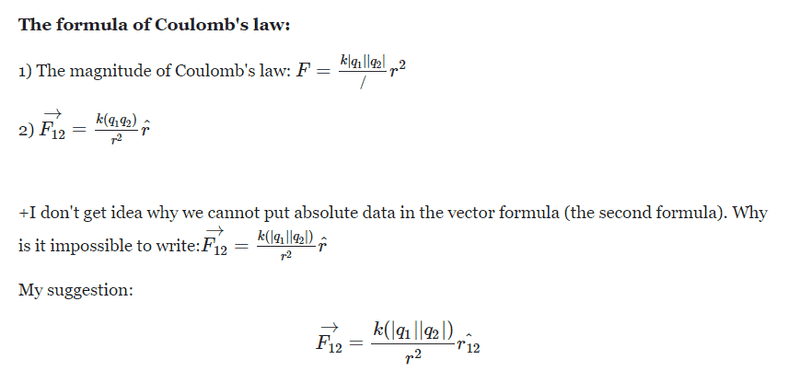
sorry I have use the image I made. Since I don't know how to perform the formula on forum :(
This is the problem I am having.
wtf12345.png
 
Last edited:
Physics news on Phys.org
Hello Rookie, :welcome:

You would miss the direction of ##\vec F## if one of the two charges has a charge opposite to the other...
In other words: ##\vec F## can be in the same direction as ##\vec r## or it can be in the opposite direction.
 
suggest2.png
 
BvU said:
Hello Rookie, :welcome:

You would miss the direction of ##\vec F## if one of the two charges has a charge opposite to the other...
In other words: ##\vec F## can be in the same direction as ##\vec r## or it can be in the opposite direction.
Oh my god. I've just realized without the absolute symbols. It would be more easier to express the direction. Oh my oh my thank you very much teacher :)
 
My pleasure
 
BvU said:
My pleasure
Teacher. There's one more thing I would like to ask. I see there are many formula using "charge density". Is charge density able to be negative !?

ae544e.gif


If a charge density can be negative, it is very much easy to express its direction. I didn't find any vector form E that use the unit vector to express direction. They mainly focus on the magnitude.
 
With ##\vec F = q\vec E\ ## you can use (almost) the same expression

Charge density can be negative, yes: negative charge leads to negative charge density :smile:

Your picture in post #6 comes through as a lot of letters/numbers :nb)
 
ConfusedRookie said:
Since I don't know how to perform the formula on forum :(
Click HELP at the bottom of any page and then LaTeX Primer.
 

Similar threads

  • · Replies 44 ·
2
Replies
44
Views
3K
  • · Replies 10 ·
Replies
10
Views
2K
  • · Replies 2 ·
Replies
2
Views
1K
  • · Replies 5 ·
Replies
5
Views
2K
  • · Replies 3 ·
Replies
3
Views
2K
  • · Replies 6 ·
Replies
6
Views
3K
  • · Replies 1 ·
Replies
1
Views
2K
  • · Replies 7 ·
Replies
7
Views
3K
  • · Replies 5 ·
Replies
5
Views
3K
  • · Replies 1 ·
Replies
1
Views
1K