Counter flow diffusion flame simulation using Fluent

Click For Summary

Discussion Overview

The discussion revolves around modeling a counter flow diffusion flame using ANSYS Fluent, specifically focusing on the discrepancies in predicted flame temperature when using methane and air as fuel and oxidizer. Participants explore the implications of various modeling assumptions, including the treatment of combustion as instantaneous and the use of non-premixed combustion modules.

Discussion Character

  • Technical explanation
  • Debate/contested
  • Mathematical reasoning

Main Points Raised

  • One participant reports a flame temperature of 800 K, which is significantly lower than expected (>1600 K), and seeks explanations for this discrepancy.
  • Another participant questions the validity of the assumption that combustion is instantaneous and suggests checking the mixture fraction values in the domain.
  • There is a discussion about the necessity of turbulence modeling in the simulation, with some participants noting that Fluent requires turbulence to be activated for non-premixed combustion.
  • Participants discuss the definition of adiabatic conditions, with one asserting that adiabatic means no heat exchange with surroundings, while another emphasizes that it relates to the total enthalpy of the gas remaining constant.
  • One participant shares results from their PDF table and simulation, indicating a maximum temperature at a mean mixture fraction of around 0.1, but expresses uncertainty about the accuracy of the lookup table being used.
  • Another participant suggests that high variance and scalar dissipation rates in the simulation could be causing the temperature drop and recommends adjustments to turbulence levels and boundary conditions.
  • Subsequent replies indicate that adjusting turbulence parameters leads to improved flame temperature predictions, with specific values provided for turbulence dissipation and kinetic energy.
  • One participant expresses gratitude for the assistance received and plans to refine their mesh and seek detailed measurements for further validation of their simulation.

Areas of Agreement / Disagreement

Participants do not reach a consensus on the initial assumptions regarding adiabatic conditions and the treatment of combustion. However, there is agreement on the need to adjust turbulence parameters to achieve more accurate temperature predictions.

Contextual Notes

Participants mention various assumptions and conditions that may affect the simulation outcomes, including the treatment of combustion as instantaneous, the necessity of turbulence modeling, and the implications of adiabatic conditions. There are also references to specific values and parameters that may influence the results, but these remain unresolved.

Who May Find This Useful

Researchers and practitioners working on combustion modeling, particularly those using ANSYS Fluent for counter flow diffusion flames, may find this discussion relevant.

upender singh
Messages
14
Reaction score
0
Hi,
I am trying to model a counter flow diffusion flame using ansys fluent with fuel/oxidiser as methane/air.
The problem is that the flame temperature(800 K) is much lower than what it should be(>1600 K).
I am using Non premixed combustion module with steady diffusion flamelet and adiabatic energy treatment since combustion is instantaneous process. I am using a standard 30 species chemkin reaction mechanism from standard mechanisms library.
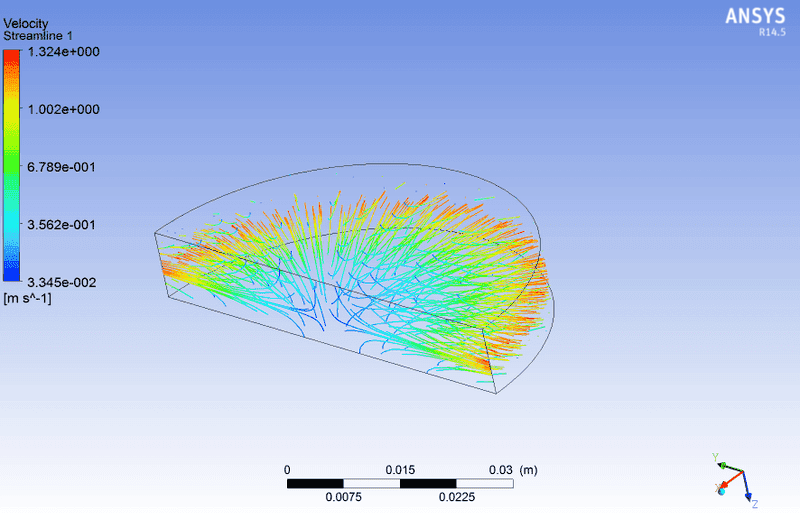
My PDF table seems OK as The plots show a max temperature of 1800 K at a mean mixture fraction value of 0.1. The geometry is a simple cylinder with two inlets in the axial direction and outlet in radial direction(image).
The Dia of two inlets is 60mm and the gap=10mm.
Can anybody explain why am I not getting the desired temperature? I would be happy to provide any further information if required.
2.png
 
Engineering news on Phys.org
upender singh said:
adiabatic energy treatment since combustion is instantaneous process

You need to think about the validity of those assumptions .
 
Last edited:
If the lookup table is OK, can you check what the values of the mixture fraction are in your domain? Can you show a contour plot of Z at the symmetry plane? Can you also visualize the mesh in that same plane? Can you show a picture of the lookup table?
Is it a laminar diffusion flame, or do you have a turbulence model activated?

My combustion simulations are almost always non-adiabatic. Do you know when a flame is non-adiabatic?
 
Hi Bigfooted,
Thanks for the reply. By look up tables, if you mean the thermodynamic table, I am using the one from the standard fluent database. My Chemkin mechanism is a 30 species one with CH4 and O2 as the boundary species. After generating the flamelets, I plot the PDF tables and I get the temperature maxima at a mean mixture fraction of around 0.1(the temperature being around 1800).
Then I go for the boundary conditions. I give a inlet flow velocity of 0.1m/s at both the inlets. I set a MMF of 1 for fuel and 0 for oxidizer.
It is a standard counterflow diffusion flame for non premixed condition. But fluent suggests that we cannot use the non premixed combustion module without keeping turbulence on. So it makes the setup turbulent. But fluent also suggests that a turbulent flame is solved as a composition of luminary local flamelets. The geometry I have shown above is just to make the problem more clear. Actually I am using an axis-symmetric equivalent of the same. I do not sure if I'm right but I am considering it adiabatic because combustion is a spontaneous process. I would have loved to share some pictures of the results but I am not sure which ones you asked for above.

Thank you
 
OK, if you simulate a 2D axially symmetric case, can you show your mesh and a contour plot of the mixture fraction?

Can you explain to me what adiabatic means? It is very important to know and I think you do not fully understand it.
 
These are the images you asked for.
I suppose adiabatic is a condition where we do not have heat exchange between system and surroundings.The mesh has two inlets on left and right, an outlet at the top and axis a the bottom. There are no walls which eventually means I have no place to define heat transfer coefficients.
8.jpg
9.jpg
 
OK, that is clear. Let's go to the next step in the analysis. Let's compare the values from the lookup table with the values from the simulation.
Can you make a graph of the temperature as a function of the mixture fraction from your pdf lookup table (for mixture fraction variance 0)?
Can you also make a graph of the temperature and the mixture fraction as a function of x from your simulation results (for y=0)? Can you make another graph with 2 lines: mixture fraction as function of temperature from the pdf table and mixture fraction as function of temperature from the simulation data on the x-axis?

I hope this comparison will show you what is wrong with your simulation.

Indeed, in an adiabatic system there is no change in heat, do you see that adiabatic has nothing to do with if the process is instantaneous or not? An adiabatic flame is simply a flame where the total enthalpy of the gas is not changing. If there is radiation, or if there is a solid (a wall) that takes heat away from the flame, then the combustion is not adiabatic.
 
The PDF plot is a 2D plot (with constant Variance=0) on a 3D surface(with constant scalar dissipation=0).Maximum of Mean Temperature(K) is 2.240994e+03 and occurs at Mean Mixture Fraction = 5.683755e-02.
10.jpg
Below are the images from simulation results as functions of x.
11.jpg

12.jpg
Should I activate the energy equation and the radiation models? Also I could not plot the last Image with two curves as I don't know how to.
 
Well, it is clear that this lookup table is not the one that is being accessed to obtain the temperature. Does your pdf table contain laminar flamelets for different mixture fraction variances? Can you visualize the mixture fraction variance in your domain?
 
  • #10
Hi Bigfooted,
Thank you for your continuous help.
Yes, my pdf table contains flamelets for different mixture fraction variances. Below is an image of the PDF table. I hope it would help.
pdf table.png


Scalar dissipation varies from 0-26 and the scaled variance varies from 0-0.25 .Following is a curve for the mixture fraction variance in the domain.
mixture fraction variance.jpg

Following is an image of scalar dissipation in the domain.
scalar dissipation.jpg


From the above data, I conclude that my domain has a max deviation of 0.15 and a max scalar dissipation of 4 and both of them peak near the zone where I am getting max temperature(850K). So I decided to make another temperature plot from PDF table keeping the value of dissipation=4 and variance =0.15.
Following is what I get.

pdf temperature.jpg

The above graph peaks around 850K(approximately around my flame temperature).
I hope this information is useful. I am certainly doing something wrong. I just cannot realize to where the problem exists.
 
Last edited:
  • #11
Your variance and scalar dissipation rate in your simulation are very high and this causes the temperature to drop. fluctuations increase due to turbulence, so you should try to lower the turbulence levels in your simulation. You could do the following:
- Lower the velocity of the streams to reduce the Reynolds number of your setup.
- Check what turbulence boundary conditions you are using. you could set them at constant k and epsilon and give a very low value for k (k=0.001) and a value for epsilon e=1. From your plots I gather that your mixture fraction variance is already set to zero at the boundaries?
 
  • Like
Likes   Reactions: upender singh
  • #12
Hi,
Thank you very much. That exactly was the problem. I used the values suggested by you.
K=0.0001, e=1, T(flame)=1450 K
K=0.0001,e=2, T(flame)=1650 K
K=0.0001, e=5, T(flame)=1780 K
K=0.0001, e=10, T(flame)=1847 K
K=0.0001, e=15, T(flame)=1893. K
There were no significant changes further increasing e or decreasing K.
Is the approach OK?
 
  • #13
Very good! The higher values for turbulence dissipation keep the turbulent kinetic energy from growing again. You can also refine your mesh to see if the solution is truly mesh independent (your mesh is quite coarse, but for this diffusion dominated flame it is probably sufficient). If you can find detailed measurements of a counterflow diffusion flame, you could use them to really fine-tune your simulation.
 
  • #14
Hi,
Thank you once again. I will test my case with different mesh refinements and post it in the thread if I find something fruitful.
It would be very kind of you if you could suggest with any such appropriate text which would contain the detailed measurements for my case.

Regards
 

Similar threads

Replies
3
Views
3K
  • · Replies 4 ·
Replies
4
Views
3K
  • · Replies 4 ·
Replies
4
Views
3K