Couple Questions about this Resistor Datasheet

  • Thread starter Thread starter Abdullah Almosalami
  • Start date Start date
  • Tags Tags
    Couple Resistor
Click For Summary
SUMMARY

This discussion centers on the specifications and limitations of 10k 5% resistors from Stackpole Electronics, particularly regarding maximum overload voltage and pulse power ratings. The maximum overload voltage is established at 700V, while the single pulse power rating can reach 430W for short durations (1us to 10us). Users are cautioned against applying voltages exceeding the overload rating, regardless of pulse duration, and are advised to conduct their own thermal modeling for safety. The conversation highlights the importance of understanding both voltage and power limits to avoid potential failures.

PREREQUISITES
  • Understanding of resistor specifications, including nominal resistance and tolerance.
  • Familiarity with pulse power calculations and thermal modeling.
  • Knowledge of electrical safety standards and voltage limits.
  • Experience with interpreting electronic component datasheets.
NEXT STEPS
  • Research "Stackpole Electronics resistor datasheets" for detailed specifications.
  • Learn about "thermal modeling for resistors" to understand heat dissipation.
  • Study "overload voltage testing methods" to grasp industry standards.
  • Explore "pulse power calculations in electronics" for accurate assessments.
USEFUL FOR

Electrical engineers, electronics hobbyists, and anyone involved in designing circuits with resistors will benefit from this discussion, particularly those working with high-voltage applications and pulse power scenarios.

Abdullah Almosalami
Messages
49
Reaction score
15
TL;DR
Overload voltage rating
Sqrt in equation
So I have these 10k 5% resistors from Stackpole Electronics and just because I never actually took the time to look at a resistor datasheet beyond nominal resistance, tolerance, and power rating specs, I decided to look them up. Came across a couple things I wanted to ask about:

1) Maximum overload voltage rating and single pulse power plot
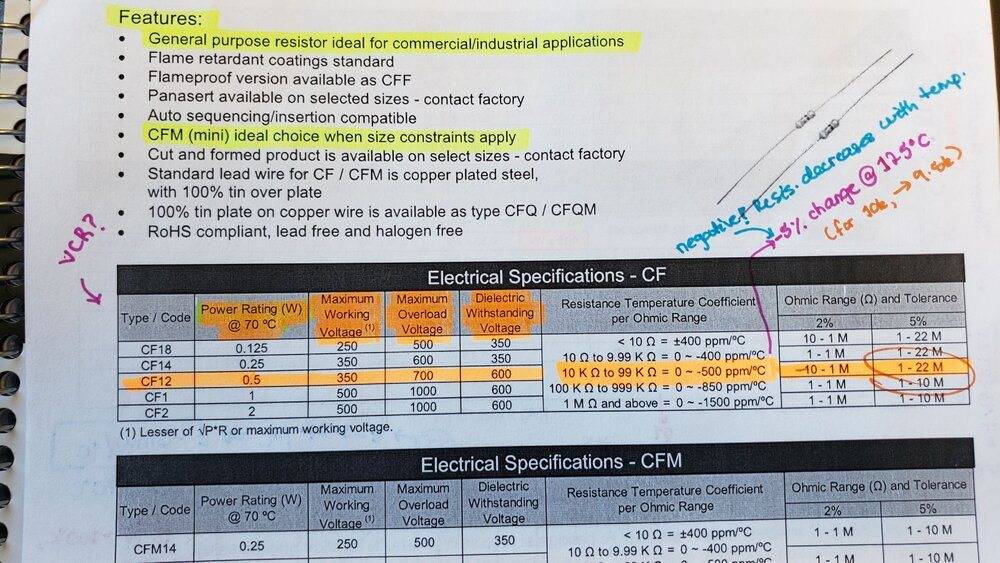
Here's a picture of the basic resistor specs (highlighted in orange) (ignore my notes). As you can see, max overload voltage is 700V.
20200622_102128.jpg


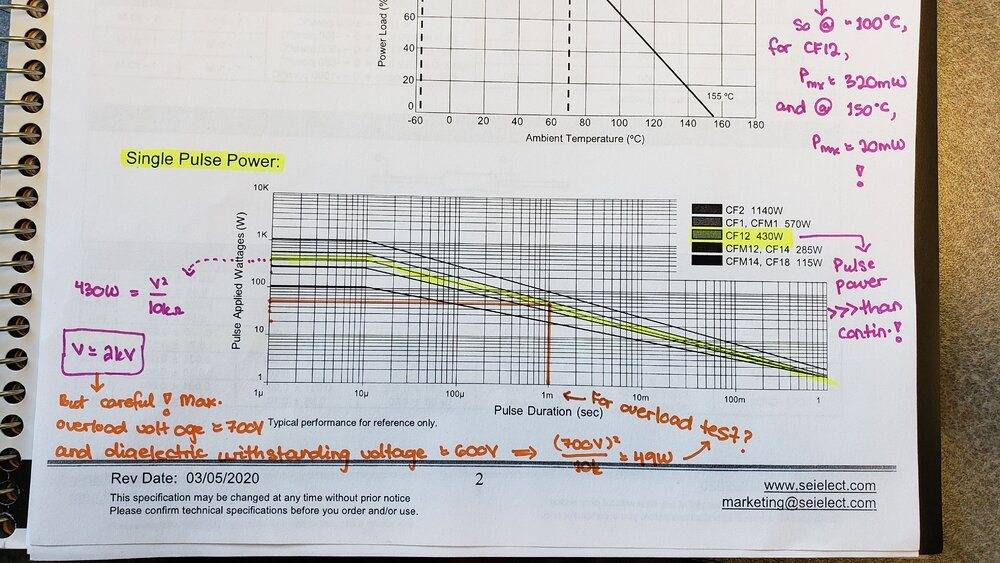
Here is the plot on single pulse power: (my resistor type is highlighted in yellow)
20200622_102154.jpg


So my first question: It seems if the pulse is short enough (say somewhere between 1us to 10us for mine), my 1/2W 10k resistor can take 430W (holy smokes). At that power, the applied voltage would be around 2kV, which is a lot higher than the max overload voltage of 700V. I'm just wondering if the test to determine the overload voltage was done at a longer pulse duration? And so indeed my resistor can take 2kV pulses of 1us length? I 'lined' out in orange what power level would correspond to an applied voltage of 700V on the graph. Also, is "overload voltage" a single pulse from 0V -> rated overload or more like operating in continuous rated voltage and then pulse overvoltage? Maybe this is a manufacturer-specific kind of question?

2) Repetitive Pulse Data Equations
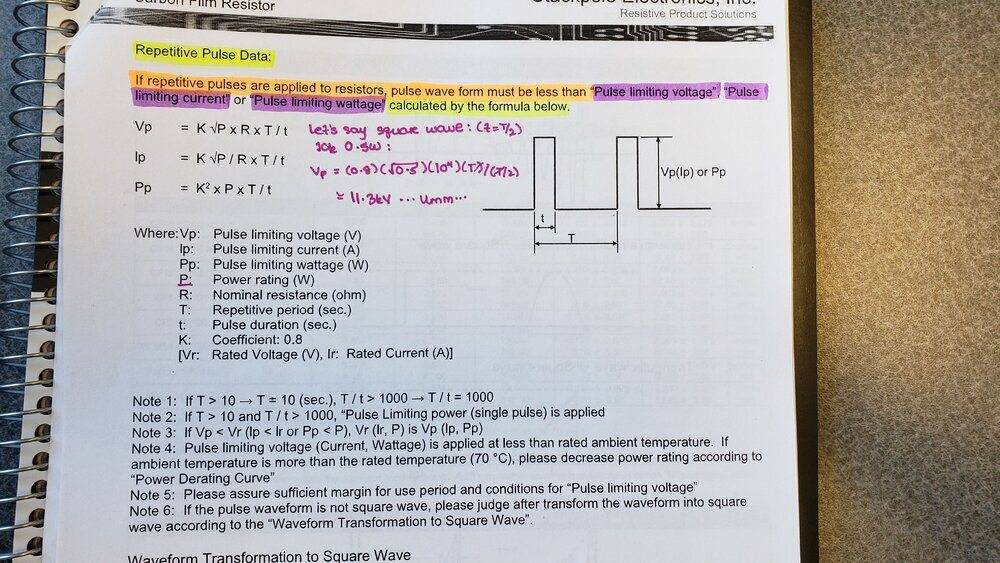
Elsewhere in the datasheet, we have equations for determining rated voltage, current, and wattage for repetitive pulses:
20200622_102210.jpg


So I wrote out the calculation for Vp for my resistor and I got 11.3kV, which is definitely wrong. What's up?

Edit: Actually, now I'm thinking the sqrt on the P is actually meant to include the R and T/t... So my calculation should be $$V_p = K\sqrt {P * R * \frac T t } \text{ instead of } V_p = K * \sqrt {P} * R * \frac T t$$That would give 80V, which makes a lot more sense... Hehe
 
Engineering news on Phys.org
The data sheet is written to apply to all resistor values. When you do calculations using your specific value (10K) you may find that one performance limit occurs well before the others. Suppose your resistor was 1 ohm, then that pulse voltage would be within the limits.

I don't think you can interpret the data sheet as representing experimental results. They are simply communicating how to use the product reliably as clearly as they can for engineers that may have diverse applications. For example, the pulse power limits were probably the result of thermal modeling that didn't really take into account how the heat was introduced.

I would assume that the pulse limits, and the continuous limits, must be derated if there is also continuous power being applied along with a pulse. You will need to do your own thermal modeling to solve the combination as well as maybe getting additional guidance from the application engineers. For example, the maximum hot spot temperature is a key thermal parameter.

You are correct about the square root. That comes from P=V2/R and the RMS calculation for pulses.
 
Abdullah Almosalami said:
It seems if the pulse is short enough (say somewhere between 1us to 10us for mine), my 1/2W 10k resistor can take 430W (holy smokes). At that power, the applied voltage would be around 2kV, which is a lot higher than the max overload voltage of 700V.

It is only said that the maximum 1us single pulse power of the CF12 type resistor is 430W, but it has never been said that the voltage value can be calculated based on the 430W and applied to the resistor.

To ensure safety, I believe that even if the pulse duration is 1us or less, we cannot apply a voltage higher than the overload voltage or the maximum overload voltage to the resistor.

Sometimes, the manufacturer’s data sheet may not cover all possible situations, in which case, I think we should put the greatest safety first.

In addition, according to the link https://www.koaglobal.com/product/library/resistor/term?sc_lang=en,
the overload voltage is the allowable voltage which is applied in 5 seconds under short time overload test. Overload voltage shall be 2.5 times of rated voltage or max. overload voltage, whichever is lower.

Therefore, please note that we must also not apply a voltage greater than 2.5 times the rated voltage.
 
Last edited:
From a practical standpoint, the maximum voltage is the lesser of:
  • The flashover voltage.
  • The highest voltage that can be applied and remain under the maximum power.

I wouldn't be at all surprised if that's what the manufacturer quotes. 😁
 
For single pulse, it's more like an AND equation, (Vp < 700V) AND (max pulse power), not just look at the max pulse power and think it will take 2KV.

They are two completely different thing, voltage max is is governed by the lead spacing( surface creepage), the material makeup of the resistor etc. You don't need power to get to HV breakdown. Power is heat. You need to obey the HV limit AND the power limit.

I use a lot of Stackpole resistors in building my power amps, BECAUSE it's CHEAP! I sure won't push the limit. I don't trust them at all. I use them at like 1/2 the spec. The resistors are getting smaller and smaller for the power rating. You ever try pumping 3/4W through a 2W rated resistor? You don't touch it! I use Stackpole and another Chinese brand, I use 3W resistor for under 1W to be safe. You look at the size of the 3W now a days, they are same or smaller size as an old style 1W resistor! I am not a physicist, but isn't power dissipation related to the surface area in air?
 

Similar threads

  • · Replies 17 ·
Replies
17
Views
2K
Replies
44
Views
6K
  • · Replies 6 ·
Replies
6
Views
7K
Replies
14
Views
7K
Replies
13
Views
4K
  • · Replies 9 ·
Replies
9
Views
3K
  • · Replies 13 ·
Replies
13
Views
7K
  • · Replies 4 ·
Replies
4
Views
10K
Replies
5
Views
4K
  • · Replies 1 ·
Replies
1
Views
5K