Coupled Thermal-structural analysis in ANSYS Workbench

Click For Summary
SUMMARY

The discussion focuses on performing a Coupled Thermal-structural analysis using ANSYS Workbench, specifically with solid226 elements for a brake model comprising one rotor and one stator. The user encountered issues with temperature discrepancies and excessive deformation in the rotor. Suggestions included refining boundary conditions, adjusting time steps, and optimizing contact definitions to improve simulation accuracy. The user later expanded the model to simulate a multi-disc brake system, facing challenges with strange movements of the discs, indicating potential under-constraint in the model.

PREREQUISITES
  • Understanding of Coupled Thermal-structural analysis in ANSYS Workbench
  • Familiarity with solid226 element usage in finite element analysis
  • Knowledge of boundary conditions and their application in mechanical simulations
  • Experience with contact conditions and pinball regions in ANSYS
NEXT STEPS
  • Research how to define and apply boundary conditions effectively in ANSYS Workbench
  • Learn about optimizing contact definitions and pinball regions in ANSYS simulations
  • Explore techniques for reducing numerical instability in finite element models
  • Investigate advanced features of ANSYS Workbench for multi-body simulations
USEFUL FOR

Mechanical engineers, ANSYS users, and researchers involved in thermal-structural analysis and simulation of complex mechanical systems.

davidfam
Messages
4
Reaction score
0
Hi all,
I'm currently working on my bachelor's thesis in mechanical engineering. I must simulate a brake model, which consist of 1 rotor and 1 stator. The rotor rotate around z-axis and the stator move along z-axis. When pressure is on stator placed. The stator and rotor will be pressed together.
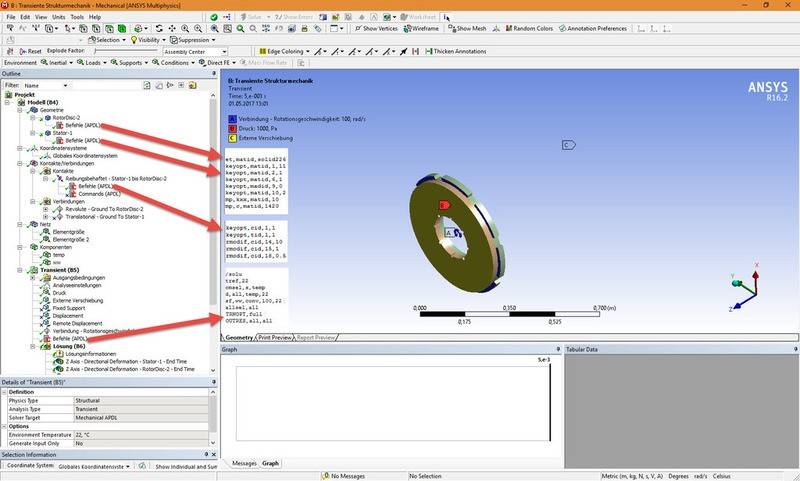
model.jpg

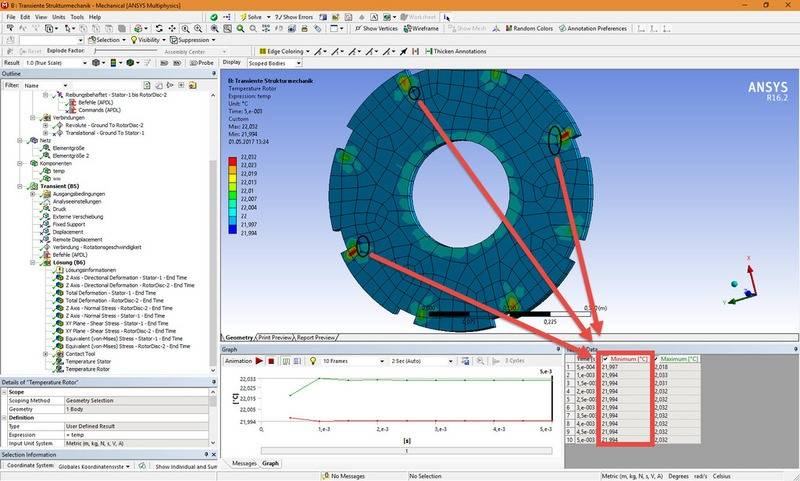
i used Coupled Thermal-structural analysis in ANSYS Workbench with solid226, but the result seemed to be not so good since the min Temperature, which appear on knots near max Temperatur of both rotor and stator is cooler than reference Temperatur (22°C) and the Total Deformation of rotor is relatively large.
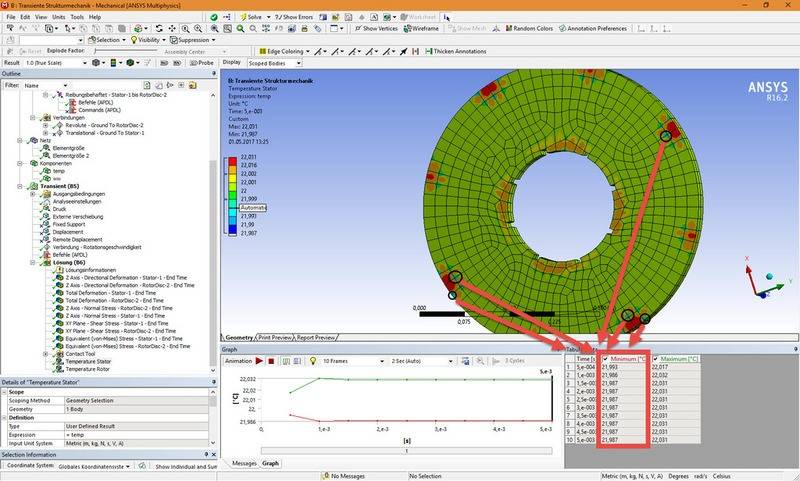
temperatur_stator.jpg


temperatur_rotor.jpg


verformung_rotor.jpg

I tried to reduce Net size and timestep but without success.
Is there something wrong with my simulation? Can someone please help me. Thank you and sorry for my bad in english
 
Engineering news on Phys.org
What boundary conditions are you applying to the model to prevent rigid body motion?
 
Mech_Engineer said:
What boundary conditions are you applying to the model to prevent rigid body motion?
Thank you for your answer. Here is my boundary condition:
2017-05-02_04-25-06.jpg

In my model, i define rotor is a Revolute joint, which can only rotate around z-axis (I'm a beginner so I really confuse hier because i don't know, if this definition can prevent rigid body motion of rotor or i must apply another boundary condition. Do you have any advice?)

rotor.jpg

And i set the surface, where pressure applied on stator as remote displacement with only z component free as below:

2017-05-02_04-23-57.jpg

Thank you!
 
Hi all,
i have solved the problems above but now i want to simulate a real model of aircraft multi discs brake with 6 stators and 5 rotors using coupled thermo-mechanic. It looks like:
2017-05-09_02-35-11_1.jpg

Boundary conditions:
5 rotos move and rotate around z-axis
5 stators move only along z-axis
6th stator is fix
Pressure 1Mpa is applied on 1st stator
But the result is so strange due strange movement of the discs(rotors and stators) as the video below.


Can anyone pls help me. Thanks
 
Thank you for your advice I think maybe my problem is the definition of contact body and contact target. I defined 1st stator as contact body and 1st rotor as contact targen in 1st contact but in 2nd contact i define 1st rotor as contact body and 2nd rotor as contact target (?) ... and so on for next rotors and rotors. I will try to change it and pinball region too as you advised and tell the result tomorrow ;)
 

Similar threads

  • · Replies 11 ·
Replies
11
Views
12K
  • · Replies 1 ·
Replies
1
Views
7K
  • · Replies 1 ·
Replies
1
Views
6K
Replies
2
Views
2K
  • · Replies 5 ·
Replies
5
Views
5K
  • · Replies 1 ·
Replies
1
Views
5K
  • · Replies 3 ·
Replies
3
Views
4K
  • · Replies 1 ·
Replies
1
Views
6K
Replies
5
Views
28K
Replies
1
Views
2K