Coupled Thermal-structural analysis in ANSYS Workbench

Click For Summary

Discussion Overview

The discussion revolves around the challenges faced in simulating a brake model using Coupled Thermal-structural analysis in ANSYS Workbench. Participants are exploring issues related to boundary conditions, contact definitions, and the overall behavior of the model under specific loading conditions.

Discussion Character

  • Technical explanation
  • Debate/contested
  • Experimental/applied

Main Points Raised

  • One participant describes their simulation setup involving a rotor and stator, noting unexpected temperature results and large deformations.
  • Questions are raised about the boundary conditions applied to prevent rigid body motion, with a focus on the definition of the rotor as a revolute joint.
  • Another participant shares their experience in simulating a more complex brake model with multiple rotors and stators, reporting strange movements in the discs.
  • Suggestions are made regarding the potential underconstraint of the model and the importance of adjusting time steps and contact conditions, including the size of the pinball region.
  • A participant expresses uncertainty about the correct definitions of contact bodies and targets in their simulation setup.

Areas of Agreement / Disagreement

Participants do not reach a consensus, as there are multiple competing views regarding the appropriate boundary conditions and contact definitions. The discussion remains unresolved with ongoing exploration of the issues presented.

Contextual Notes

Limitations include potential misunderstandings of contact definitions and boundary conditions, as well as the need for further clarification on the effects of time steps and pinball regions in the simulation.

davidfam
Messages
4
Reaction score
0
Hi all,
I'm currently working on my bachelor's thesis in mechanical engineering. I must simulate a brake model, which consist of 1 rotor and 1 stator. The rotor rotate around z-axis and the stator move along z-axis. When pressure is on stator placed. The stator and rotor will be pressed together.
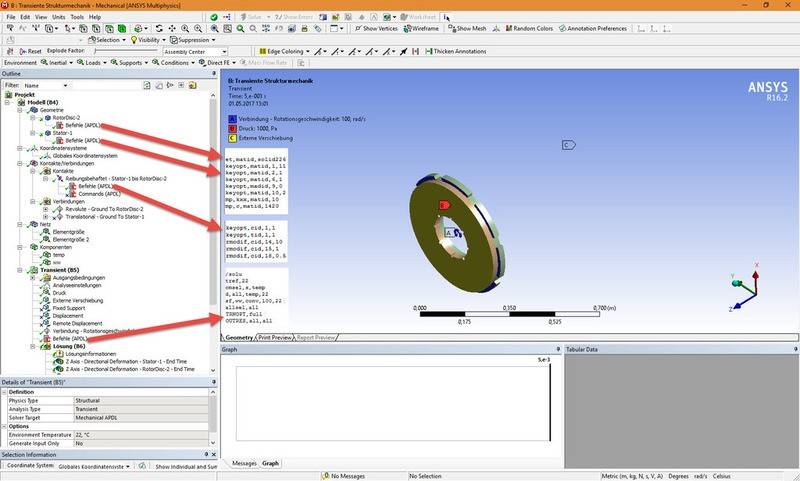
model.jpg

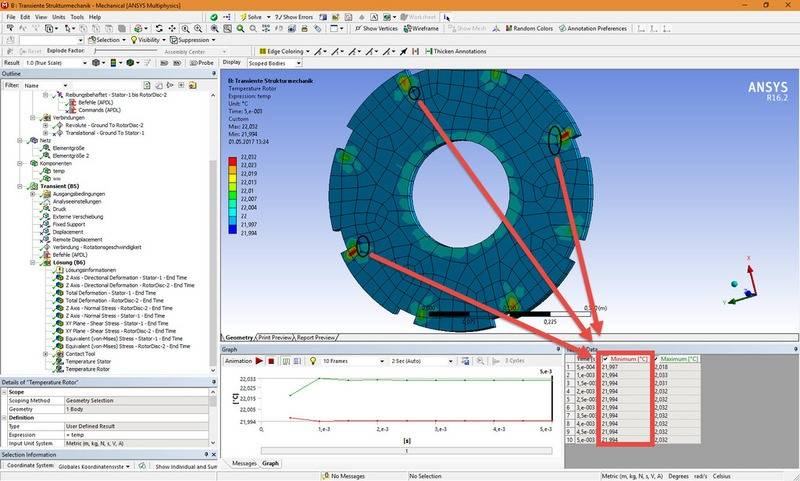
i used Coupled Thermal-structural analysis in ANSYS Workbench with solid226, but the result seemed to be not so good since the min Temperature, which appear on knots near max Temperatur of both rotor and stator is cooler than reference Temperatur (22°C) and the Total Deformation of rotor is relatively large.
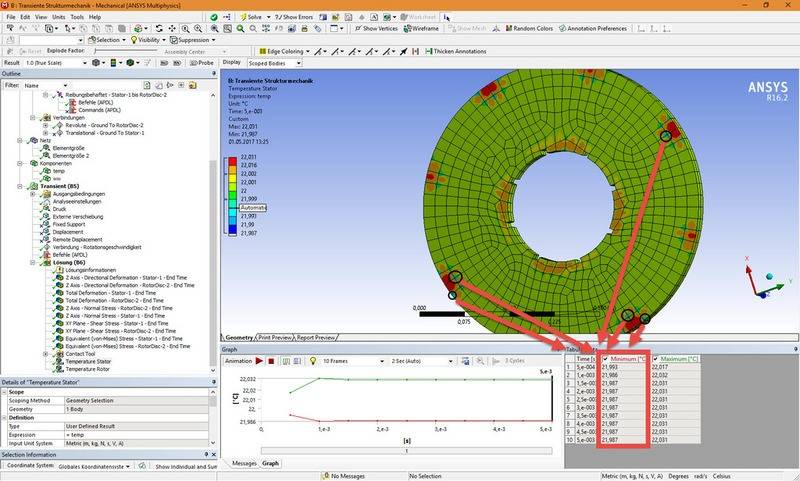
temperatur_stator.jpg


temperatur_rotor.jpg


verformung_rotor.jpg

I tried to reduce Net size and timestep but without success.
Is there something wrong with my simulation? Can someone please help me. Thank you and sorry for my bad in english
 
Engineering news on Phys.org
What boundary conditions are you applying to the model to prevent rigid body motion?
 
Mech_Engineer said:
What boundary conditions are you applying to the model to prevent rigid body motion?
Thank you for your answer. Here is my boundary condition:
2017-05-02_04-25-06.jpg

In my model, i define rotor is a Revolute joint, which can only rotate around z-axis (I'm a beginner so I really confuse hier because i don't know, if this definition can prevent rigid body motion of rotor or i must apply another boundary condition. Do you have any advice?)

rotor.jpg

And i set the surface, where pressure applied on stator as remote displacement with only z component free as below:

2017-05-02_04-23-57.jpg

Thank you!
 
Hi all,
i have solved the problems above but now i want to simulate a real model of aircraft multi discs brake with 6 stators and 5 rotors using coupled thermo-mechanic. It looks like:
2017-05-09_02-35-11_1.jpg

Boundary conditions:
5 rotos move and rotate around z-axis
5 stators move only along z-axis
6th stator is fix
Pressure 1Mpa is applied on 1st stator
But the result is so strange due strange movement of the discs(rotors and stators) as the video below.


Can anyone pls help me. Thanks
 
Thank you for your advice I think maybe my problem is the definition of contact body and contact target. I defined 1st stator as contact body and 1st rotor as contact targen in 1st contact but in 2nd contact i define 1st rotor as contact body and 2nd rotor as contact target (?) ... and so on for next rotors and rotors. I will try to change it and pinball region too as you advised and tell the result tomorrow ;)
 

Similar threads

  • · Replies 11 ·
Replies
11
Views
12K
  • · Replies 1 ·
Replies
1
Views
7K
  • · Replies 1 ·
Replies
1
Views
6K
Replies
2
Views
2K
  • · Replies 5 ·
Replies
5
Views
5K
  • · Replies 1 ·
Replies
1
Views
5K
  • · Replies 3 ·
Replies
3
Views
4K
  • · Replies 1 ·
Replies
1
Views
7K
Replies
5
Views
28K
Replies
1
Views
2K