Covering Maps and Liftings - Munkres Theorem 54.4

  • Context: Graduate 
  • Thread starter Thread starter Math Amateur
  • Start date Start date
  • Tags Tags
    Munkres Theorem
Click For Summary
SUMMARY

The discussion centers on Theorem 54.4 from Munkres' book "Topology," specifically regarding the proof of surjectivity of the projection map p. The key point raised is the existence of elements in the preimage p-1(b0), particularly whether there exists an element e1 different from e0. It is established that the proof does not require e1 to be distinct from e0, as the surjectivity holds even if e1 equals e0. This clarification is crucial for understanding the nature of lifts in the context of the fundamental group of the circle.

PREREQUISITES
  • Understanding of fundamental groups in topology
  • Familiarity with path-connected spaces
  • Knowledge of projection maps in algebraic topology
  • Basic concepts of lifting properties in covering spaces
NEXT STEPS
  • Study the concept of surjectivity in projection maps
  • Explore the properties of covering spaces in algebraic topology
  • Learn about the fundamental group of the circle and its implications
  • Investigate the lifting criterion for paths in topological spaces
USEFUL FOR

Mathematicians, particularly those studying algebraic topology, students of topology, and anyone interested in the detailed workings of Munkres' Theorem 54.4 and its implications for covering maps and lifts.

Math Amateur
Gold Member
MHB
Messages
3,920
Reaction score
48
I am reading Munkres book Topology.

Currently, I am studying Section 54: The Fundamental Group of the Circle and need help with a minor point in the proof of Theorem 54.4

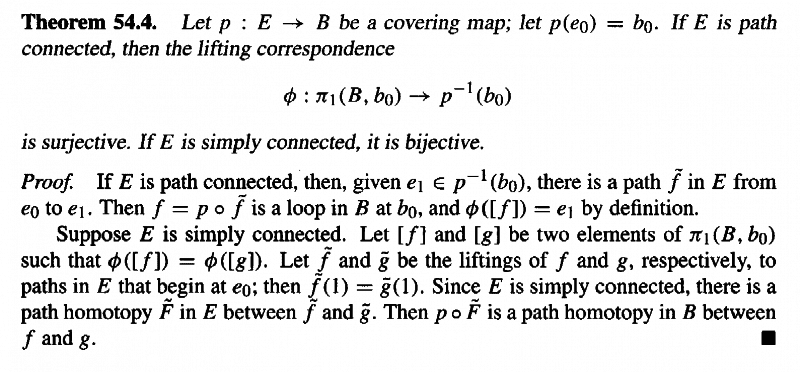
Theorem 54.4 and its proof reads as follows:
?temp_hash=6dcc0996c2b1982c64b7700cce279a30.png

In the proof we read:"If E is path connected, then, given e_1 \in p^{-1}(b_0), ... ... "... ... BUT ... ... how do we know there exists an e_1 different from e_0 in p^{-1}(b_0) ... maybe e_0 is the only element in p^{-1}(b_0)?

What, indeed, do we know about the nature of p^{-1}(b_0)?

Hope someone can help ...

Peter
 

Attachments

  • Munkres - Theorem 53.4   .png
    Munkres - Theorem 53.4 .png
    59.5 KB · Views: 751
  • Munkres - Theorem 53.4   .png
    Munkres - Theorem 53.4 .png
    59.5 KB · Views: 570
Physics news on Phys.org
he is trying to prove surjectivity, i.e. that every element of p^(-1)(b0) occurs as a lift. so he starts by taking any point in p^(-1)(b0) and produces a lift that gives it. I.e. his statement is: "IF e1 is a point of p^(-01)(b0), then e1 occurs as a lift." He is not assuming any such e1 exists that is different from e0. Indeed if none did exist, surjectivity would be trivial, since the lift of the identity element of the fundamental group would give the unique point e0. Note his proof works also when e1 = e0.
 
  • Like
Likes   Reactions: Math Amateur
mathwonk said:
he is trying to prove surjectivity, i.e. that every element of p^(-1)(b0) occurs as a lift. so he starts by taking any point in p^(-1)(b0) and produces a lift that gives it. I.e. his statement is: "IF e1 is a point of p^(-01)(b0), then e1 occurs as a lift." He is not assuming any such e1 exists that is different from e0. Indeed if none did exist, surjectivity would be trivial, since the lift of the identity element of the fundamental group would give the unique point e0. Note his proof works also when e1 = e0.

Thanks for the reply mathwonk ... Most helpful

Peter
 

Similar threads

  • · Replies 8 ·
Replies
8
Views
3K
  • · Replies 2 ·
Replies
2
Views
2K
  • · Replies 7 ·
Replies
7
Views
5K
  • · Replies 12 ·
Replies
12
Views
5K
  • · Replies 11 ·
Replies
11
Views
4K
  • · Replies 5 ·
Replies
5
Views
3K
  • · Replies 5 ·
Replies
5
Views
2K
  • · Replies 2 ·
Replies
2
Views
4K
Replies
2
Views
2K
  • · Replies 2 ·
Replies
2
Views
2K