Creating a Robotic Parrot: Could This Work?

  • Thread starter Thread starter Cloudz
  • Start date Start date
  • Tags Tags
    Work
Click For Summary

Discussion Overview

The discussion revolves around the feasibility and design considerations for creating a robotic parrot, focusing on the mechanics of wing movement, control systems, and potential programming platforms. Participants explore various aspects of the project, including materials, motor specifications, and electronic components.

Discussion Character

  • Exploratory
  • Technical explanation
  • Conceptual clarification
  • Debate/contested
  • Homework-related

Main Points Raised

  • One participant proposes a design for the wings using hollow square tubes and torsion springs, seeking feedback on torque requirements for the motor and gearbox.
  • Another participant suggests studying parrot anatomy to better replicate wing movements and mentions the potential use of Raspberry Pi versus Arduino for control.
  • Discussion includes the differences between Raspberry Pi and Arduino, with some participants noting that Arduino can handle more devices, while Raspberry Pi is better for fewer devices.
  • Some participants mention the possibility of combining Raspberry Pi and Arduino for enhanced functionality, with one participant expressing a lack of electronics knowledge but interest in using an Arduino Uno.
  • Links to external resources, including videos and articles about robotic parrots, are shared to provide inspiration and ideas.

Areas of Agreement / Disagreement

Participants express varying opinions on the best approach to control the robotic parrot, with no consensus on whether to use Raspberry Pi, Arduino, or a combination of both. The discussion remains unresolved regarding the optimal design and technical specifications for the wing mechanism.

Contextual Notes

Participants have not reached a definitive conclusion on the torque requirements for the motor or the effectiveness of the proposed wing design. There are also unresolved questions about the programming and control aspects of the project.

Cloudz
Messages
4
Reaction score
2
TL;DR
I had an idea for a project but unsure if it would work.
So, I want to make a robot parrot. I would like the parrot to be able to open and close their wings. I had a couple of ideas for the wings, one of which I'm not sure would work.

Could this idea work? If so, how much torque would the motor/gearbox need and how would that be found? If it doesn't work, are there any tweaks that could be made to make it work?

The idea:
The wing would be made with varying sizes of hollow 1/16 in. thick square tubes with shafts connecting each of the tubes in a sort of zig-zag pattern. The tubes, starting at the tip of the wing, are a 5.7 in. long tube with a height of 3/8 in. (length may change), a 2.85 in. long tube with a height of 1/2 in., a 2.85 in. long tube with a height of 3/4 in., and a (currently, though subject to change) 5 in. long tube with a height of 1/2 in. There are 3 joints in total. Inside the joints of the tubes are 315° right-wound torsion springs (with a max torque of 0.33 in-lbs) that keep the wing in a semi-folded position. There would be a rope attached to the end piece of the wing and run along the inside of each tube. At the end, there would be a motor and gearbox attached to a spool for the rope. The idea is that when the spool is turned, the rope is pulled tight and the wings open, and when the rope is given some slack, the wings return to their folded shape. I'm not sure if any of this info is useful but thought it wouldn't hurt to add it.

Any help is appreciated!
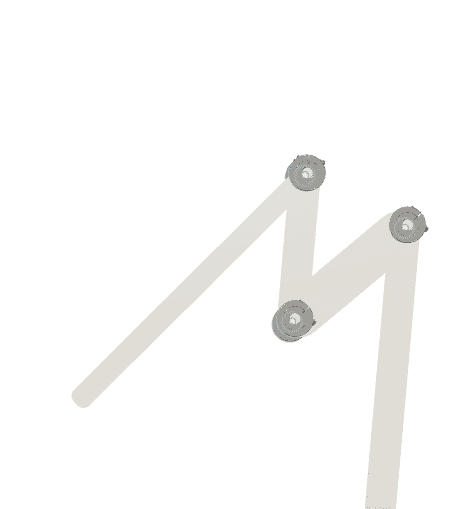
Screen Shot 2020-04-19 at 6.01.50 PM.png
 
Physics news on Phys.org
I suppose the first thing to do is studying the parrot skeleton and the types of movement in order to replicate the joints. If you know about programming, maybe Raspberry Pi would be better than Arduino, but it depends on what do you want the parrot to do.
 
The basic difference between Raspberry-PI and Arduino is in how many devices can be controlled. The Pi is good for a few devices but the Arduino can handle quite a lot of devices ie sensors, motors...

Some DIYers gang the two together with the PI sending commands to the arduino which controls all the devices.

https://www.electronicshub.org/raspberry-pi-vs-arduino/
 
jedishrfu said:
You might get some ideas from the youtube videos of parrots below:


and this article about a 3D printed parrot:

https://3dprint.com/22638/3d-printed-robotic-parrot/

and this one with a flapping mechanism:


Those all look really cool! Thank you!
 
jedishrfu said:
The basic difference between Raspberry-PI and Arduino is in how many devices can be controlled. The Pi is good for a few devices but the Arduino can handle quite a lot of devices ie sensors, motors...

Some DIYers gang the two together with the PI sending commands to the arduino which controls all the devices.

https://www.electronicshub.org/raspberry-pi-vs-arduino/

I'm not too well versed in electronics, so I was originally planning on using an Arduino Uno I had laying around. What do you mean that they gang two together?
 
Gang is another way of saying connected together.

If you search a bit on raspberry pi / arduino projects you can see how its done. Basically the pi controls the arduino. It loads a communications program in the arduino and then sends to the arduino commands to execute.

 
Last edited:
  • Like
Likes   Reactions: Cloudz
jedishrfu said:
Gang is another way of saying connected together.

If you search a bit on raspberry pi / arduino projects you can see how its done. Basically the pi controls the arduino. It loads a communications program in the arduino and then sends to the arduino commands to execute.


Thank you! Seems pretty interesting
 
  • Like
Likes   Reactions: jedishrfu

Similar threads

Replies
19
Views
3K
  • · Replies 9 ·
Replies
9
Views
2K
Replies
15
Views
4K
  • · Replies 2 ·
Replies
2
Views
2K
  • · Replies 6 ·
Replies
6
Views
5K
Replies
10
Views
3K
  • · Replies 10 ·
Replies
10
Views
2K
  • · Replies 35 ·
2
Replies
35
Views
8K
  • · Replies 3 ·
Replies
3
Views
2K
  • · Replies 4 ·
Replies
4
Views
4K