Creating a Summation Expression with k and m Variables

Click For Summary
SUMMARY

This discussion focuses on creating summation expressions using k and m variables in LaTeX. Users are encouraged to utilize the syntax \sum_{n=k ,m=1}^{k+1} and \sum_{p^{m} \le x \atop \text{p is prime }m \ge 1} for effective mathematical representation. The conversation highlights the importance of spacing and sizing in LaTeX expressions, suggesting the use of \substack for better alignment. Additionally, the subarray environment is recommended for aligning subscripts.

PREREQUISITES
  • Familiarity with LaTeX syntax for mathematical expressions
  • Understanding of summation notation in mathematics
  • Knowledge of prime numbers and their representation
  • Basic experience with LaTeX environments such as array and subarray
NEXT STEPS
  • Explore advanced LaTeX formatting techniques for mathematical documents
  • Learn about the \substack command for improved alignment in LaTeX
  • Investigate the differences between array and subarray environments in LaTeX
  • Practice creating complex summation expressions in LaTeX
USEFUL FOR

Mathematicians, students, and educators who are creating documents with complex mathematical expressions in LaTeX will benefit from this discussion.
alyafey22
Gold Member
MHB
Messages
1,556
Reaction score
2
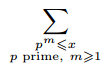
How to write something similar to the following

View attachment 1121

Or is it better to write

$$\sum_{n=k ,m=1}^{k+1}$$
 

Attachments

  • multi-indexed sum.PNG
    multi-indexed sum.PNG
    1.4 KB · Views: 120
Last edited:
Physics news on Phys.org
Try this syntax that produces the following output:

\large \sum_{p^{m} \le x \atop \text{p is prime }m \ge 1 }

$$\large \sum_{p^{m} \le x \atop \text{p is prime }m \ge 1 } $$

The spacing and sizing could use a little work but it's a good start for now.

EDIT: Just found another one on the same page. Try this code as well:

\large \sum_{\substack{p^{m} \le x \\ \text{p is prime }m \ge 1}}

$$\large \sum_{\substack{p^{m} \le x \\ \text{p is prime }m \ge 1}}$$
 
There is also the subarray environment, which is similar to the regular array environment. It allows aligning the subscripts left or right.

\atop is a plain TeX command.
 

Similar threads

  • · Replies 2 ·
Replies
2
Views
9K
  • · Replies 1 ·
Replies
1
Views
2K
  • · Replies 4 ·
Replies
4
Views
898
  • · Replies 1 ·
Replies
1
Views
3K
  • · Replies 5 ·
Replies
5
Views
1K
  • · Replies 44 ·
2
Replies
44
Views
6K
  • · Replies 3 ·
Replies
3
Views
3K
  • · Replies 5 ·
Replies
5
Views
2K
  • · Replies 2 ·
Replies
2
Views
2K
  • · Replies 3 ·
Replies
3
Views
2K