Creating an Airtight Tank: Tips and Techniques for a Successful Design

  • Thread starter Thread starter Loochia
  • Start date Start date
  • Tags Tags
    Tank
Click For Summary

Discussion Overview

The discussion revolves around the design and construction of an airtight tank capable of withstanding pressure, specifically for a freshman engineering design class project. Participants explore various materials, construction techniques, and safety considerations related to creating a pressure vessel.

Discussion Character

  • Exploratory
  • Technical explanation
  • Debate/contested
  • Homework-related

Main Points Raised

  • One participant notes that using flat sides for a pressure vessel may be problematic and questions the reasoning behind this choice.
  • Another participant suggests using cylindrical shapes with hemispherical ends as a more effective design for pressure vessels.
  • There is a proposal to switch from epoxy glue to acrylic cement or hot melt adhesives to improve the tank's integrity.
  • Some participants discuss the importance of using materials and adhesives with similar strength properties to the vessel's main material.
  • One suggestion includes using tension bands to absorb pressure in a box-shaped design, assuming the material can withstand deformation.
  • A participant recommends using water for pressure testing instead of air for safety reasons, highlighting the reduced energy release in case of failure.
  • Another participant emphasizes the need to address leakage at joints, proposing rubber seals, gaskets, or silicone sealing as potential solutions.
  • There is a recognition that the limitations of glue were a learning experience rather than a failure in the design process.

Areas of Agreement / Disagreement

Participants express various opinions on the best design and materials for the airtight tank, indicating that multiple competing views remain. The discussion does not reach a consensus on a single approach or solution.

Contextual Notes

Participants mention the importance of safety during pressure testing and the need for proper supervision or guidance from a professor. There are also references to specific design criteria that may influence the choice of materials and construction methods.
Loochia
Messages
2
Reaction score
1
Summary: Help!

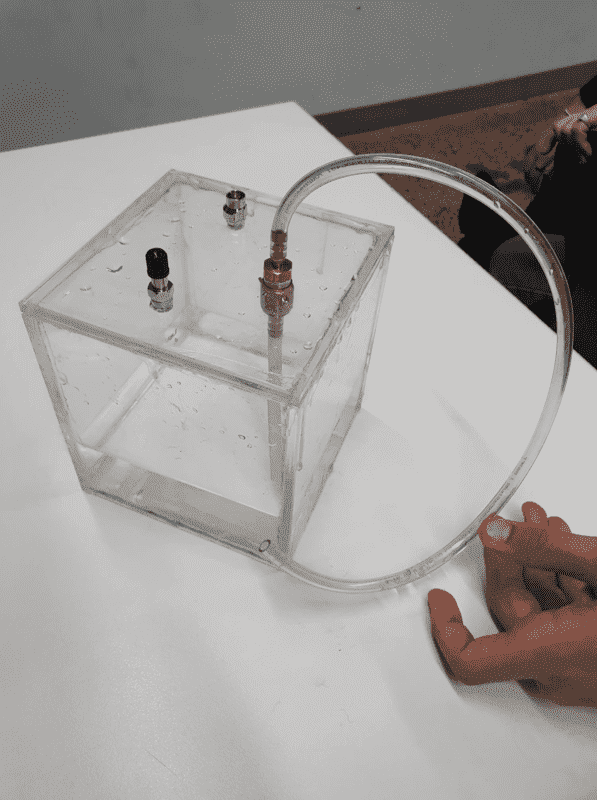
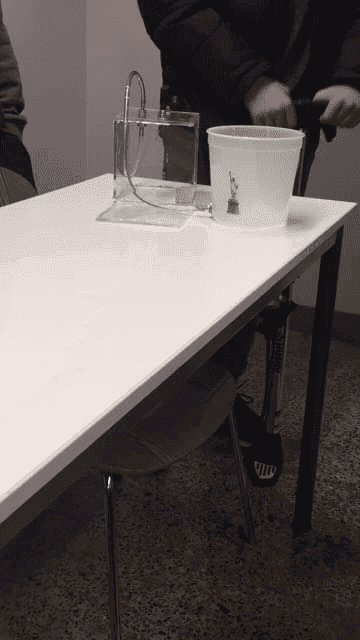
For my freshman engineering in design class, my group is trying to make an airtight tank that can withstand some pressure that is pumped in. For our prototype, we built a tank out of acrylic sheets and glued it together with epoxy glue, but it popped the second we pumped a little air inside. Does anyone have any suggestions as to other methods of created an airtight tank? Different materials, glues, etc?
PrototypePic.png
PrototypeFail.png
 
  • Like
Likes   Reactions: 256bits
Physics news on Phys.org
(thread moved to the schoolwork forums)

Welcome to the PF. :smile:

Well, making a pressure vessel with flat sides seems to be the first problem. Can you say why?

Once you fix that problem, what kinds of joints do you think you should use to improve the strength of the seals? Do you have access to a CNC milling machine or a 3-D printer?
 
How would we make a pressure vessel without flat sides? Like a cylinder?

We were thinking of switching our glue to acryilc cement and/or using hot melt adhesives. What do you think about these changes?

We have access to a 3-D printer and I believe there is a CNC milling machine in the workshop.
 
Loochia said:
Like a cylinder?
Yes. Starting with a tubing-like material gets you the rounded sides, but the top and bottom are still problematic. Can you mate hemispheres with the tubing to make a more traditional pressure vessel shape? Can you add bracing members outside of the structure? What are the rules/guidelines for this project?

1574183308580.png
 
A cylindrical vessel with hemispherical or 'dished' heads (like those shown above) is close to the best shape you can use for a pressure vessel (theoretically, a sphere would be best).

Usually you want what is holding the vessel together (the glue in this case) to be of similar, or close, strength properties of the material being used. Notice in the Google image results above this is typically a full penetration weld or rivets when steel is the case.

If the cylinder can be seamless with just the heads fitted on, this would be as perfect as you can get.

Hope this helps.
 
Last edited:
Loochia said:
For my freshman engineering in design class, my group is trying to make an airtight tank that can withstand some pressure...
How much pressure? What is this device going to be used for? Do you have aa professor advising/supervising on this project?
 
If you continue to use angled joins (i.e. a box) you may want to absorb some of the pressure using tension bands tightened around the sides, like near the edges and perhaps also at center. This assumes the material of the sides are capable of some plastic/elastic deformation without rupturing.

If you get into the problem where the box can structurally hold the pressure but the seams leak you may want to consider using an internal balloon that gets inflated inside the box.

For safe pressure testing you really should consider using water instead of air, as the energy release in case of failure is much less for water. If you only have an air pump you can fill the box with water so only a tiny fraction at top is air and then use the pump to pressurize a very small volume only.

No matter what you do be mindful of safety at all times when pressurized. Use goggles and safety distance (like use a water hose filled with water right up to the pump to keep persons at safe distance while pressurizing).

Edit: corrected that my fingers spelled goggles with double o instead of g :rolleyes:
 
Last edited:
  • Like
  • Haha
Likes   Reactions: 256bits, Tom.G and berkeman
Loochia said:
Summary: Help!

For my freshman engineering in design class, my group is trying to make an airtight tank that can withstand some pressure that is pumped in. For our prototype, we built a tank out of acrylic sheets and glued it together with epoxy glue, but it popped the second we pumped a little air inside. Does anyone have any suggestions as to other methods of created an airtight tank? Different materials, glues, etc?
View attachment 253053 View attachment 253054
Great learning experience, as to why some things are made the way they are made ( for optimization of what you want to optimize - which might be material cost, fabrication, durability, maintenance, ease of use, safety( ie rupture, leakage), volume and/pressure in this case. )

Square box is OK if there is no other criteria, such as who can make a vessel to hold the most pressure.
You just have to figure out a way to stop leakage ( rubber seals at the joints ( corner problematic ), or some silicon sealing ), gaskets, etc ).
Holding the box together- banding as mentioned by @Flip Larsen., clamps on the parallel faces, welding, etc.

I think you have found out that glue is limited in its ability.
I wouldn't consider that a failure, but as one of the steps in the design procedure towards an end result.
 

Similar threads

  • · Replies 5 ·
Replies
5
Views
9K
  • · Replies 1 ·
Replies
1
Views
3K
  • · Replies 12 ·
Replies
12
Views
4K
  • · Replies 39 ·
2
Replies
39
Views
15K
  • · Replies 5 ·
Replies
5
Views
4K
  • · Replies 9 ·
Replies
9
Views
5K
  • · Replies 17 ·
Replies
17
Views
7K
  • · Replies 52 ·
2
Replies
52
Views
8K
  • · Replies 8 ·
Replies
8
Views
4K
  • · Replies 2 ·
Replies
2
Views
10K