Crossbow Physics: Calculating Spring Constant, Tension Force & Power
- Thread starter pevi70
- Start date
-
- Tags
- Physics
Join the discussion
Registration is free. Ask a follow-up in this thread, or start your own.
52 replies · 14K views
Physics news on Phys.org
pevi70
- 22
- 0
This is the set-up:
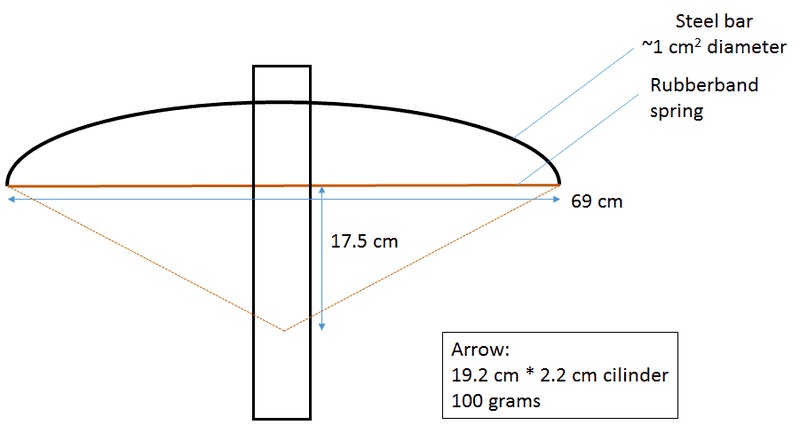
I can measure the velocity of the departing arrow. The mass of the rubberband spring is unknown and not practical to measure.
I would be interested to use the velocity and the other known parameters to calculate bow characteristics including the power of the bow.
Let me know if you need more information!
I can measure the velocity of the departing arrow. The mass of the rubberband spring is unknown and not practical to measure.
I would be interested to use the velocity and the other known parameters to calculate bow characteristics including the power of the bow.
Let me know if you need more information!
Attachments

pevi70
- 22
- 0
The rubberband has a round shape (rod shape) with a diameter of about 5 mm. I will post a picture of the actual bow later today.
I have no equipment to measure extensions under different loads, so I don't have or can easily collect that information.
I have no equipment to measure extensions under different loads, so I don't have or can easily collect that information.
pevi70
- 22
- 0
Despite the picture, quite some assumptions need to made: no recoil for example.
If you would assume that the propulsion is coming only from a mass less rubber spring, no friction exists, how would you calculate the time it would take for the arrow to cross the 17.5 cm (knowing the final speed)?
How could I approach that?
Thanks for your thoughts!
If you would assume that the propulsion is coming only from a mass less rubber spring, no friction exists, how would you calculate the time it would take for the arrow to cross the 17.5 cm (knowing the final speed)?
How could I approach that?
Thanks for your thoughts!
Science Advisor
- 3,625
- 3,311
Extension of the rubber band can be measured easily enough with a ruler. If you don't have a dynamometer on hand, you can measure draw force the way it was traditionally measured - hang the crossbow on a wall, and attach weights of known mass to the spring, measuring the distance the nocking point moves for each weight (hence the traditional nomenclature for bow power - 'draw weight'), as well as the associated extension of the rubber band.pevi70 said:I have no equipment to measure extensions under different loads, so I don't have or can easily collect that information.
Different crossbows are then ranked by their draw weight at full draw.
pevi70
- 22
- 0
Thats simply not practical. You need a special lever to lock the spring. I can measure the speed of the arrow.
I would really appreciate it if someone could help me how to calculate the time needed to propel the arrow by the spring in an idealized environment.
I would really appreciate it if someone could help me how to calculate the time needed to propel the arrow by the spring in an idealized environment.
Science Advisor
- 3,625
- 3,311
?
Why would you need to lock the string? Get a bottle, fill it with sand, weigh it, then attach it to the string and measure how much it stretches. Then change the bottle for a different weight or add more bottles and repeat.
Why would you need to lock the string? Get a bottle, fill it with sand, weigh it, then attach it to the string and measure how much it stretches. Then change the bottle for a different weight or add more bottles and repeat.
pevi70
- 22
- 0
These bows are so strong, you need a special lever to charge the spring.
Science Advisor
- 3,625
- 3,311
If you do it by hand, sure. But here you're just hanging weights on the string. You can hang as much as it takes. I really don't see the problem here.
I really don't have any experience with stretching strings, but if it's anything like traditional bows in efficiency, then you'll need something like 50-70 kg at full draw for 60m/s bolt (which you don't need, since we just want to find out how the string extension vs draw weight looks like - the first few cm of draw should suffice).
I really don't have any experience with stretching strings, but if it's anything like traditional bows in efficiency, then you'll need something like 50-70 kg at full draw for 60m/s bolt (which you don't need, since we just want to find out how the string extension vs draw weight looks like - the first few cm of draw should suffice).
pevi70
- 22
- 0
Here is a picture of the bow:
(The width of the wooden part of the bow is 4 cm)
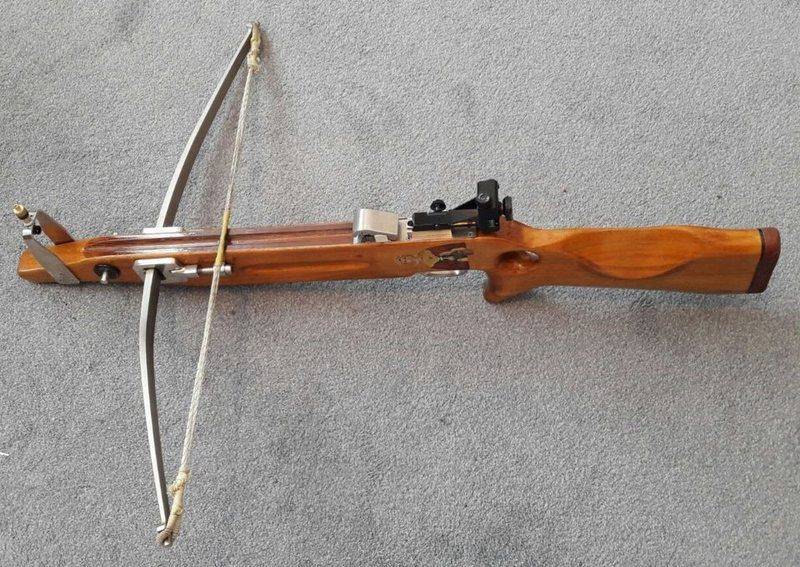
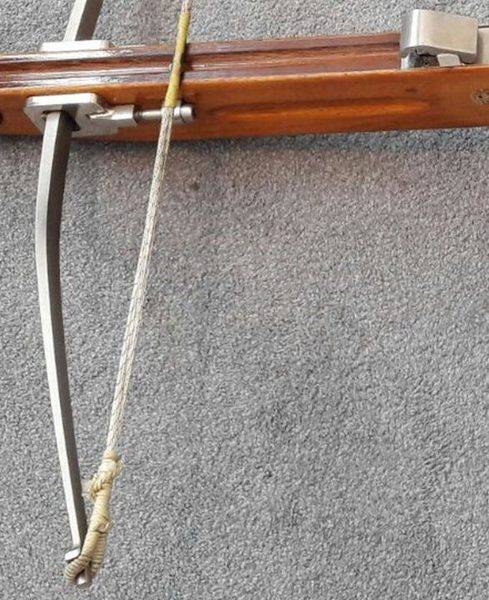
(The width of the wooden part of the bow is 4 cm)
Science Advisor
Gold Member
- 1,532
- 462
Since you can measure v (velocity at the arrow separation); and, for an object accelerating from 0 to v, s= 1/2vt, and with s and v then you can determine t (time of acceleration) and subsequently the acceleration a. If of any benefit, from that using F = ma you can determine the average effective bow force. (if, as you specified, you ignore friction and recoil.)
Edit: I just saw thr bow picture and are you sure there is no flexing of the crossbar? If there is as strong a pull force as you state, it is hard for me not to expect flexing in that component.
Edit: I just saw thr bow picture and are you sure there is no flexing of the crossbar? If there is as strong a pull force as you state, it is hard for me not to expect flexing in that component.
pevi70
- 22
- 0
I think s=1/2vt only applies if the acceleration is constant.
pevi70
- 22
- 0
OK, I thought it didnt apply. Thats great, thanks a million!
pevi70
- 22
- 0
Thanks Nidum, what is it?
Do you agree with JBA?
Do you agree with JBA?
pevi70
- 22
- 0
What does that mean?
And do you agree with JBA?
And do you agree with JBA?
Science Advisor
- 2,992
- 852
Problem is that all responders - including myself - are now a bit uncertain as to what exactly we are trying to analyse .
So I'm trying to get a definite understanding of the mechanics of this cross bow . Is it the metal spring , the rubber rope or a combination of both that provides the driving force ?
So I'm trying to get a definite understanding of the mechanics of this cross bow . Is it the metal spring , the rubber rope or a combination of both that provides the driving force ?
pevi70
- 22
- 0
Do you agree with JBA?
Dr.D
- 2,411
- 723
Nidum said:So I'm trying to get a definite understanding of the mechanics of this cross bow . Is it the metal spring , the rubber rope or a combination of both that provides the driving force ?
Amen!
Similar threads
Calculating Spring Constant and Energy Conservation: How Fast Will the Bag Drop?
- MarieMarie94
- · Replies 3 ·
- Introductory Physics Homework Help
- Replies
- 3
Undergrad Calculating Spring Constant - Force or Energy?
- Cintdrix
- · Replies 1 ·
- Mechanics
- Replies
- 1