How Does Increasing Resistance Affect Current Flow in a Circuit?

  • Thread starter Thread starter REEEEEEEE
  • Start date Start date
  • Tags Tags
    Analysis
Click For Summary

Homework Help Overview

The discussion revolves around the relationship between resistance and current flow in a circuit, specifically examining how increasing resistance affects current. Participants are analyzing graphs and data related to this relationship.

Discussion Character

  • Exploratory, Assumption checking, Problem interpretation

Approaches and Questions Raised

  • Participants are questioning the clarity and source of the data presented in the graphs, as well as the specific branches of the circuit being analyzed. There is a focus on understanding what variables are being changed and which are held constant in the context of the graphs.

Discussion Status

The discussion is ongoing, with participants seeking clarification on the original question and the data presented. Some have provided guidance on how to properly graph the relationship between current and resistance, emphasizing the need for clear definitions of fixed and variable components.

Contextual Notes

There is a noted lack of clarity in the original question, and participants are requesting additional information, such as a complete question and clearer graphical representations.

REEEEEEEE
Messages
10
Reaction score
0
Homework Statement
Graphically represent in EXCEL or equivalent program the characteristics
current-resistance (abscissa) of the three currents in the circuit. Comment the obtained graphic.
(Hint: Plot the theoretical, simulated and experimental characteristics and compare the
differences between values and their evolution).
Relevant Equations
U=RI (OHM'S LAW)
For example given the circuit
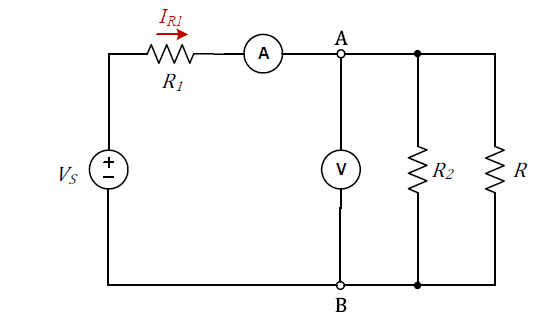
Captura de ecrã 2021-11-20 201327.png


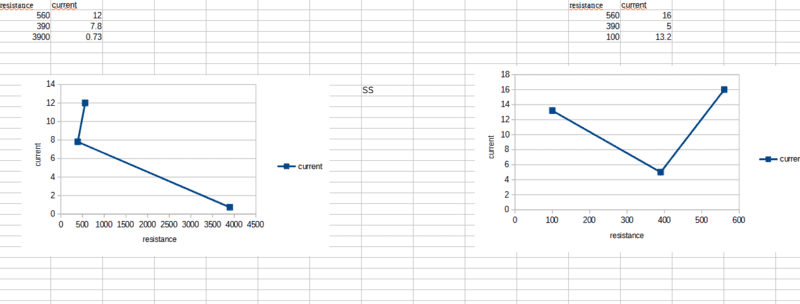
I make the graphs :
Captura de ecrã 2021-11-20 201958.png


and comment that or graph 1 as resistance grows larger the current grows smaller (is inversely proportional) I will use the simulation and experimental data to check the values and conclude that this act is true.
Is this what I'm supposed to do?
 
Physics news on Phys.org
Those are odd-looking graphs. Where do those numbers come from? Which branch(es) of the circuit do the graphs refer to? What is being varied and what is constant? (e.g. if you are plotting the current through R2 as R2 varies, is R held constant? At what value? This is important, though the question as quoted doesn't make it clear.)
 
mjc123 said:
Those are odd-looking graphs. Where do those numbers come from? Which branch(es) of the circuit do the graphs refer to? What is being varied and what is constant? (e.g. if you are plotting the current through R2 as R2 varies, is R held constant? At what value? This is important, though the question as quoted doesn't make it clear.)
Above the graph you can se the values o current and resistance and I apologise or not explaining that the order goes rom top to botom:R1,R2,R.
 
But that is meaningless. Each set of values {R1, R2, R} will be associated with a particular value of the current - or, to be precise, with a particular set of values {IR1, IR2, IR}. What you need to do is graph one of these current values as a function of one of the resistances, e.g. IR vs. R while holding R1 and R2 constant. And do this in turn for each of the 3 currents.
 
  • Like
Likes   Reactions: DaveE
mjc123 said:
the question as quoted doesn't make it clear
This ^^^.
Can you post the complete question? Maybe post a (good) picture with your phone?
What component values are fixed, and which are varied in the analysis?
 

Similar threads

  • · Replies 5 ·
Replies
5
Views
2K
  • · Replies 3 ·
Replies
3
Views
2K
  • · Replies 14 ·
Replies
14
Views
5K
  • · Replies 3 ·
Replies
3
Views
2K
Replies
2
Views
1K
  • · Replies 8 ·
Replies
8
Views
11K
Replies
3
Views
2K
  • · Replies 8 ·
Replies
8
Views
2K
  • · Replies 2 ·
Replies
2
Views
2K
Replies
5
Views
2K