Dark matter does not interact with ordinary matter....

  • Context: High School 
  • Thread starter Thread starter etotheipi
  • Start date Start date
  • Tags Tags
    Dark matter Matter
Join the discussion
Registration is free. Ask a follow-up in this thread, or start your own.
5 replies · 2K views
etotheipi
In the other thread, it was noted that dark matter doesn't interact with ordinary matter.

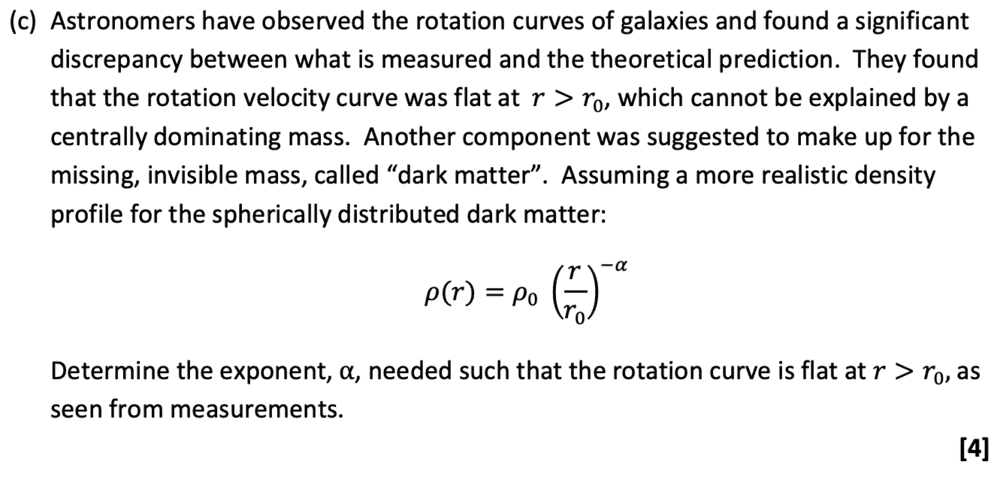
Now I tread cautiously, not knowing any of the relevant theory. In some school questions, I've come across discussion of 'dark matter halos' which are necessary to ensure the rotation curve of the galaxy fits what we observe; an example would be something like:
1598980351364.png


For the purposes of this problem, for instance, we're just supposed to assume the dark matter interacts gravitationally just like ordinary matter does.

But if dark matter doesn't actually interact with ordinary matter, electromagnetically, gravitationally, or otherwise, then I wondered if someone could explain to me how we should perform these sorts of calculations? Thanks!
 
Astronomy news on Phys.org
etotheipi said:
In the other thread, it was noted that dark matter doesn't interact with ordinary matter.

No, it was noted that dark matter doesn't interact non-gravitationally with ordinary matter.

etotheipi said:
if dark matter doesn't actually interact with ordinary matter, electromagnetically, gravitationally, or otherwise

Nobody has been saying dark matter doesn't interact gravitationally. The whole reason for postulating dark matter in cosmological models is to provide enough of a source of gravity, over and above visible matter, to account for observations.
 
  • Like
Likes   Reactions: etotheipi and Motore
Cool, thanks. I only asked because I noticed some sadness in response to the post that said "Wrong. It interacts gravitationally".

I'm glad there's nothing more to it! :smile:
 
Dark matter interacts gravitationally with normal matter and other dark matter. It just doesn't interact electromagnetically with anything. And collisions are electromagnetic interactions - if you "touch" a table, the electron clouds of your fingertip atoms are repelled by the electron clouds of the table atoms. That doesn't happen with dark matter - it just passes through.

So dark matter can be dragged around gravitationally - that's the dark matter halo. It just doesn't collide and suffer frictional losses the way regular matter does, so it doesn't clump into stars and planets and all the other junk we see out there.

etotheipi said:
I noticed some sadness in response to the post that said "Wrong. It interacts gravitationally".
That statement is correct. It just doesn't read as the most constructive attitude...
 
  • Like
Likes   Reactions: etotheipi and Motore
To be more precise, I believe the actual limitations are on it not having electromagnetic or strong nuclear charge.

No electromagnetic charge is required because with such a charge it would behave very similar to normal matter. Which it definitely doesn't.

If it interacted with the strong nuclear force, it would collide with normal matter pretty frequently, making it super easy to detect in experiments here on Earth. I believe it would also change how the first elements formed in the very early universe.

It is very possible, however, for dark matter to interact with the weak nuclear force. And it definitely interacts with gravity because everything does (gravity interacts with mass, energy, momentum, and pressure, and everything has at least energy).

Weak nuclear force interactions are why physicists are looking for dark matter using underground experiments, for example.
 
  • Like
Likes   Reactions: PeroK, Ibix and etotheipi