Delayed-choice quantum eraser experiment

Click For Summary

Discussion Overview

The discussion revolves around the delayed-choice quantum eraser experiment, exploring the implications of entangled photons and interference patterns based on future measurements. Participants examine the relationship between the setup of the experiment, the presence of which-way information, and the resulting interference or lack thereof.

Discussion Character

  • Exploratory
  • Debate/contested
  • Technical explanation

Main Points Raised

  • One participant notes that interference is observed at detector D0 when entangled photons are detected at D1 or D2, but not when detected at D3 or D4, raising questions about the implications of applying the quantum eraser to all entangled photons.
  • Another participant suggests that eliminating beamsplitters BSa and BSb would not change the correlation between detected photons and fringe patterns at D0, arguing that the presence of which-way information is crucial for interference to disappear.
  • A different viewpoint proposes creating two identical paths to investigate interference, though this raises questions about the quantum erasing aspect of the experiment.
  • One participant expresses confusion about how to establish which-way information with the proposed setup, indicating uncertainty about the implications of their earlier statements.
  • Several participants express shared confusion regarding the experiment and its interpretations, indicating a collective struggle to resolve the complexities involved.
  • Links to external articles are shared, with one participant expressing interest in further reading on the transactional interpretation of quantum mechanics, suggesting it may provide additional insights.

Areas of Agreement / Disagreement

Participants express varying interpretations of the experiment and its implications, with no consensus reached on the effects of the quantum eraser or the establishment of which-way information. The discussion remains unresolved with multiple competing views presented.

Contextual Notes

Participants acknowledge limitations in their understanding and reasoning, with some expressing uncertainty about the implications of their claims and the experimental setup. The discussion reflects a complex interplay of ideas without definitive conclusions.

gtorassa
Messages
6
Reaction score
1
TL;DR
A specific configuration of delayed-choice quantum eraser experiment where the eraser involves all the photons (not just a part of them)
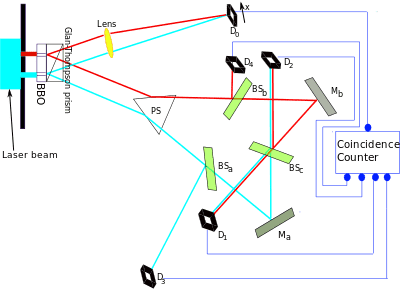
In the Kim's experiments (see picture below) part of the downwards photons are involved in a quantum eraser and part aren't.
1567414560458.png


In D0 (upward path) we see interference if the entangled photons (downward path) are detected in D1 or D2 and we don't see interference if the entangled photons are detected in D3 or D4.
Taking into account all the photons, in D0 we don't see any interference.
But what happens in D0 if we apply the eraser to all the entangled photons going downwards?
If we see interference (due to the eraser) it means that the behaviour in D0 depends on what happens in the future, if we don't see any interference it means that the eraser doesn't work.
 
Physics news on Phys.org
Thanks for bringing up this quantum erasing experiment, I'm ruminating on it as well.

As I understand it, if we apply the eraser to all the entangled photons, i.e. eliminate beamsplitters BSa and BSb, nothing would change: To each photon detected at detector D1 (D2) correlates a fringe-photon (anti-fringe photon) at D0. The function of D3 and D4 is only that to show that as long we have information on the which-way then interference disappears.

As to the 'back from the future' action that's where I got stuck too. But I'm very skeptic. For such strong statements I would like to see equally strong evidence. I believe one can recast the observed phenomenon within the classical causal order. But, admittedly, I have to clarify myself on this. If I may add my two cents... My guess is that if someone replaces D1 and D2 with a screen (or CCD or step motor readout) one would see the fringe- and anti-fringe interference pattern. The photons have orthogonal polarization, say vertical (V) and horizontal (H). The system behaves as if, when photons come from slit A with V pol. and from slit B with H pol. they always hit one detector and produce one type of fringe, whereas when polarization is inverted (photons from slit A with H pol. and from slit B with V pol.) then they always hit the other detector producing the other fringe type. However, that would imply that some sort of destructive (constructive) interference occurs at BSc always to allow the photons hit only D1 (D2) for the two different situations. How this can be I don't know, in fact that could be completely wrong, but seems to me the only way one can save classical causality.
 
I'm not thinking about eliminating the BSa and BSb beamsplitters, I'm thinking about creating two identical paths:

1567426841227.png


Do we see interference?
 
But with this you have also eliminated the quantum erasing part. That is, you can trace back the which-way and therefore both detectors will show no interference fringes.

Edit: Thinking on this further (was perhaps too hasty with my answer) I'm no longer sure. In fact how can we establish the which-way with this setup? Only by inserting again a detector on the path. Ok, I'm confused , should perhaps delete this post, just keep it for those who have already read... :rolleyes:
 
:smile: don't worry, I'm confused too :wink:.
I have been thinking about this problem for some months but I cannot solve it
 
gtorassa said:
:smile: don't worry, I'm confused too :wink:.
I have been thinking about this problem for some months but I cannot solve it
You might find this interesting.

https://arxiv.org/abs/1905.03137
 
  • Like
Likes   Reactions: gtorassa, vanhees71 and Aidyan
Mentz114 said:
You might find this interesting.

https://arxiv.org/abs/1905.03137

Thanks. This article seems to be precisely what I was looking for. Will go through it. Kastner has also many other similar articles on the matter. She seems to work a lot on the transactional interpretation of QM. Her blog might give more insights: https://transactionalinterpretation.org/
 

Similar threads

  • · Replies 3 ·
Replies
3
Views
4K
  • · Replies 2 ·
Replies
2
Views
2K
  • · Replies 8 ·
Replies
8
Views
2K
  • · Replies 1 ·
Replies
1
Views
2K
  • · Replies 1 ·
Replies
1
Views
1K
  • · Replies 24 ·
Replies
24
Views
4K
  • · Replies 1 ·
Replies
1
Views
2K
  • · Replies 4 ·
Replies
4
Views
2K
  • · Replies 3 ·
Replies
3
Views
1K
  • · Replies 9 ·
Replies
9
Views
2K