Undergrad Derivation of Cauchy-Schwarz Inequality

Click For Summary
The discussion centers on the derivation of the Cauchy-Schwarz inequality, specifically the transition from the inequalities involving the dot product of vectors to the absolute value form. Participants express confusion about the algebraic steps taken in the textbook, particularly how the inequality -|v||w| ≤ v · w ≤ |v||w| leads to |v · w| ≤ |v||w|. Clarifications are provided regarding the geometric definition of the dot product and the properties of absolute values. The conversation emphasizes the importance of understanding the underlying definitions and properties of inequalities in mathematics. Overall, the thread highlights the need for clear explanations in mathematical derivations.
member 731016
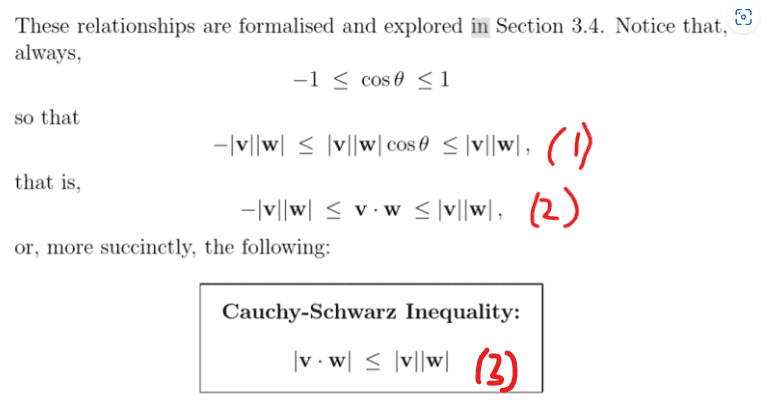
For this,
1679289109955.png

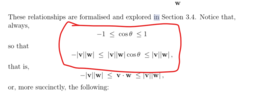
I don't understand how they got from (1) to (2)? Dose someone please know what binary operation allows for that?

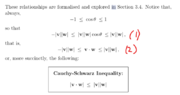
I also don't understand how they algebraically got from line (2) to (3).

Many thanks!
 

Attachments

  • 1679288278254.png
    1679288278254.png
    12.9 KB · Views: 165
  • 1679288324177.png
    1679288324177.png
    13.2 KB · Views: 314
Last edited by a moderator:
Physics news on Phys.org
jedishrfu said:
They used the geometric definition of vector dot product which is:

##u \cdot v = |u| |v| cos(\theta)## where its understood that ##\theta## is the angle between u and v

https://en.wikipedia.org/wiki/Dot_product
Thank you for your reply @jedishrfu !

Sorry if I was not clear. How did they go from ## -|v||w| ≤ v \cdot w ≤ |v||w| ## be equal to ##|v \cdot w| ≤ |v||w|##? The textbook dose not show any immediate steps.

I also don't know what allowed them to multiply all of ##-1 ≤ \cos\theta ≤ 1## by ##|v||w| ## to get line (2).

Many thanks!
 
Callumnc1 said:
Sorry if I was not clear. How did they go from ## -|v||w| ≤ v \cdot w ≤ |v||w| ## be equal to ##|v \cdot w| ≤ |v||w|##? The textbook dose not show any immediate steps.
Try it the other way. What does ##|x|\leq a## tell you about the range of allowed values for ##x##?
Callumnc1 said:
I also don't know what allowed them to multiply all of ##-1 ≤ \cos\theta ≤ 1## by ##|v||w| ## to get line (2).
If one number (e.g. ##\cos\theta##) is less than another (e.g. ##1##) and I multiply both by some positive value (e.g. ##|v||w|##), do you think the product with the smaller value (##|v||w|\cos\theta##) could ever be larger than the product with the larger value (##1|v||w|##)?
 
  • Like
Likes member 731016
Ibix said:
Try it the other way. What does ##|x|\leq a## tell you about the range of allowed values for ##x##?
Thank you for your reply @Ibix!

The range of allowed values of x have to such that their abs is less than or equal to a.

Many thanks!
 
Ibix said:
If one number (e.g. ##\cos\theta##) is less than another (e.g. ##1##) and I multiply both by some positive value (e.g. ##|v||w|##), do you think the product with the smaller value (##|v||w|\cos\theta##) could ever be larger than the product with the larger value (##1|v||w|##)?
Thank you for your reply @Ibix!

No I don't think so.

Many thanks!
 
Callumnc1 said:
##-|v||w| ≤ v \cdot w ≤ |v||w| ## be equal to ##|v \cdot w| ≤ |v||w|##?

By definition, if ## -b \leq a \leq b ## then we write this as ## |a| \leq b##
 
  • Like
Likes member 731016 and jedishrfu
malawi_glenn said:
By definition, if ## -b \leq a \leq b ## then we write this as ## |a| \leq b##
Thank you for your reply @malawi_glenn! Sorry, where did you read that is true? I am not sure where it is derived from. I have never seen that before sorry.

Many thanks!
 
Callumnc1 said:
Thank you for your reply @malawi_glenn! Sorry, where did you read that is true? I am not sure where it is derived from. I have never seen that before sorry.

Many thanks!
Any math textbook on pre calc should cover this

https://en.wikipedia.org/wiki/Absolute_value

And it is not derived it is a definition, a way of writing more compact
 
  • Like
Likes member 731016
  • #11
Callumnc1 said:
Thank you for your reply @malawi_glenn! Sorry, where did you read that is true? I am not sure where it is derived from. I have never seen that before sorry.
Draw a number line. Mark ##0## and ##\pm b##. What region of this line can ##a## lie in if ##|a|\leq b##? What region can it lie in if ##-b\leq a\leq b##?
 
  • Like
Likes member 731016
  • #12
Ibix said:
Draw a number line. Mark ##0## and ##\pm b##. What region of this line can ##a## lie in if ##|a|\leq b##? What region can it lie in if ##-b\leq a\leq b##?
Thank you for your reply @lbix ! I will do some thinking. Many thanks!
 
  • #13
If ##-b \le a \le b##, then ##a \le b## and ##-b \le a## (or, ##-a \le b##). So ##\pm a \le b##. Since ##|a|## is either ##a## or ##-a##, then ##|a| \le b##.
 
  • Like
Likes member 731016, DaveE and Ibix
  • #14
Euge said:
If ##-b \le a \le b##, then ##a \le b## and ##-b \le a## (or, ##-a \le b##). So ##\pm a \le b##. Since ##|a|## is either ##a## or ##-a##, then ##|a| \le b##.
Thank you for your reply @Euge!

Could you also equally just take the absolute value of the of both sides of the inequality ##\pm a \le b## instead of using the definition of absolute value? This would give ##|a| \le |b|##

Many thanks!
 
  • #15
Callumnc1 said:
Could you also equally just take the absolute value of the of both sides of the inequality ##\pm a \le b## instead of using the definition of absolute value? This would give ##|a| \le |b|##
In general, the inequality ##a \le b## does not imply ##|a| \le |b|##. For example, ##-2 \le 1## but ##|-2| > |1|## since ##|-2| = 2## and ##|-1| = 1##.
 
  • Like
Likes Greg Bernhardt, member 731016 and malawi_glenn

Similar threads

  • · Replies 6 ·
Replies
6
Views
2K
  • · Replies 2 ·
Replies
2
Views
2K
  • · Replies 2 ·
Replies
2
Views
2K
  • · Replies 13 ·
Replies
13
Views
3K
Replies
4
Views
3K
  • · Replies 2 ·
Replies
2
Views
2K
  • · Replies 2 ·
Replies
2
Views
2K
  • · Replies 5 ·
Replies
5
Views
4K
  • · Replies 3 ·
Replies
3
Views
2K
Replies
1
Views
2K