Derivative of A Def. Integral Equals Another Def. Integral?

Click For Summary

Discussion Overview

The discussion revolves around the differentiation of a definite integral as presented in a textbook on differential equations. Participants explore the application of the Leibniz integral rule and the implications of variable dependencies within the integral's limits and integrand.

Discussion Character

  • Technical explanation
  • Mathematical reasoning
  • Debate/contested

Main Points Raised

  • One participant references the Leibniz integral rule as a method for differentiating a definite integral with variable limits and integrands.
  • Another participant discusses the presence of multiple occurrences of the variable ##x## in the integral, suggesting that this complexity necessitates careful consideration of dependencies.
  • A detailed derivation is provided, showing how to differentiate the definite integral using total differentials and partial derivatives, leading to a formulation involving the integrand and its derivatives.
  • There is a clarification regarding the dependencies of variables in the integrand, with one participant assuming that certain variables do not depend on ##x##, while another later asserts that the variables in the denominator do not depend on ##x##.

Areas of Agreement / Disagreement

Participants express differing views on the dependencies of certain variables within the integral, indicating that there is no consensus on this aspect. The discussion remains unresolved regarding the implications of these dependencies on the differentiation process.

Contextual Notes

Participants note that the excerpt from the textbook does not clarify the dependencies of all variables involved, which could affect the interpretation of the differentiation process.

terryphi
Messages
57
Reaction score
0
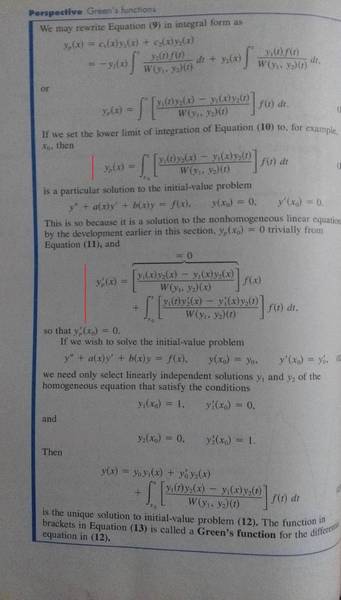
I'm going through the book "Elementry Differnetial Equations With Boundary Value Problems" 4th Eddition by William R. Derrick and Stanley I. Grossman.

On Page 138 (below)
Dg03h.jpg
)

The authors take the derivative of a definite integral and end up with a definite integral plus another term. How did they do this?
 
Physics news on Phys.org
Use Leibniz integral rule
$$\frac{\mathrm{d}}{\mathrm{d}x}\int_{a(x)}^{b(x)} \! f(x,t) \, \mathrm{d}x=\frac{\mathrm{d}b(x)}{\mathrm{d}x}f(x,b(x))-\frac{\mathrm{d}a(x)}{\mathrm{d}x}f(x,a(x))+\int_{a(x)}^{b(x)} \! \frac{\mathrm{\partial}}{\mathrm{\partial}x} f(x,t) \, \mathrm{d}x$$
https://en.wikipedia.org/wiki/Leibniz_integral_rule
 
It is because they differentiate with respect to ##x## and there are at least three occurrences of ##x## in the formula that is being integrated: one as an upper integration limit, and two as function arguments in the integrand. There may be up to two more, being the ##y_1,y_2## in the denominator of the integrand. The excerpt does not make clear whether they also depend on ##x##, so I will assume they do not, although they could, since there is a ##y_1(x)## and ##y_2(x)## in the numerator.

Let the function ##A:\mathbb R^2\to\mathbb R## be an antiderivative (indefinite integral) of the integrand with respect to ##t##, ie ##\frac{\partial }{\partial t}A(t,x)=a(t,x)## where ##a(t,x)## is the integrand.

Then the definite integral is
$$A(x,x)-A(x_0,x)$$
Differentiating this wrt ##x## and using the total differential rule gives
\begin{align*}
\frac d{dx}\left(A(x,x)-A(x_0,x)\right)
&=D_1A(x,x)\frac{dx}{dx} + D_2A(x,x)\frac{dx}{dx}
-D_1A(x_0,x)\frac{dx_0}{dx}-D_2A(x_0,x)\frac{dx}{dx}\\
&=D_1A(x,x)\cdot 1 + D_2A(x,x)\cdot 1
-D_1A(x_0,x)\cdot 0-D_2A(x_0,x)\cdot 1\\
&=D_1A(x,x) + D_2A(x,x)-D_2A(x_0,x)
\end{align*}
where ##D_kA## indicates the partial derivative of function ##A## wrt its ##k##th argument.
This is equal to
\begin{align*}
a(x,x) + D_u\bigg(A(x,u)-A(x_0,u)\bigg)\bigg|_{u=x}
&=
a(x,x) + D_u \int_{x_0}^x a(t,u)dt\bigg|_{u=x}
\end{align*}
where ##D_u## indicates partial differentiation wrt the variable ##u##
In the second term we can, given certain mild assumptions, move the differentiation operator inside the integral sign to obtain:
\begin{align*}
a(x,x) + \int_{x_0}^x D_ua(t,u)dt\bigg|_{u=x}
=a(x,x) + \int_{x_0}^x D_xa(t,x)dt
\end{align*}

EDIT: Which is a derivation of the Leibniz integration rule referenced in the above post, which appeared on my screen when I posted this.
 
Last edited:
andrewkirk said:
The excerpt does not make clear whether they also depend on ##x##, so I will assume they do not, although they could, since there is a ##y_1(x)## and ##y_2(x)## in the numerator.
The y's in the denominator of the integral do not depend on x. After differentiating The t's in the denominator turn to x's.
 
  • Like
Likes   Reactions: terryphi

Similar threads

  • · Replies 20 ·
Replies
20
Views
4K
  • · Replies 16 ·
Replies
16
Views
2K
  • · Replies 4 ·
Replies
4
Views
2K
Replies
9
Views
3K
  • · Replies 24 ·
Replies
24
Views
3K
  • · Replies 11 ·
Replies
11
Views
5K
  • · Replies 2 ·
Replies
2
Views
2K
  • · Replies 11 ·
Replies
11
Views
2K
  • · Replies 1 ·
Replies
1
Views
1K
  • · Replies 2 ·
Replies
2
Views
2K