Derive equation for electric potential of electric dipole

Click For Summary
SUMMARY

The discussion centers on the derivation of the electric field equation for an electric dipole, specifically addressing the formula presented in a textbook. The equation derived in the book is E = kq/(z - 1/2 d)² - kq/(z + 1/2 d)², which considers the negative charge at the origin of the z-axis. A participant questions the accuracy of this derivation, suggesting an alternative equation E = kq/(z - d)² - kq/z². The confusion arises from the interpretation of the origin's position, which is clarified to be between the charges.

PREREQUISITES
  • Understanding of electric dipoles and their components
  • Familiarity with Coulomb's law and electric field equations
  • Basic knowledge of vector calculus
  • Concept of point charges and their interactions
NEXT STEPS
  • Study the derivation of electric field equations for dipoles in detail
  • Explore the concept of electric potential and its relation to electric fields
  • Learn about the behavior of electric fields at varying distances from dipoles
  • Investigate the implications of charge distribution on electric field calculations
USEFUL FOR

Students of physics, electrical engineers, and anyone interested in understanding the principles of electric fields and dipoles.

kahwawashay1
Messages
95
Reaction score
0
I'm not understanding how the equation of the electric field due to an electric dipole is derived. This is how my book derives it:

Say you have electric dipole composed of charges +q and -q a distance d apart, with the negative charge at the origin of the z-axis. Then, at any point z, the E field is:

\frac{kq}{(z-\frac{1}{2}d)^{2}} - \frac{kq}{(z+\frac{1}{2}d)^{2}}

Below is the exact picture of the situation from my book:
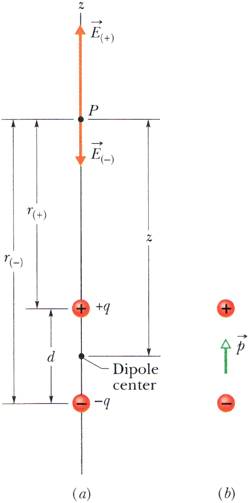
22dipole2.jpg


But shouldn't the equation be:
\frac{kq}{(z-d)^{2}} - \frac{kq}{z^{2}}

??

In my book's equation, it looks like they're just treating the two charges as if they're at the same point (the midpoint, corresponding to (1/2)d)...I know that for large z, this wouldn't matter much, but still, what if you want small z...
 
Last edited:
Physics news on Phys.org
You have misunderstood the position of the origin. z=0 is between the charges (the dot).
 
torquil said:
You have misunderstood the position of the origin. z=0 is between the charges (the dot).

Oh! wow I am stupid thanks lol
 

Similar threads

  • · Replies 1 ·
Replies
1
Views
2K
  • · Replies 21 ·
Replies
21
Views
2K
  • · Replies 1 ·
Replies
1
Views
2K
  • · Replies 3 ·
Replies
3
Views
716
  • · Replies 4 ·
Replies
4
Views
1K
  • · Replies 3 ·
Replies
3
Views
1K
  • · Replies 11 ·
Replies
11
Views
4K
  • · Replies 6 ·
Replies
6
Views
2K
  • · Replies 2 ·
Replies
2
Views
2K
  • · Replies 16 ·
Replies
16
Views
2K