Derive Fresnel's Equations for Parallel Incidence using Maxwell's BC's

Click For Summary
SUMMARY

The forum discussion focuses on deriving Fresnel's equations for parallel incidence using Maxwell's boundary conditions. The user meticulously applies the boundary conditions, particularly emphasizing the continuity of the tangential components of the electric field, represented as $$\sqrt{\mu_i \epsilon_i} \left[ \frac{1}{k_i} \left(\vec{B_i} \times \vec{k_i} \right) + \frac{1}{k_r} \left(\vec{B_r} \times \vec{k_r} \right) \right] \times \hat{n} = \sqrt{\mu_t \epsilon_t} \left[ \frac{1}{k_t} \left( \vec{B_t} \times \vec{k_t} \right)\right] \times \hat{n}$$. The derived equations for parallel polarization are $$\left(\frac{E_r}{E_i} \right)_{parallel} = \frac{\eta_t \cos \theta_t - \eta_i \cos \theta_i}{ \eta_i \cos \theta_i + \eta_t \cos \theta_t}$$ and $$\left( \frac{E_t}{E_i} \right)_{parallel} = \frac{2 \eta_t \cos \theta_t}{\eta_i \cos \theta_i + \eta_t \cos \theta_t}$$. The user expresses confusion regarding the appearance of cross terms in the equations and seeks clarification on the derivation process.

PREREQUISITES
  • Understanding of Maxwell's equations, particularly boundary conditions.
  • Familiarity with electromagnetic wave propagation and polarization.
  • Knowledge of vector calculus, specifically cross products and dot products.
  • Basic concepts of optics, including indices of refraction and Fresnel's equations.
NEXT STEPS
  • Study the derivation of Fresnel's equations for perpendicular incidence to compare methodologies.
  • Explore the implications of assuming non-magnetic materials in electromagnetic wave equations.
  • Learn about the physical significance of cross terms in wave equations and their derivations.
  • Investigate the application of boundary conditions in different geometrical configurations of wave propagation
PhDeezNutz
Messages
851
Reaction score
561
Homework Statement
Derive Fresnels equation for Parallel Incidence using Maxwell's Boundary Conditions
Relevant Equations
Maxwell's BC's say the tangential component of field must be continuous across the interface $$\sqrt{\mu_i \epsilon_i} \left[ \frac{1}{k_i} \left(\vec{B_i} \times \vec{k_i} \right) + \frac{1}{k_r} \left(\vec{B_r} \times \vec{k_r} \right) \right] \times \hat{n} = \sqrt{\mu_t \epsilon_t} \left[ \frac{1}{k_t} \left( \vec{B_t} \times \vec{k_t} \right)\right] \times \hat{n}$$

The correct equations taken from wikipedia are pictured in my attempt at a solutions
I'd first like to preface this post with the "right answer" per wikipedia (I've seen the same answer elsewhere on more reputable websites)
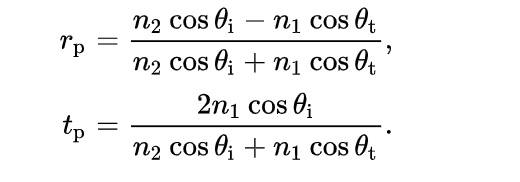
Image 9-18-19 at 1.59 PM.jpg
The thing I find trouble some is the cross terms such as ##n_2 \cos \theta_i## where indices of refraction are "mixed with the other angle".

I have meticulously applied Maxwell's boundary conditions namely that the tangential components of $\vec{E}$ must be continuous across the boundary. I'm positing that ##\frac{B_r}{B_i} = \frac{E_r}{E_i}## since to my knowledge their magnitudes are always related by constants.
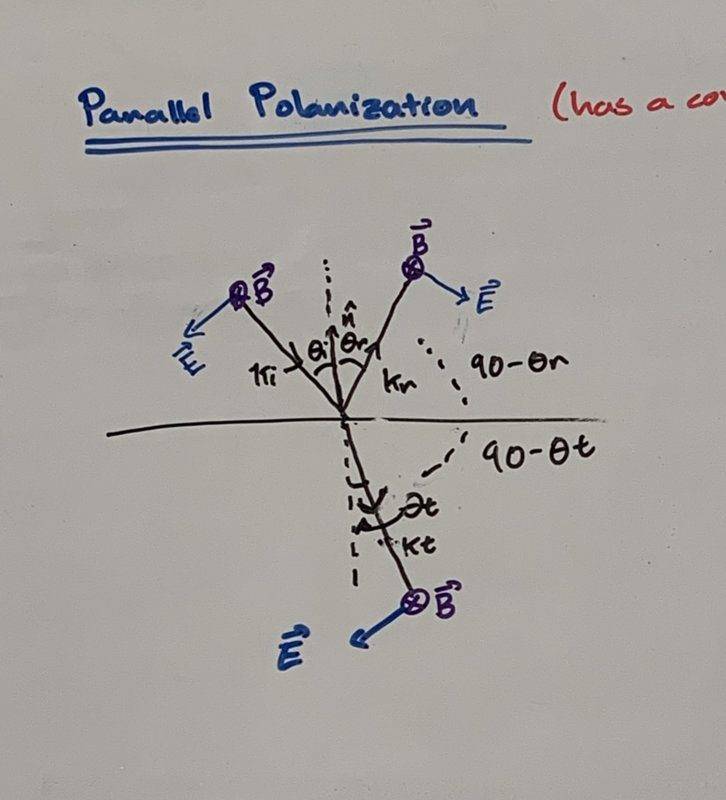
fullsizeoutput_136a.jpeg


the aforementioned Boundary Condition can be expressed as the following in terms of ##\vec{B}$ and $\vec{k}##;

$$\sqrt{\mu_i \epsilon_i} \left[ \frac{1}{k_i} \left(\vec{B_i} \times \vec{k_i} \right) + \frac{1}{k_r} \left(\vec{B_r} \times \vec{k_r} \right) \right] \times \hat{n} = \sqrt{\mu_t \epsilon_t} \left[ \frac{1}{k_t} \left( \vec{B_t} \times \vec{k_t} \right)\right] \times \hat{n}$$Using the vector identity

$$\left( \vec{B} \times \vec{k} \right) \times \hat{n} = - \left( \vec{k} \times \vec{B} \right) \times \hat{n} = -\left( \hat{n} \cdot \vec{k} \right) \vec{B} + \left( \hat{n} \cdot \vec{B} \right)\vec{k} = -\left( \hat{n} \cdot \vec{k} \right) \vec{B}$$

(since the magnetic field is orthogonal to the normal)

I'm going to do this term by term while paying close attention to the geometry

$$\frac{\sqrt{\mu_i \epsilon_i}}{k_i}\left( \vec{B_i} \times \vec{k_i} \right) \times \hat{n} = - \frac{\sqrt{\mu_i \epsilon_i}}{k_i} \left( \hat{n} \cdot \vec{k_i} \right) \vec{B_i} = - \frac{\sqrt{\mu_i \epsilon_i}}{k_i} k_i \cos \left( \pi - \theta_i\right) \vec{B_i} = \sqrt{\mu_i \epsilon_i} \cos \theta_i \vec{B_i}$$

$$\frac{\sqrt{\mu_i \epsilon_i}}{k_r}\left( \vec{B_r} \times \vec{k_r} \right) \times \hat{n} = - \frac{\sqrt{\mu_i \epsilon_i}}{k_r} \left( \hat{n} \cdot \vec{k_r} \right) \vec{B_r} = - \sqrt{\mu_i \epsilon_i} \cos \theta_r \vec{B_r}$$

$$\frac{\sqrt{\mu_t \epsilon_t}}{k_t}\left( \vec{B_t} \times \vec{k_t} \right) \times \hat{n} = - \frac{\sqrt{\mu_t \epsilon_t}}{k_t} \left( \hat{n} \cdot \vec{k_t} \right) \vec{B_t} = - \frac{\sqrt{\mu_t \epsilon_t}}{k_t} k_t \cos \left( \pi - \theta_t\right) \vec{B_t} = \sqrt{\mu_t \epsilon_t} \cos \theta_t \vec{B_t}$$

After invoking ##\theta_i = \theta_r## and ##\vec{B_i} + \vec{B_r} = \vec{B_t}## we have

$$\sqrt{\mu_i \epsilon_i} \cos \theta_i \vec{B_i} - \sqrt{\mu_i \epsilon_i} \cos \theta_i \vec{B_r} = \sqrt{\mu_t \epsilon_t} \cos \theta_t \vec{B_i} + \sqrt{\mu_t \epsilon_t} \cos \theta_t \vec{B_r}$$

Collecting like terms of $\vec{B_i}$ on one side and $\vec{B_r}$ on the other we have

$$- \left[ \sqrt{\mu_i \epsilon_i} \cos \theta_i + \sqrt{\mu_t \epsilon_t} \cos \theta_t \right] \vec{B_r} = \left[ \sqrt{\mu_t \epsilon_t} \cos \theta_t - \sqrt{\mu_i \epsilon_i} \cos \theta_i \right] \vec{B_i}$$

Taking the dot product of each side with itself

$$\left( \sqrt{\mu_i \epsilon_i} \cos \theta_i + \sqrt{\mu_t \epsilon_t} \cos \theta_t\right)^2 B_r^2 = \left( \sqrt{\mu_t \epsilon_t} \cos \theta_t - \sqrt{\mu_i \epsilon_i} \cos \theta_i \right)^2 B_i^2$$

After taking

(1) Dividing and taking the square root of the previous line

(2) Invoking the assumption that ##\frac{B_r}{B_i} = \frac{E_r}{E_i}##

(3) Using ##\eta = \sqrt{\mu \epsilon}##

(4) Using ##\frac{E_t}{E_r} = 1 + \frac{E_r}{E_i}##

We find the Fresnel equations for parallel polarization are

$$\left(\frac{E_r}{E_i} \right)_{parallel} = \frac{\eta_t \cos \theta_t - \eta_i \cos \theta_i}{ \eta_i \cos \theta_i + \eta_t \cos \theta_t}$$

$$\left( \frac{E_t}{E_i} \right)_{parallel} = \frac{2 \eta_t \cos \theta_t}{\eta_i \cos \theta_i + \eta_t \cos \theta_t}$$

My answers conflict with wikipedia which corroborates lecture notes from both Brown University and MIT, but I wasn't able to understand\follow the derivations in those notes. The most startling concern with my answer is the lack of "cross terms" such as $\eta_i \cos \theta_t$ and $\eta_t \cos \theta_i$ and the like which are present in the first picture I posted. At the same time I can't see anything wrong with my math and I can't fathom how these "cross terms" appear.

If anyone could provide helpful hints or point me in the right direction I would be greatly appreciative.
 
Physics news on Phys.org
PhDeezNutz said:
Homework Equations: Maxwell's BC's say the tangential component of field must be continuous across the interface $$\sqrt{\mu_i \epsilon_i} \left[ \frac{1}{k_i} \left(\vec{B_i} \times \vec{k_i} \right) + \frac{1}{k_r} \left(\vec{B_r} \times \vec{k_r} \right) \right] \times \hat{n} = \sqrt{\mu_t \epsilon_t} \left[ \frac{1}{k_t} \left( \vec{B_t} \times \vec{k_t} \right)\right] \times \hat{n}$$
Should the factor of ##\sqrt{\mu_i \epsilon_i}## on the left side be ##\frac{1}{\sqrt{\mu_i \epsilon_i}}##?
Similarly for the right side of the equation.
 
  • Like
Likes   Reactions: PhDeezNutz
TSny said:
Should the factor of ##\sqrt{\mu_i \epsilon_i}## on the left side be ##\frac{1}{\sqrt{\mu_i \epsilon_i}}##?
Similarly for the right side of the equation.
Thank you for responding.

Forgive me If I'm wrong, I thought the definition of ##\vec{B}## in terms of the wave-vector ##\vec{k}## was

$$\vec{B} = \frac{\sqrt{\mu \epsilon}}{k} \left( \vec{k} \times \vec{E} \right)$$

and consequently

$$ \vec{E} = \frac{\sqrt{\mu \epsilon}}{k} \left( \vec{B} \times \vec{k} \right)$$

The specific part you quoted was me trying to say that the "tangential components of ##\vec{E}## are continuous across the boundary".

Also, forgive me for jumping the gun but do you see where the so-called "cross terms" come from? I tried looking at ##\frac{E_t}{E_i} = \frac{\sqrt{\mu_i \epsilon_i} B_i}{\sqrt{\mu_t \epsilon_t} B_t}##

The best I could do was get the following

$$ \frac{E_t}{E_i} = \frac{2 \eta_i \cos \theta_i}{\eta_t \cos \theta_i + \frac{\eta_t ^2}{\eta_i} \cos \theta_t}$$

Which is "kind of like" the wikipedia answer but not quite; it has one cross term instead of the desired two cross terms.

I've been reading multiple EM and optics book and I was able to derive the case of perpendicular incidence with no problem whatsoever. I just can't get a handle on this parallel incidence case.
 
i am confused by what you are doing
firstly most of the time i think fresnel equations assume ##\mu## is the same as vacuum it is derived for non-magnetic material
second i don't understand why the parallel H field condition needs to be this complicated.
PhDeezNutz said:
Homework Statement: Derive Fresnels equation for Parallel Incidence using Maxwell's Boundary Conditions
Homework Equations: Maxwell's BC's say the tangential component of field must be continuous across the interface $$\sqrt{\mu_i \epsilon_i} \left[ \frac{1}{k_i} \left(\vec{B_i} \times \vec{k_i} \right) + \frac{1}{k_r} \left(\vec{B_r} \times \vec{k_r} \right) \right] \times \hat{n} = \sqrt{\mu_t \epsilon_t} \left[ \frac{1}{k_t} \left( \vec{B_t} \times \vec{k_t} \right)\right] \times \hat{n}$$

The correct equations taken from wikipedia are pictured in my attempt at a solutions

√μiϵi[1ki(→Bi×→ki)+1kr(→Br×→kr)]×^n=√μtϵt[1kt(→Bt×→kt)]×^n
as shown in the diagram the magnetic field is already parallel to the interface i don't understand the need for all this cross product
the condition is
##
\nabla \times \vec H = 0
##
and since the all the waves line in one plane then you get a linear equation and the fact ##\mu## is same further simplifies things. you just get
##B_i + B_r = B_t##

thirdly you only seem to use one boundary condition throughout the problem but you have two unknowns here
##
E_r and E_t
##
each of which can be related to the corresponding B using the index of refraction

so you also need to use another condition
##
\nabla \times \vec E = 0
##

i think that's way to do it it might be wrong
 
  • Like
Likes   Reactions: PhDeezNutz
timetraveller123 said:
i am confused by what you are doing
firstly most of the time i think fresnel equations assume ##\mu## is the same as vacuum it is derived for non-magnetic material
second i don't understand why the parallel H field condition needs to be this complicated.

as shown in the diagram the magnetic field is already parallel to the interface i don't understand the need for all this cross product
the condition is
##
\nabla \times \vec H = 0
##
and since the all the waves line in one plane then you get a linear equation and the fact ##\mu## is same further simplifies things. you just get
##B_i + B_r = B_t##

thirdly you only seem to use one boundary condition throughout the problem but you have two unknowns here
##
E_r and E_t
##
each of which can be related to the corresponding B using the index of refraction

so you also need to use another condition
##
\nabla \times \vec E = 0
##

i think that's way to do it it might be wrong

I'm glad you brought it up because I forgot to in my original post. You are right many of the derivations for Fresnel's equations invoke ##\mu_i = \mu_t = \mu_0## for both Perpendicular and Parallel Polarizations. However I was able to correctly derive the expression for perpendicular incidence without using that assumption. I'm hoping to do the same with Parallel Polarization.

I have two reasons for using the complicated cross product expression

1) It incorporates the index of refraction which is what the wikipedia final answer is in terms of.

2) Using the vector identity (and the picture) allows us to get rid of terms and we get a final expression of

$$\sqrt{\mu_i \epsilon_i} \cos \theta_i \vec{B_i} - \sqrt{\mu_i \epsilon_i} \cos \theta_i \vec{B_r} = \sqrt{\mu_t \epsilon_t} \cos \theta_t \vec{B_i} + \sqrt{\mu_t \epsilon_t} \cos \theta_t \vec{B_r}
$$

Are you saying this statement would have been apparent without the cross product condition? If so I don't see it.

I appear to only be using one boundary condition but I'm actually using 3 of the 4. Two of which are being implicitly assumed.

I might as well state them for completeness.

$$ \left(\vec{B_i} + \vec{B_r} \right) \cdot \hat{n} = \vec{B_t} \cdot \hat{n}$$

$$ \left(\vec{B_i} + \vec{B_r} \right) \times \hat{n} = \vec{B_t} \times\hat{n}$$

$$\sqrt{\mu_i \epsilon_i} \left[ \frac{1}{k_i} \left(\vec{B_i} \times \vec{k_i} \right) + \frac{1}{k_r} \left(\vec{B_r} \times \vec{k_r} \right) \right] \cdot \hat{n} = \sqrt{\mu_t \epsilon_t} \left[ \frac{1}{k_t} \left( \vec{B_t} \times \vec{k_t} \right)\right] \cdot \hat{n}
$$
$$\sqrt{\mu_i \epsilon_i} \left[ \frac{1}{k_i} \left(\vec{B_i} \times \vec{k_i} \right) + \frac{1}{k_r} \left(\vec{B_r} \times \vec{k_r} \right) \right] \times \hat{n} = \sqrt{\mu_t \epsilon_t} \left[ \frac{1}{k_t} \left( \vec{B_t} \times \vec{k_t} \right)\right] \times \hat{n}$$

I use the first two to substantiate ##\vec{B_i} + \vec{B_r} = \vec{B_t}## since ## \vec{B_i} + \vec{B_r} - \vec{B_t}## is both orthogonal and parallel to ##\hat{n}## meaning it could only be the zero vector.

I might try using the third boundary condition instead.
 
PhDeezNutz said:
I'm glad you brought it up because I forgot to in my original post. You are right many of the derivations for Fresnel's equations invoke μi=μt=μ0μi=μt=μ0\mu_i = \mu_t = \mu_0 for both Perpendicular and Parallel Polarizations. However I was able to correctly derive the expression for perpendicular incidence without using that assumption. I'm hoping to do the same with Parallel Polarization.
i think you would get a very similar form to this equation
1568903321618.png

but not exactly it the form is very similar except the n will be replaced with something i looked up online the derivation is the exact same
but if you want this exact equation i think you have to assume ##\mu## is same

PhDeezNutz said:
(→Bi+→Br)×^n=→Bt×^n
as you said this only holds true for the case where ##\mu ## is same everywhere
the boundary condition here is

PhDeezNutz said:
Are you saying this statement would have been apparent without the cross product condition? If so I don't see it.
yes i think you are overthinking just looking at the diagram you provided , we can see that all the ##B_i,B_r,B_t## all lie along the same line so there is no need for vector decomposition and since they are tangent to surface you don't need to do any dot or cross product just equate sum of incident and reflected with transmitted

another boundary condition is needed to solve

the four here are

##
1)\nabla . \vec D = 0\\
2)\nabla \times \vec E = 0\\
3)\nabla . \vec B = 0\\
4)\nabla \times \vec H = 0
##
the first one i think gets you Snell law
second one is the one you need to use
third one gets you 0=0
fourth one is the one you have been using so far
 
Last edited:
  • Like
Likes   Reactions: PhDeezNutz
PhDeezNutz said:
I thought the definition of ##\vec{B}## in terms of the wave-vector ##\vec{k}## was

$$\vec{B} = \frac{\sqrt{\mu \epsilon}}{k} \left( \vec{k} \times \vec{E} \right)$$
Yes. (I take it you're using Gaussian units, not SI units.)

and consequently

$$ \vec{E} = \frac{\sqrt{\mu \epsilon}}{k} \left( \vec{B} \times \vec{k} \right)$$
Here, you should have ##\frac{1}{\sqrt{\mu \epsilon}}## instead of ##\sqrt{\mu \epsilon}##.

Also, forgive me for jumping the gun but do you see where the so-called "cross terms" come from?
Making the above correction should do the job.

ASIDE: It's certainly OK to use the vector cross-product equations to express the continuity of the tangential component of ##\vec E##. But, alternately, you can see from your diagram that this continuity can be expressed simply as

##E_i \cos \theta_i - E_r \cos \theta_r = E_t \cos \theta_t##

You also have ##B_i + B_r = B_t##.

Using ##B = \sqrt{\mu \epsilon}\,E## you can write both of these expressions in terms of just the electric fields or just the magnetic fields.
 
  • Like
Likes   Reactions: PhDeezNutz
TSny said:
Yes. (I take it you're using Gaussian units, not SI units.)

Here, you should have ##\frac{1}{\sqrt{\mu \epsilon}}## instead of ##\sqrt{\mu \epsilon}##.

Making the above correction should do the job.

ASIDE: It's certainly OK to use the vector cross-product equations to express the continuity of the tangential component of ##\vec E##. But, alternately, you can see from your diagram that this continuity can be expressed simply as

##E_i \cos \theta_i - E_r \cos \theta_r = E_t \cos \theta_t##

You also have ##B_i + B_r = B_t##.

Using ##B = \sqrt{\mu \epsilon}\,E## you can write both of these expressions in terms of just the electric fields or just the magnetic fields.

I can't convince myself that ##\vec{E} = \frac{k}{\sqrt{\mu \epsilon}} \left( \vec{B} \times \vec{k} \right)##

Geometrically speaking we have the following

fullsizeoutput_136b.jpeg
 
Your diagram isn't correct. For example, if you take ##\vec E \times \vec B## according to your diagram, what do you get? Is it correct? Edit: Actually, there's nothing wrong with the diagram. It shows the correct orientation of the 3 vectors shown. But I think you are using the diagram incorrectly to get your equations in the diagram.

Also, suppose you take the magnitude of both sides of ##\vec B = \frac{\sqrt{\mu \epsilon}}{k}\left( \vec k \times \vec E\right )##. What does this imply for the relation between the magnitude of ##\vec E## and the magnitude of ##\vec B##? Then do the same for ##\vec E = \frac{\sqrt{\mu \epsilon}}{k} \left( \vec B \times \vec k \right)##.
 
  • Like
Likes   Reactions: PhDeezNutz
  • #10
TSny said:
Your diagram isn't correct. For example, if you take ##\vec E \times \vec B## according to your diagram, what do you get? Is it correct?

Also, suppose you take the magnitude of both sides of ##\vec B = \frac{\sqrt{\mu \epsilon}}{k}\left( \vec k \times \vec E\right )##. What does this imply for the relation between the magnitude of ##\vec E## and the magnitude of ##\vec B##? Then do the same for ##\vec E = \frac{\sqrt{\mu \epsilon}}{k} \left( \vec B \times \vec k \right)##.

According to my diagram ##\vec{E} \times \vec{B} = \frac{\mu \epsilon}{k} \vec{k}## is that not correct?

If we take the magnitudes of both sides of ##\vec B = \frac{\sqrt{\mu \epsilon}}{k}\left( \vec k \times \vec E\right )## we get ##B = \sqrt{\mu \epsilon} E ##

If we take magnitudes of both sides of ##\vec E = \frac{\sqrt{\mu \epsilon}}{k} \left( \vec B \times \vec k \right)## we get ##E = \sqrt{\mu \epsilon} B##oh....good point. Now I have to re-write my boundary conditions but I think it will get me somewhere.
 
  • #11
PhDeezNutz said:
oh....good point. Now I have to re-write my boundary conditions but I think it will get me somewhere.
Your starting equations will just have ##\sqrt{\mu \epsilon}## replaced by ##\frac{1}{\sqrt{\mu \epsilon}}## everywhere. So, you can just take the answer you got and make the same replacement.

PhDeezNutz said:
According to my diagram ##\vec{E} \times \vec{B} = \frac{\mu \epsilon}{k} \vec{k}## is that not correct?
This can't be correct. By definition of the cross product, ##\vec E \times \vec B## must have a result that is proportional to the magnitudes ##|\vec E|## and ##|\vec B|##.

Suppose you have three mutually perpendicular vectors ##\vec A##, ##\vec B##, and ##\vec C## such that ##\vec C = \vec A \times \vec B## as shown:
1568919564801.png

It does not follow that ##\vec B \times \vec C = \vec A##.
 
  • Like
Likes   Reactions: PhDeezNutz
  • #12
Alright @TSny I incorporated your suggestion but I also switched gears; instead of trying to prove the approximate formula on wikipedia I opted to try and prove the general formula given by Jackson's Classical Electrodynamics.

Here we go, this is going to be a long oneLet's start with a picture (thumbnail) just for completeness

fullsizeoutput_136a.jpeg

Let's also state what is supposed to be the right answer from Jackson for ##\left(\frac{E_t}{E_i} \right)_{parallel}##

$$\left(\frac{E_t}{E_i} \right)_{parallel} = \frac{2\eta_in_t \cos \theta_i}{\frac{\mu_i}{\mu_t}\eta_t^2 \cos \theta_i +\eta_i \sqrt{\eta_t^2 - \eta_i^2 \sin^2 \theta_i}} $$

My answer does not match this, my answer is

$$\frac{2 \eta_i \eta_t \cos \theta_i}{ \frac{\mu_i}{\mu_t}\eta_t^2 \cos \theta_i + \frac{\eta_t^2}{\eta_i}\sqrt{\eta_t^2 - \eta_i^2 \sin^2 \theta_i}}$$

That ##\frac{\eta_t^2}{\eta_i}## should be ##\eta_i##

Here's the work

The boundary condition I used was that the tangential components of ##\vec{E}## must be continuous across the boundary

$$ \left( \vec{E_i} + \vec{E_r}\right) \times \hat{n} = \vec{E_t} \times \hat{n} $$

In terms of ##\vec{B}## and ##\vec{k}## that is

$$\frac{1}{\sqrt{\mu_i \epsilon_i}} \left[ k_i \left( \vec{B_i} \times \vec{k_i}\right) + k_r \left( \vec{B_r} \times \vec{k_r}\right) \right] = \frac{1}{\sqrt{\mu_t \epsilon_t}} \left[ k_t \left( \vec{B_t} \times \vec{k_t} \right) \right]$$

I'm going to use the vector identity ##\left( \vec{B} \times \vec{k} \right) \times \hat{n} = - \left(\vec{k} \times \vec{B}\right) \times \hat{n} = - (\hat{n} \cdot \vec{k} ) \vec{B} + (\hat{n} \cdot \vec{B}) \vec{k} = - (\hat{n} \cdot \vec{k} ) \vec{B} ## (Since ##\vec{B}## is orthogonal to ##\hat{n}##)

Going term by term and using some geometry (translating vectors so their tales align and whatnot)

$$\frac{1}{\sqrt{\mu_i \epsilon_i}} \left[ k_i \left( \vec{B_i} \times \vec{k_i} \right) \right] \times \hat{n} = - \frac{k_i}{\sqrt{\mu_i \epsilon_i}} \left( \hat{n} \cdot \vec{k_i} \right) \vec{B_i} = \frac{k_i^2}{\sqrt{\mu_i \epsilon_i}} \cos \theta_i \vec{B_i}$$

$$\frac{1}{\sqrt{\mu_i \epsilon_i}} \left[ k_r \left( \vec{B_r} \times \vec{k_r} \right) \right] \times \hat{n} = - \frac{k_r}{\sqrt{\mu_i \epsilon_i}} \left( \hat{n} \cdot \vec{k_r} \right) \vec{B_r} = - \frac{k_r^2}{\sqrt{\mu_i \epsilon_i}} \cos \theta_i \vec{B_r}$$

$$\frac{1}{\sqrt{\mu_t \epsilon_t}} \left[ k_t \left( \vec{B_t} \times \vec{k_t} \right) \right] \times \hat{n} = - \frac{k_t}{\sqrt{\mu_t \epsilon_t}} \left( \hat{n} \cdot \vec{k_t} \right) \vec{B_t} = \frac{k_t^2}{\sqrt{\mu_i \epsilon_i}} \cos \theta_r \vec{B_r}$$

I BELIEVE AS A CONSEQUENCE OF SNELL'S LAW that ##k_i^2 = k_r^2##

So we have

$$\frac{k_i^2}{\sqrt{\mu_i \epsilon_i}} \left[ \cos \theta_i \vec{B_i} - \cos \theta_i \vec{B_r} \right] = \frac{k_t^2}{\sqrt{\mu_t \epsilon_t}} \cos \theta_t \vec{B_t}$$

By definition of the index of refraction and ##k^2## we can say ##\frac{k_i^2}{\sqrt{\mu_i \epsilon_i}} = \sqrt{\mu_i \epsilon_i} \frac{\omega_2}{c^2}## and ##\frac{k_t^2}{\sqrt{\mu_t \epsilon_t}} = \sqrt{\mu_i \epsilon_t} \frac{\omega_2}{c^2}##. Notice that ##\frac{\omega_2}{c^2}## is common to both sides so we can cancel them out and the previous equation becomes

$$\sqrt{\mu_i \epsilon_i} \left[ \cos \theta_i \vec{B_i} - \cos \theta_i \vec{B_r} \right] = \sqrt{\mu_t \epsilon_t} \cos \theta_t \vec{B_t} $$

Now I'm going to use another boundary condition, namely that the tangential components of ##\vec{H}## are continuous across the boundary ##\frac{1}{\mu_i} \left[ \vec{B_i} + \vec{B_r} \right] \times \hat{n} = \frac{1}{\mu_t} \vec{B_r} \times \hat{n} \Rightarrow \vec{B_r} = \frac{\mu_i}{\mu_t} \vec{B_t} - \vec{B_i}##. Substituting this into the previous equation and moving terms of ##\vec{B_i}## to one side and ##\vec{B_t}## to the other.

$$2 \sqrt{\mu_i \epsilon_i} \cos \theta_i \vec{B_i} = \left[ \frac{\mu_i \sqrt{\mu_i \epsilon_i}}{\mu_t} \cos \theta_i + \sqrt{\mu_t \epsilon_t} \cos \theta_t \right] \vec{B_t}$$

Taking the dot product of each side with itself and then taking the square root I get

$$\frac{B_t}{B_i} = \frac{2 \sqrt{\mu_i \epsilon_i} \cos \theta_i}{\frac{\mu_i \sqrt{\mu_i \epsilon_i}}{\mu_t} \cos \theta_i + \sqrt{\mu_t \epsilon_t} \cos \theta_t}$$Recall ##\frac{B_t}{B_i} = \frac{\sqrt{\mu_t \epsilon_t} E_t}{\sqrt{\mu_i \epsilon_i} E_i} \Rightarrow \frac{E_t}{E_i} = \frac{\sqrt{\mu_i \epsilon_i} B_t}{\sqrt{\mu_t \epsilon_t} B_i}##

So we have

$$\frac{E_t}{E_i} = \frac{2 \mu_i \epsilon_i \cos \theta_i}{\frac{\mu_i}{\mu_t} \sqrt{\mu_i \epsilon_i}\sqrt{\mu_t \epsilon_t}\cos \theta_i + \mu_t \epsilon_t \cos \theta_t}$$

Multiply by a form of one, namely ##\frac{\frac{\sqrt{\mu_t\epsilon_t}}{\sqrt{\mu_i \epsilon_i}}}{\frac{\sqrt{\mu_t \epsilon_t}}{\sqrt{\mu_i \epsilon_i}}}## and use the definition that ##\eta = \sqrt{\mu \epsilon}##

(EQUATION*)
$$\frac{2 \eta_i \eta_t \cos \theta_i}{ \frac{\mu_i}{\mu_t}\eta_t^2 \cos \theta_i + \frac{\eta_t^3}{\eta_i}\cos \theta_t}$$

Work on the term ##\frac{\eta_t^3}{\eta_i}\cos \theta_t## using Snell's Law

$$\cos \theta_t = \sqrt{1 - \sin^2 \theta_t}$$

$$\sin^2 \theta_t = \frac{\eta_i^2}{\eta_t^2} \sin^2 \theta_i =$$$$\cos \theta_t = \sqrt{1- \frac{\eta_i^2}{\eta_t^2} \sin^2 \theta_i}$$

$$\frac{\eta_t^3}{\eta_i}\cos \theta_t = \frac{\eta_t^2}{\eta_i} \sqrt{\eta_t^2 - \eta_i^2 \sin^2 \theta_i}$$

Substituting this into (EQUATION *)

We get
$$\frac{2 \eta_i \eta_t \cos \theta_i}{ \frac{\mu_i}{\mu_t}\eta_t^2 \cos \theta_i + \frac{\eta_t^2}{\eta_i}\sqrt{\eta_t^2 - \eta_i^2 \sin^2 \theta_i}}$$

As you can see I'm very close but not quite there. As mentioned earlier that ##\frac{\eta_t^2}{\eta_i}## should be ##\eta_i## I can't see where I went wrong. I fully acknowledge that this is a strenuous derivation but hopefully I made a small mistake that is easy rectifiable. Any help is greatly appreciated.
 
  • #13
PhDeezNutz said:
Here's the work

The boundary condition I used was that the tangential components of ##\vec{E}## must be continuous across the boundary

$$ \left( \vec{E_i} + \vec{E_r}\right) \times \hat{n} = \vec{E_t} \times \hat{n} $$

In terms of ##\vec{B}## and ##\vec{k}## that is

$$\frac{1}{\sqrt{\mu_i \epsilon_i}} \left[ k_i \left( \vec{B_i} \times \vec{k_i}\right) + k_r \left( \vec{B_r} \times \vec{k_r}\right) \right] = \frac{1}{\sqrt{\mu_t \epsilon_t}} \left[ k_t \left( \vec{B_t} \times \vec{k_t} \right) \right]$$
I believe you need to move ##k_i##, ##k_r##, and ##k_t## into the denominator as you had in your first post. So, it should be

$$\frac{1}{\sqrt{\mu_i \epsilon_i}} \left[ \frac{1}{k_i} \left( \vec{B_i} \times \vec{k_i}\right) +\frac{1}{ k_r} \left( \vec{B_r} \times \vec{k_r}\right) \right] = \frac{1}{\sqrt{\mu_t \epsilon_t}} \left[ \frac{1}{k_t} \left( \vec{B_t} \times \vec{k_t} \right) \right]$$
 
  • Like
Likes   Reactions: PhDeezNutz
  • #14
TSny said:
I believe you need to move ##k_i##, ##k_r##, and ##k_t## into the denominator as you had in your first post. So, it should be

$$\frac{1}{\sqrt{\mu_i \epsilon_i}} \left[ \frac{1}{k_i} \left( \vec{B_i} \times \vec{k_i}\right) +\frac{1}{ k_r} \left( \vec{B_r} \times \vec{k_r}\right) \right] = \frac{1}{\sqrt{\mu_t \epsilon_t}} \left[ \frac{1}{k_t} \left( \vec{B_t} \times \vec{k_t} \right) \right]$$

My goodness you are right, I'm making so many mathematical intuitive leaps that are wrong, thanks for being patient with me. I'll have to rewrite my boundary conditions yet again and maybe that will rectify my problem. That said I find it concerning that I got 2/3 terms right and I feel like this fix will yield a similar problem but we shall see.

Just to prove that you're right for anyone else that will read this thread

$$\vec{B} = \frac{\sqrt{\mu \epsilon}}{k} \left( \vec{k} \times \vec{E} \right) = \sqrt{\mu \epsilon} \left( \hat{k} \times \vec{E} \right) $$

Implies

$$\frac{1}{\sqrt{\mu \epsilon}} \vec{B} = \left( \hat{k} \times \vec{E} \right)$$

Now to solve for ##\vec{E}## by taking the cross product with ##\hat{k}## and using a vector identity

$$\frac{1}{\sqrt{\mu \epsilon}} \left( \vec{B} \times \hat{k} \right) = \left( \hat{k} \times \vec{E} \right) \times \hat{k} = - \left[ \hat{k} \times \left( \hat{k} \times \vec{E} \right) \right] = - \left[ \vec{E} \left( \vec{k} \cdot \vec{E} \right) - \vec{E} \left(\hat{k} \cdot \hat{k} \right) \right] = \vec{E}$$

Therefore

$$\vec{E} = \frac{1}{\sqrt{\mu \epsilon}} \left( \vec{B} \times \frac{\vec{k}}{k}\right) = \frac{1}{k \sqrt{\mu \epsilon}} \left( \vec{B} \times \vec{k} \right)$$

I will rework it and hopefully I'll get somewhere. It's hard to see how this will help me corroborate Jackson's expression but at least I will be closer to being right.

Again thanks for your help.

I'll make a post in a couple of hours.
 
  • #15
if by general case you mean for differing ##\mu## and ##\epsilon## then i suggest you don's use snell's law till the end
instead work with the boundary conditions in terms of ##\mu## and ##\epsilon##
##\nabla \times \vec H=0## is
##
\frac{B_i+B_t}{\mu_i}=\frac{B_t}{\mu_t}
##
and ##\nabla \times \vec E = 0## is the same
##(E_i-E_r)cos\theta_i=E_tcos\theta_t##

it is the exact same as before
 
  • Like
Likes   Reactions: PhDeezNutz
  • #16
timetraveller123 said:
if by general case you mean for differing ##\mu## and ##\epsilon## then i suggest you don's use snell's law till the end
instead work with the boundary conditions in terms of ##\mu## and ##\epsilon##
##\nabla \times \vec H=0## is
##
\frac{B_i+B_t}{\mu_i}=\frac{B_t}{\mu_t}
##
and ##\nabla \times \vec E = 0## is the same
##(E_i-E_r)cos\theta_i=E_tcos\theta_t##

it is the exact same as before
I think from the continuity of the normal component of ##\vec{D}## we have

$$\epsilon_i \vec{E_i} \cdot \hat {n} + \epsilon_i \vec{E_r} \cdot \hat {n} = \epsilon_t \vec{E_t} \cdot \hat{n}$$

Using some geometry, lining up vectors tail to tail and then looking at angles between them

$$\epsilon_i E_i \cos \left(\frac{\pi}{2} + \theta_i \right) + \epsilon_i E_r \cos \left( \theta_i \right) = \epsilon_t E_t \cos \left( \frac{\pi}{2} + \theta_t \right)$$

$$- \epsilon_i E_i \cos \theta_i + \epsilon_i E_r \cos \theta_i = - \epsilon_t E_t \sin \theta_t $$

I used this relation to get the answer that was in Jackson. I will upload the pictures in a follow up post. At some point I will type it all up.

Thank you both for your help.
 
  • Like
Likes   Reactions: timetraveller123
  • #17
The final formulas for perpendicular polarization are at the top of the second page. And the final formulas for parallel polarization are at the bottom of the fourth page.

Without a loss of generality.

Eat your heart out Jackson. All joking aside I understand that If he went into that much detail for each derivation the book would be 10x as long...but this derivation was not as trivial as he let's on.
fullsizeoutput_137e.jpeg


fullsizeoutput_137c.jpeg


fullsizeoutput_137f.jpeg


xx0VNcX8TCSmMaiXlAJgUg.jpg
 
  • Like
Likes   Reactions: timetraveller123
  • #18
what i was saying is that it need not to be this long

##
\frac{B_i+B_r}{\mu_i}=\frac{B_t}{\mu_T}\\
\frac{E_i+E_r}{\mu_i c_i}=\frac{E_t}{\mu_t c_t} ---- (1)\\
(E_i-E_r)cos \theta_i = (E_t cos \theta_t) ---(2)
##
solving 1 and 2 you get the answer
adding 1*##(\mu_i c_i)## with 2/##cos \theta_i## you get
##
2E_i= E_t(\frac{\mu_i c_i}{\mu_t c_t} + \frac{cos \theta_t}{cos\theta_i})
##
and you have expressed ##E_t## in terms of ##E_i## you just need to shift and apply snell law and you get the expression
to get ##E_r## just plug it back into 1 or 2

while your method certainly works i still feel that the vectors and cross product made it much longer that it needed to be and was a overkill.
the B field was aligned to begin with so that gave a nice linear equation and only the curl of E=0 condition needed some decomposition but even it could have been gotten with some basic trigo.
just my two cents.
 
  • #19
timetraveller123 said:
what i was saying is that it need not to be this long

##
\frac{B_i+B_r}{\mu_i}=\frac{B_t}{\mu_T}\\
\frac{E_i+E_r}{\mu_i c_i}=\frac{E_t}{\mu_t c_t} ---- (1)\\
(E_i-E_r)cos \theta_i = (E_t cos \theta_t) ---(2)
##
solving 1 and 2 you get the answer
adding 1*##(\mu_i c_i)## with 2/##cos \theta_i## you get
##
2E_i= E_t(\frac{\mu_i c_i}{\mu_t c_t} + \frac{cos \theta_t}{cos\theta_i})
##
and you have expressed ##E_t## in terms of ##E_i## you just need to shift and apply snell law and you get the expression
to get ##E_r## just plug it back into 1 or 2

while your method certainly works i still feel that the vectors and cross product made it much longer that it needed to be and was a overkill.
the B field was aligned to begin with so that gave a nice linear equation and only the curl of E=0 condition needed some decomposition but even it could have been gotten with some basic trigo.
just my two cents.

I actually see that now lol. Maybe I’ll try it again using your suggestion at some later time. Again, thank you for your help.
 

Similar threads

  • · Replies 7 ·
Replies
7
Views
3K
  • · Replies 9 ·
Replies
9
Views
2K
  • · Replies 7 ·
Replies
7
Views
2K
  • · Replies 3 ·
Replies
3
Views
2K
  • · Replies 1 ·
Replies
1
Views
3K
  • · Replies 6 ·
Replies
6
Views
4K
  • · Replies 4 ·
Replies
4
Views
3K
Replies
1
Views
2K
  • · Replies 3 ·
Replies
3
Views
2K
  • · Replies 1 ·
Replies
1
Views
2K