TonyV
Two small blocks, each of mass m, are connected by a string of constant length 4h and negligible mass. Block A is placed on a very rough tabletop as shown below, and block B hangs over the edge of the table. The tabletop is a distance 2h above the floor. Block A is then released from rest at a distance h above the floor at time t = 0 and the system begins to move. The coefficient of kinetic friction is μk.
Express all algebraic answers in terms of μk, h, m1, m2, , and g.
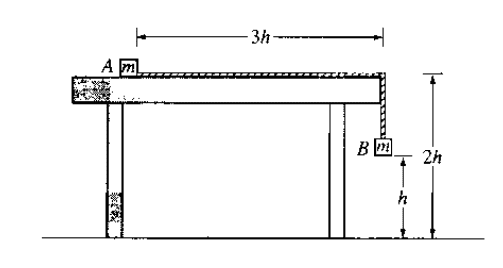
A) Write equations for the sum of forces in both directions.
From what I understand, the sum of all forces would be ΣF = (sum of forces) = ma.
B) Derive an equation for the acceleration of block B as it descends.
I thoughtlessly did this without accounting for friction and ended up with g/2. I did a similar problem for homework and was used that information to come up with this equation for acceleration... However, I am unsure of whether or not I am on the right path.
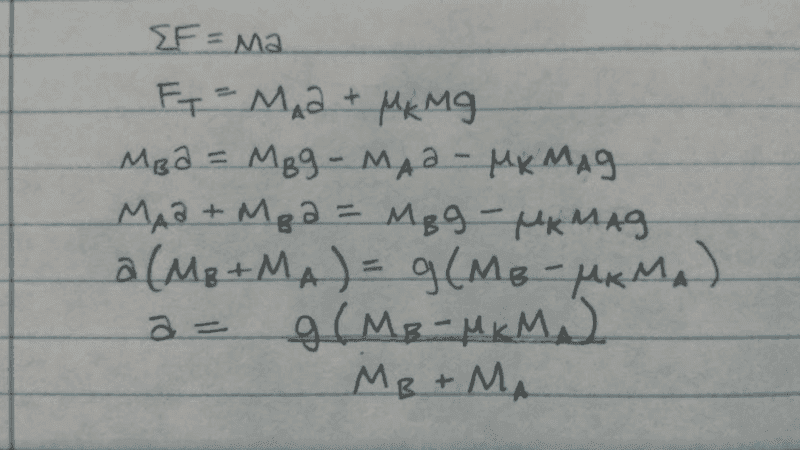
I would end up with variables canceling out in the final equation, correct??
C) Block B strikes the floor and does not bounce. Determine the time t at which block B strikes the floor.
For this I ended up with 2√h/g. However, since I got this equation by substituting acceleration with the equation from the previous step (g/2) in h=½at^2. I am unsure of how to proceed until I am certain of what I need to use for acceleration to solve for time.
I am grateful for any assistance and/or suggestions. I love physics but still have much to learn! However, I want to understand as much as possible.

Express all algebraic answers in terms of μk, h, m1, m2, , and g.
A) Write equations for the sum of forces in both directions.
From what I understand, the sum of all forces would be ΣF = (sum of forces) = ma.
B) Derive an equation for the acceleration of block B as it descends.
I thoughtlessly did this without accounting for friction and ended up with g/2. I did a similar problem for homework and was used that information to come up with this equation for acceleration... However, I am unsure of whether or not I am on the right path.
I would end up with variables canceling out in the final equation, correct??
C) Block B strikes the floor and does not bounce. Determine the time t at which block B strikes the floor.
For this I ended up with 2√h/g. However, since I got this equation by substituting acceleration with the equation from the previous step (g/2) in h=½at^2. I am unsure of how to proceed until I am certain of what I need to use for acceleration to solve for time.
I am grateful for any assistance and/or suggestions. I love physics but still have much to learn! However, I want to understand as much as possible.
Attachments


