Deriving the 1-D Linear Convection Equation

Click For Summary
SUMMARY

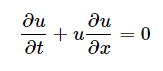
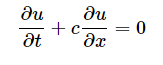
The discussion focuses on the derivation of the 1-D Linear Convection Equation from the 1-D Navier-Stokes equations under the assumptions of inviscid flow, no pressure gradient, and no body forces. The key point is the linearization process, where the velocity term is expressed as a sum of a constant velocity, u0, and a small perturbation, u'. The equation transitions from a nonlinear form, $$\frac {\partial u} {\partial t} + u \frac {\partial u} {\partial x} = 0$$, to a linear form, $$\frac {\partial u'} {\partial t} + u_0 \frac {\partial u'} {\partial x} = 0$$. The discussion emphasizes the importance of understanding why only one instance of the velocity term is replaced during this process.

PREREQUISITES
  • Understanding of 1-D Navier-Stokes equations
  • Familiarity with linearization techniques in fluid dynamics
  • Knowledge of perturbation methods
  • Basic grasp of inviscid flow concepts
NEXT STEPS
  • Study the derivation of the 1-D Navier-Stokes equations
  • Learn about linearization techniques in fluid dynamics
  • Research perturbation methods in fluid mechanics
  • Explore the implications of inviscid flow on convection equations
USEFUL FOR

Students and professionals in fluid dynamics, particularly those focusing on convection phenomena, as well as researchers interested in the mathematical modeling of fluid flow.

Mr_Acceleration
Messages
3
Reaction score
0
With the assumptions of Inviscid flow, no pressure gradient and no body force terms in 1-D Navier Stokes becomes 1-D nonlinear convection equation;
sadasd.png

And if we assume velocity of wave propagation is constant value c, equation becomes 1-D linear convection equation;
sadasd.png

This is online derivation and my question is why only the u value outside of partial derivatives is replaced with c? we have 3 u term there. I was thinking they were all same term. So why do we only replace one of them?
 
Engineering news on Phys.org
I don't think this is correct. Can you please provide the full derivation ?
 
dRic2 said:
I don't think this is correct. Can you please provide the full derivation ?
123.png

Here is the derivation.
 
This is correct so far. The problem is this:

Mr_Acceleration said:
And if we assume velocity of wave propagation is constant value c, equation becomes 1-D linear convection equation;

This is not. That's why I'd like a full derivation.

Anyway the reasoning is the following:
$$ \frac {\partial u} {\partial t} + u \frac {\partial u} {\partial x} = 0$$
is NON-linear. What you usually do is linearize it, by writing ##u = u_0 + u'## where ##u_0## is an unperturbed constant velocity and ##u'## is a small perturbation. If you substitute into the diff equation ##\frac {\partial u_0} {\partial t} = \frac {\partial u_0} {\partial x} = 0## because ##u_0## is a constant. You finally end up with
$$ \frac {\partial u'} {\partial t} + u_0 \frac {\partial u'} {\partial x} = 0$$
 
  • Like
Likes   Reactions: SCP and Mr_Acceleration
Thank you for your answer. I didn't know about this. Now i will search linearization with pertubation.
 

Similar threads

  • · Replies 4 ·
Replies
4
Views
6K
  • · Replies 3 ·
Replies
3
Views
1K
Replies
3
Views
2K
Replies
33
Views
4K
  • · Replies 5 ·
Replies
5
Views
5K
  • · Replies 51 ·
2
Replies
51
Views
9K
  • · Replies 18 ·
Replies
18
Views
2K
  • · Replies 1 ·
Replies
1
Views
2K
  • · Replies 12 ·
Replies
12
Views
10K
  • · Replies 4 ·
Replies
4
Views
2K