Deriving the differential equation for the underdamped case

Click For Summary
SUMMARY

The discussion centers on deriving the differential equation for the underdamped case in oscillatory systems. The formula for underdamped oscillation is expressed as λ = -γ ± sqrt(γ² - ω²), leading to the solution x(t) = Ae^(-γx)[e^(i(θ+ωx)) + e^(-i(θ+ωx))]. Participants note that the complex components cancel, leaving a real part that should yield x(t) = Ae^(-γx)2cos(θ+ωx). The conclusion is that the teacher's solution omits a critical factor of 2 in the final expression.

PREREQUISITES
  • Understanding of differential equations
  • Familiarity with complex numbers and their properties
  • Knowledge of oscillatory motion and damping
  • Basic grasp of exponential functions and trigonometric identities
NEXT STEPS
  • Study the derivation of the differential equation for damped harmonic oscillators
  • Explore the properties of complex conjugates in oscillatory systems
  • Learn about the role of damping in mechanical and electrical oscillators
  • Investigate the application of trigonometric identities in simplifying oscillatory equations
USEFUL FOR

Students and professionals in physics, particularly those focusing on mechanics and wave phenomena, as well as educators teaching differential equations and oscillatory motion.

Tony Hau
Messages
107
Reaction score
30
The formula for general oscillation is:
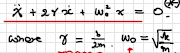
1586875856916.png

The formula for underdamping oscillation is:

1586875210286.png

where λ = -γ +- sqart(γ^2 - ω^2), whereas A+ and A- , as well as λ+ and λ-, are complex conjugates of each other.

After some operations, we get:
x(t) = Ae^(-γx)[e^i(θ+ωx) +e^-i(θ+ωx)], where A is the modulus of A+ and A-.

The notes of my teacher give the answer as

1586875556072.png


Obviously, the complex part of e^i(θ+ωx) and e^-i(θ+ωx) cancells each other. However, the real part of the two expressions is the same. So, why isn't the final answer of x(t) Ae^(-γx)2cos(θ+ωx)?
 

Attachments

  • 1586875884559.png
    1586875884559.png
    1.6 KB · Views: 287
  • 1586875891728.png
    1586875891728.png
    1.6 KB · Views: 270
Physics news on Phys.org
The solution given by my teacher indeed misses a factor of 2. My guess is correct.
 

Similar threads

  • · Replies 6 ·
Replies
6
Views
3K
  • · Replies 2 ·
Replies
2
Views
3K
  • · Replies 2 ·
Replies
2
Views
3K
  • · Replies 4 ·
Replies
4
Views
2K
  • · Replies 3 ·
Replies
3
Views
2K
  • · Replies 1 ·
Replies
1
Views
3K
  • · Replies 5 ·
Replies
5
Views
2K
  • · Replies 1 ·
Replies
1
Views
2K
  • · Replies 1 ·
Replies
1
Views
3K