Deriving the magnitude range of the force F for which van does not tip over

Click For Summary
SUMMARY

The discussion centers on determining the conditions under which a van does not tip over when subjected to a horizontal force F. Participants clarify that the normal reaction forces on the wheels can be treated as equal, enabling the calculation of frictional forces and torques. The key insight is that the sum of frictional torques must equal zero to maintain stability, and the analysis should consider the effects of varying the force F. The conversation emphasizes the importance of visualizing the forces and moments acting on the center of mass (COM) to derive the magnitude range of F accurately.

PREREQUISITES
  • Understanding of normal reaction forces in mechanics
  • Familiarity with torque and its role in rotational equilibrium
  • Knowledge of center of mass (COM) concepts
  • Basic principles of friction and its application in stability analysis
NEXT STEPS
  • Study the principles of static equilibrium in rigid bodies
  • Learn about calculating torques in mechanical systems
  • Explore the effects of applied forces on the stability of vehicles
  • Investigate the role of friction in preventing tipping and sliding
USEFUL FOR

Students and professionals in mechanical engineering, physics enthusiasts, and anyone interested in vehicle dynamics and stability analysis.

anmsstu
Messages
2
Reaction score
0
Homework Statement
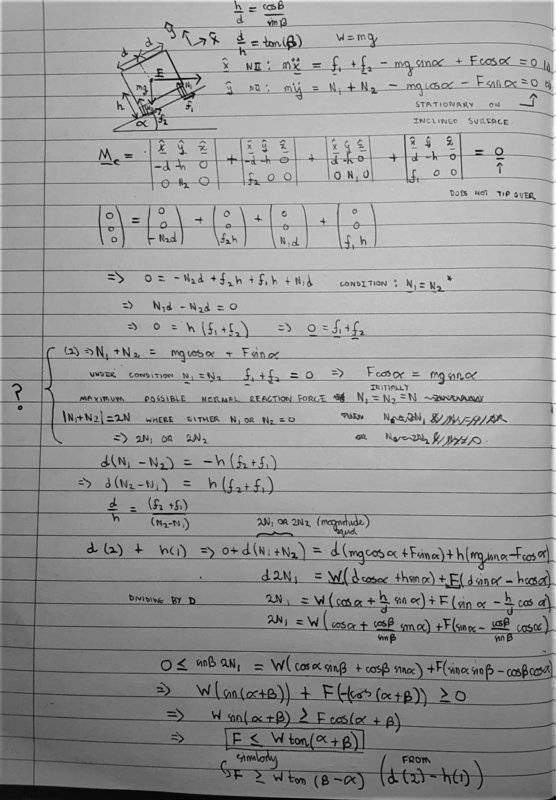
The van is on an inclined plane (inclined by angle α) and has weight W. Wheels are distance 2d apart, COM is vertical distance h from inclined plane surface and parallel-to-plane distance d from both wheels and horizontal force acts through C. The van is stationary.

The first part of the question assumes both normal reaction forces on the wheels are equal and thus by taking the moment about COM the sum of frictional forces is zero.

The problem (second part of the question) asks to show for F such that van doesn't tip over :
W*tan⁡(β-α) ≤ F ≤ W*tan⁡(α+β) with tan⁡(β)=d/h, W = mg
where normal reaction forces on wheels are not necessarily equal.
Relevant Equations
tan⁡(β)=d/h
M = r×F
Okay so I'm not quite sure about the normal reaction forces. The condition is that they are both equal for the sum of frictional forces to be zero but then technically when substituting into the number equations in place of [ n(1) + n(2) ] either 2n(1) or 2n(2) makes me confused as then n(1) does not equal n(2) which would mean you cannot get rid of f(1) + f(2)? Unless f(1) + f(2) = 0 in all cases where van doesn't tip over. But then wouldn't that imply that if we have 2n(1) or 2n(2) then it will tip over? But this is the correct approach supposedly. Also I'm guessing 2n(`1) and 2n(2) are like the extremes of normal contact force at one wheel or the other which enable you to find the range for magnitude of F. I don't think I understand.
PLAS (2).jpg
 
Physics news on Phys.org
anmsstu said:
COM is vertical distance h from inclined plane surface.
I think you mean it is the distance from the surface, not the vertical distance from it.
anmsstu said:
The first part of the question assumes both normal reaction forces on the wheels are equal and thus by taking the moment about COM the sum of frictional forces is zero.
It took me a while to realize you had left out of the problem statement that there is a horizontal force F applied at the COM; centrifugal perhaps.
I think you mean the sum of frictional torques is zero. The forces would be equal and opposite.

It will be a lot simpler if you consider the two cases separately. When F is weak, which way might it tip? What do you know about the normal forces when about to tip?

By the way, your diagram is a bit misleading for the purposes of the left hand inequality. The vertical through C should be to the left of the leftward wheel.
 
Last edited:
  • Like
Likes   Reactions: anmsstu
haruspex said:
I think you mean the sum of frictional torques is zero. The forces would be equal and opposite.
Ah yeah ofc! : 0 Okay now I can visualise it and see that it's not dependent on the normal reaction forces being equal. Thank You :)
 

Similar threads

  • · Replies 7 ·
Replies
7
Views
3K
  • · Replies 21 ·
Replies
21
Views
2K
Replies
3
Views
885
Replies
6
Views
4K
  • · Replies 21 ·
Replies
21
Views
2K
  • · Replies 12 ·
Replies
12
Views
4K
  • · Replies 20 ·
Replies
20
Views
5K
  • · Replies 3 ·
Replies
3
Views
2K
  • · Replies 24 ·
Replies
24
Views
3K
  • · Replies 21 ·
Replies
21
Views
3K