mse14
- 1
- 0
- Homework Statement
- Recursive formulae and total probability
- Relevant Equations
- Consider two jars, each initially containing an equal number of balls. We perform four successive ball exchanges. In each exchange, we pick simultaneously and at random a ball from each jar and move it to the other jar. Let ##p_{i,n−i}(k)## denote the probability that after ##k## exchanges, a jar will contain ##i## balls that started in that jar and ##n−i## balls that started in the other jar. Suppose we want to find ##p_{n, 0}(4).## We argue recursively, using the total probability theorem. We have
##p_{n, 0}(4) = \frac 1n \cdot \frac 1n \cdot p_{n - 1, 1}(3), ##
## p_{n - 1, 1}(3) = p_{n, 0}(2) + 2 \cdot \frac{n - 1}{n} \cdot \frac 1n \cdot p_{n - 1, 1}(2) + \frac 2n \cdot \frac 2n \cdot p_{n - 2, 2}(2), ##
## p_{n, 0}(2) = \ldots ##
## \ldots##
I am only interested in the verbal descriptions of ##p_{n, 0}(4), \ p_{n - 1, 1}(3)##.
The right hand side of ##p_{n, 0}(4)## describes the probability of choosing one ball from one jar and the probability of choosing one ball from another jar and the probability of one of the jars containing ##n-1## original balls together with a ball from the other jar. Is that correct?
For ##p_{n - 1, 1}(3)## we need the total probability law.
In pictorial form, the total probability law looks like this below:
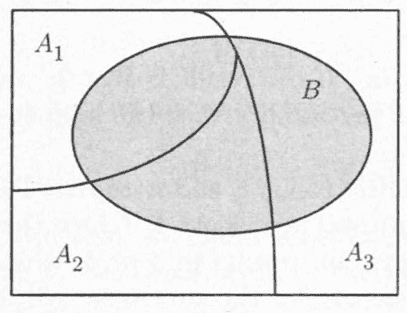
Using the notation from the pic above, we have ##p(A_1) = p_{n, 0}(2), \ p(A_2) = p_{n-1, 1}(2), \ p(A_3) = p_{n-2, 2}(2)##. Assuming that's correct, what's ##B## here? Do we have two values for ##B##, namely,##2 \cdot \frac {n-1}{n} \cdot \frac 1n## and ##\frac 2n \cdot \frac 2n##? Shouldn't ##B## have only one value? Also, shouldn't ##p_{n, 0}(2)## have a coeffcient, say ##B##, according to the total probability law? Lastly, what probability does ##2 \cdot \frac {n-1}{n} \cdot \frac 1n## represent? I understand where the coefficient ##2## comes from, but not sure about the rest of the expression.
The right hand side of ##p_{n, 0}(4)## describes the probability of choosing one ball from one jar and the probability of choosing one ball from another jar and the probability of one of the jars containing ##n-1## original balls together with a ball from the other jar. Is that correct?
For ##p_{n - 1, 1}(3)## we need the total probability law.
In pictorial form, the total probability law looks like this below:
Using the notation from the pic above, we have ##p(A_1) = p_{n, 0}(2), \ p(A_2) = p_{n-1, 1}(2), \ p(A_3) = p_{n-2, 2}(2)##. Assuming that's correct, what's ##B## here? Do we have two values for ##B##, namely,##2 \cdot \frac {n-1}{n} \cdot \frac 1n## and ##\frac 2n \cdot \frac 2n##? Shouldn't ##B## have only one value? Also, shouldn't ##p_{n, 0}(2)## have a coeffcient, say ##B##, according to the total probability law? Lastly, what probability does ##2 \cdot \frac {n-1}{n} \cdot \frac 1n## represent? I understand where the coefficient ##2## comes from, but not sure about the rest of the expression.