Detecting Lorentz Force: Experiment with Strong Neodymium Magnet

Click For Summary
SUMMARY

This discussion centers on an experiment designed to detect the Lorentz force using a hollow conducting cylinder and strong neodymium magnets (N45 and N52). The experiment revealed that the expected counterclockwise current flow did not produce a detectable magnetic field within the solenoid, which consisted of 590 turns of 34 AWG wire. The user attempted to differentiate between induced electromotive force (emf) and the magnetic field produced by spiraling charges but observed no significant output changes when using a voltmeter or sensitive headphones.

PREREQUISITES
  • Understanding of Lorentz force principles
  • Familiarity with electromagnetic induction
  • Knowledge of solenoid construction and characteristics
  • Experience with measuring devices like voltmeters and sensitive headphones
NEXT STEPS
  • Investigate the principles of electromagnetic induction in detail
  • Learn about the design and optimization of solenoids for magnetic field detection
  • Research the effects of frequency on induced emf in coils
  • Explore advanced measurement techniques for detecting weak magnetic fields
USEFUL FOR

Physics students, experimental physicists, and engineers interested in electromagnetism and magnetic field detection techniques.

Samson4
Messages
242
Reaction score
15
I setup an experiment to detect a magnetic field due to the Lorentz force acting on a current. It is a hollow conducting cylinder with a magnet at one end. With current flowing in the cylinder I approach the negative end with the north pole of the magnet. Using the left hand rule I expected the current to flow in a counterclockwise spiral resulting in a magnetic field through the solenoid. The solenoid inside the cylinder should experience a changing magnetic field but this does not happen. Why is this not working? I'm using a very strong neodymium magnet.
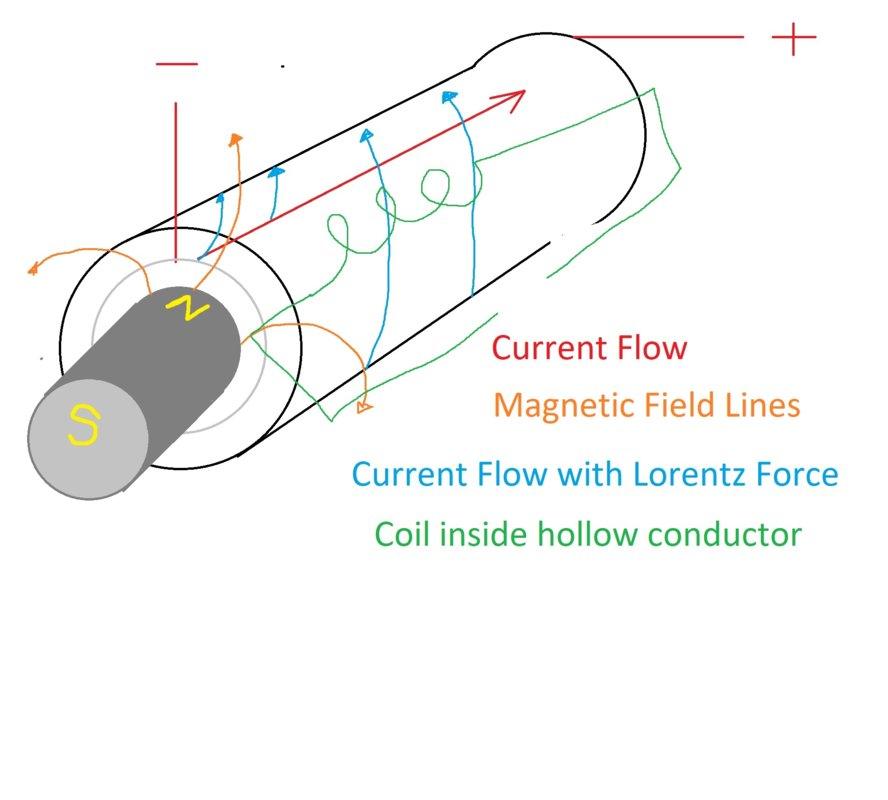
hollow conductor.jpg
 
Physics news on Phys.org
What do you think the current through the hollow cylinder does? Your drawing shows the current running parallel to the cylinder's axis. If that's the case, it provides no field inside it, so what is its purpose? What did you use to measure the effects of a changing magnetic field through the solenoid? Was it sensitive enough? In experiments of this sort, one needs not only a strong magnet, but also a solenoid of many turns, at least a few hundred. If you really are trying to measure the Lorentz force and not the induced emf, how is your setup going to achieve this goal?
 
  • Like
Likes   Reactions: Samson4
I think the current is running parallel to the axis before the lorentz force produces a spiral path in the current flow. I used a N45 and N52 neodymium magnet and got zero results. Then I used a coil of 150 turns instead of the magnet and tried a 10khz frequency to try and detect something. I was trying to measure a magnetic field propagating through the cylinder away from the end where the magnetic field is supplied. The solenoid had 590 turns of 34 awg wire. I've tried applying the magnetic field with the power on and off to be able to differentiate between induced emf and a magnetic field produced by the spiraling charges.

With the power off/on or the cylinder absent altogether; I don't notice any difference in the output of the solenoid when using a voltmeter or with the solenoid connect to a pair of sensitive headphones.
 

Similar threads

  • · Replies 10 ·
Replies
10
Views
2K
  • · Replies 5 ·
Replies
5
Views
1K
  • · Replies 6 ·
Replies
6
Views
2K
  • · Replies 8 ·
Replies
8
Views
2K
  • · Replies 2 ·
Replies
2
Views
2K
  • · Replies 4 ·
Replies
4
Views
10K
  • · Replies 61 ·
3
Replies
61
Views
5K
  • · Replies 20 ·
Replies
20
Views
2K
Replies
9
Views
3K
  • · Replies 42 ·
2
Replies
42
Views
3K