Determinant of functional derivative operator in QFT

2 replies · 2K views · last reply
paralleltransport
Messages
128
Reaction score
97
Homework Statement
This is not a homework problem.
Relevant Equations
U is a matrix element of SU(N). dU is the haar measure (left invariant measure) on the SU(N) lie group.
Hello,

I would like help to clarify what det( {\delta \over \delta J}) W(J) (equation 15.79) actually means, and why it returns a number (and not a matrix). This comes from the following problem statement (Kaku, Quantum Field Theory, a Modern Introduction)
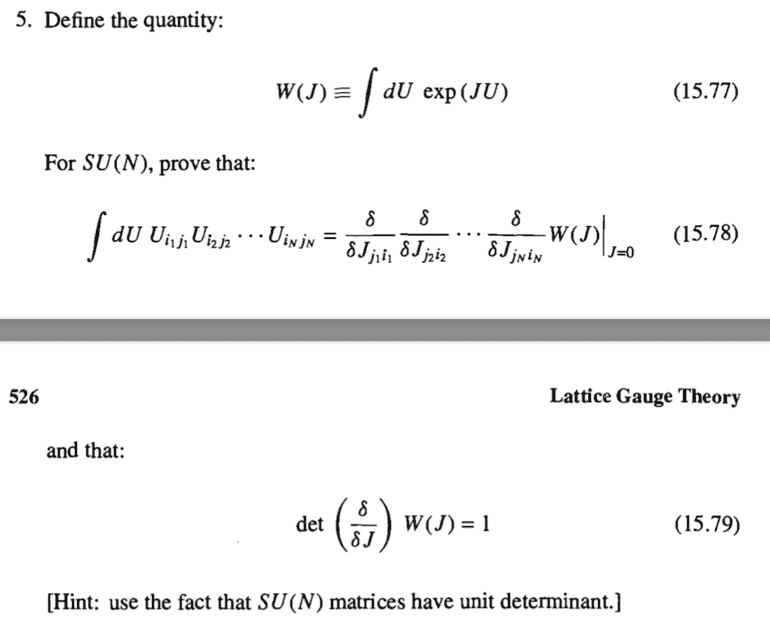
Printed textbook page showing problem 5: definition W(J) = integral dU exp(JU) (15.77), a statement for SU(N) of the integral dU U products equal to functional derivatives of W(J) at J=0 (15.78), and det(delta/delta J) W(J) = 1 (15.79) with a hint about unit determinant.


Naively, one would define det ({\delta \over \delta J}) W(J) to be the determinant of the matrix whose i, j'th element is
δWδJijδWδJij
 
paralleltransport said:
I would like help to clarify what [itex]\det(\frac{\delta }{\delta J}) W(J)[/itex].
The determinant of any [itex]n \times n[/itex] matrix (such as [itex]u[/itex] and [itex]\frac{\delta}{\delta J}[/itex]) is given by [tex]\det (M) = \frac{1}{n!} \epsilon_{i_{1} \cdots i_{n}} \ \epsilon_{j_{1} \cdots j_{n}} \ M_{i_{1}j_{1}} \ \cdots \ M_{i_{n}j_{n}} .[/tex] Now take [itex]M = u \in SU(n)[/itex] and integrate over [itex]SU(n)[/itex]: since [itex]\det (u) = 1[/itex] and the measure is normalized [itex]\int_{SU(n)} d \mu (u) = 1[/itex], you get [tex]1 = \frac{1}{n!} \epsilon_{i_{1} \cdots i_{n}} \ \epsilon_{j_{1} \cdots j_{n}} \int_{SU(n)} d \mu (u) \ u_{i_{1}j_{1}} \ \cdots \ u_{i_{n}j_{n}} ,[/tex] or [tex]1 = \left( \frac{1}{n!} \epsilon_{i_{1} \ \cdots \ i_{n}} \ \epsilon_{j_{1} \ \cdots \ j_{n}} \frac{\delta}{\delta J_{i_{1}j_{1}}} \ \cdots \frac{\delta}{\delta J_{i_{n}j_{n}}} \right) W(J) \equiv \mbox{det}(\frac{\delta}{\delta J}) W(J) .[/tex]
 
  • Like
Likes   Reactions: paralleltransport