Determine the magnetic field inside and outside the cable using Ampere's law

Click For Summary
SUMMARY

This discussion focuses on determining the magnetic field inside and outside a coaxial cable using Ampere's Law. Participants clarify that the current density, represented as J = k/r, varies with the distance from the center of the inner conductor. To find the magnetic field B inside the inner conductor, one must calculate the total current within a circular region of radius d, where d is less than or equal to the radius a of the solid inner cylinder. The integration of the current density over concentric rings is essential for accurately determining the enclosed current.

PREREQUISITES
  • Understanding of Ampere's Law and its application in electromagnetism
  • Familiarity with current density concepts, specifically J = k/r
  • Knowledge of integration techniques over circular regions
  • Basic principles of coaxial cables and their geometry
NEXT STEPS
  • Study the derivation of magnetic fields in coaxial cables using Ampere's Law
  • Learn about the mathematical integration of functions over circular areas
  • Explore the implications of varying current density in cylindrical conductors
  • Investigate practical applications of magnetic fields in electrical engineering
USEFUL FOR

Students and professionals in electrical engineering, physicists, and anyone interested in the application of Ampere's Law to real-world scenarios involving coaxial cables and magnetic fields.

Karl Karlsson
Messages
104
Reaction score
12
Homework Statement
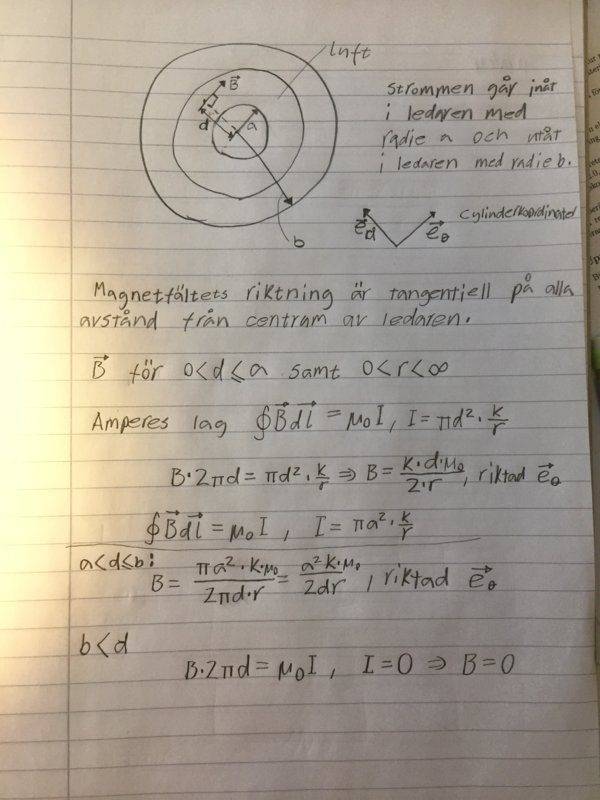
For electrical installations in homes and buildings, it is important to have control over electric and magnetic fields so that they do not disturb the environment in an undesirable way. Coaxial cables are very popular for transmitting information, they consist of an inner (circular) conductor with radius a and a thin outer conductor (shield) with radius b. Both conductors are separated by air. The inner conductor conducts a current whose current density decreases with distance, so that J(r) = k/r where k is a constant. The outer conductor conducts an equal current in the opposite direction. Determine the magnetic field inside and outside the cable.
Relevant Equations
Amperes law, definition of current density.
My attempt:
IMG_0593.jpeg


I realized after i had tried to solve the problem that the current must be constant in the cables. But no information about where the cables has radius a and b is given so how would I go about to find an expression for the current?

Thanks in advance!
 
Physics news on Phys.org
You said in the problem statement that the current density goes as k/r
integrate that wrt r in the inner cable, set that equal to total current flow in the outer THIN cable

a is the radius of a cylinder that conducts everywhere inside it - it is a SOLID cylinder
b is the radius of the larger HOLLOW cylinder.
Might want to google coaxial cable to get a picture, your drawing doesn't look to convincing,

Does this help?
 
note that in your case b=c
1583447568130.png
 
Replusz said:
You said in the problem statement that the current density goes as k/r
integrate that wrt r in the inner cable, set that equal to total current flow in the outer THIN cable
J(r) = I/A(r) is that right?
Why will integration of k/r be equal to the total current flow in the outer cable (what boundaries of integration?) or do you only mean the primitive function? Under what conditions?

Thanks!
 
In order to find ##B## inside the inner conductor, you need to be able to find the total current inside a circular region of radius ##d##, where ##d \leq a##, as shown below. Can you think of a way to do this? You have to take into account that the current density ##j## varies with distance ##r## from the center.

1583451159791.png
 
TSny said:
In order to find ##B## inside the inner conductor, you need to be able to find the total current inside a circular region of radius ##d##, where ##d \leq a##, as shown below. Can you think of a way to do this? You have to take into account that the current density ##j## varies with distance ##r## from the center.

View attachment 258193
Yeah, I know I didn't do correct at the places where you pointed out because the current must be constant, right? If the current density varies with distance then the area must also vary with distance because J(r) = I/A(r), is that not correct? The answer on your question is no, I cannot think of a way to find the current enclosed by a circular loop. How would you do it?

Thanks!
 
Have you done integrations over a circular region by breaking the region into concentric thin rings?
 
TSny said:
Have you done integrations over a circular region by breaking the region into concentric thin rings?
Yes, the expression under the integral would then be k/r * 2*pi*s*ds , but what will the upper boundary for s be? The radius of the cable can't be a everywhere since the current must be constant right?
 
Karl Karlsson said:
Yes, the expression under the integral would then be k/r * 2*pi*s*ds ,
You are letting s denote the radius of a ring. OK. The picture would then look like
1583466127586.png


But what about the value of r in your expression k/r * 2*pi*s*ds? Think about what r represents here. Is r related to s?

but what will the upper boundary for s be? The radius of the cable can't be a everywhere since the current must be constant right?
When you applied Ampere's law, you chose a circular "Amperian" path of radius d. So, in applying the law, you need to know how much current is "enclosed" by this path. Can you see what the limits of integration should be for finding the enclosed current?
 
  • #10
TSny said:
Is r related to s?
It must be in order for current to be constant.

TSny said:
When you applied Ampere's law, you chose a circular "Amperian" path of radius d. So, in applying the law, you need to know how much current is "enclosed" by this path. Can you see what the limits of integration should be for finding the enclosed current?
My answer is still no.
 
  • #11
Karl Karlsson said:
It must be in order for current to be constant.
I'm not sure what you mean by saying that the current is constant. You are given a formula for the current density J = k/r. Here, r is a variable that represents distance from the center of the inner conductor. Suppose we consider two small patches of area, shown as blue squares below
1583509538423.png


Each patch has the same area dA. Which of the two patches has more current flowing through it?

How would you express mathematically the amount of current flowing through each patch?
 
  • #12
TSny said:
I'm not sure what you mean by saying that the current is constant. You are given a formula for the current density J = k/r. Here, r is a variable that represents distance from the center of the inner conductor. Suppose we consider two small patches of area, shown as blue squares below
View attachment 258233

Each patch has the same area dA. Which of the two patches has more current flowing through it?

How would you express mathematically the amount of current flowing through each patch?
Ooh, now I see. Whoever created this problem should have formulated differently and not written that current density decreases with distance. I thought they meant decreases with distance along the length of the cable but the meant along the radius. Now I get the correct answer. Thanks!
 
  • Like
Likes   Reactions: TSny

Similar threads

Replies
10
Views
2K
  • · Replies 5 ·
Replies
5
Views
1K
  • · Replies 16 ·
Replies
16
Views
3K
  • · Replies 2 ·
Replies
2
Views
3K
Replies
4
Views
2K
  • · Replies 15 ·
Replies
15
Views
1K
Replies
6
Views
1K
  • · Replies 2 ·
Replies
2
Views
2K
  • · Replies 13 ·
Replies
13
Views
3K
  • · Replies 4 ·
Replies
4
Views
2K