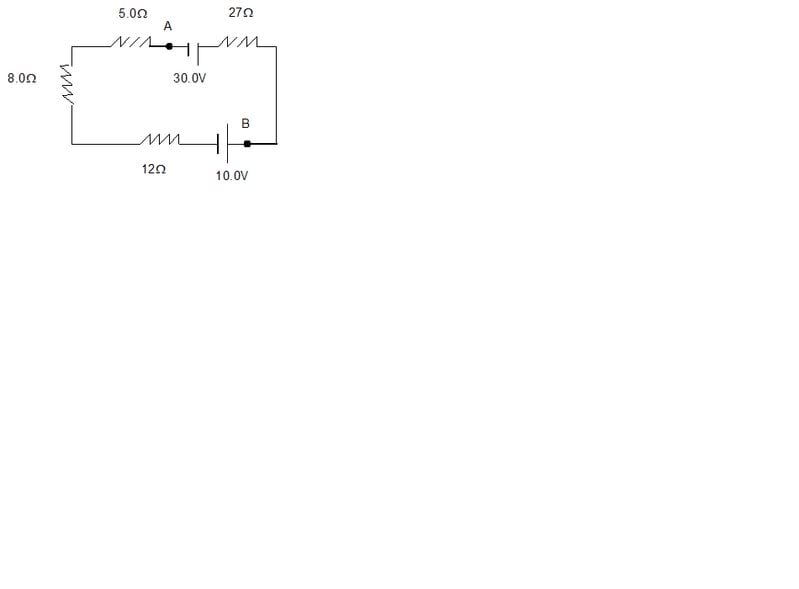
Determine the magnitude of the current in the circuit

Click For Summary
SUMMARY

The discussion focuses on calculating the current and voltage in a circuit using Ohm's Law. The current (I) is determined to be 0.3846A by applying the formula I = (30V - 10V) / (27Ω + 5Ω + 8Ω + 12Ω). The voltage between points A and B (Vab) is calculated as +19.6158V, indicating that point B is at a higher potential than point A.

PREREQUISITES
  • Understanding of Ohm's Law
  • Basic circuit analysis skills
  • Familiarity with voltage and current concepts
  • Knowledge of series circuit components
NEXT STEPS
  • Study advanced circuit analysis techniques
  • Learn about Kirchhoff's Voltage Law (KVL)
  • Explore the use of multimeters for measuring current and voltage
  • Investigate the impact of resistance on circuit performance
USEFUL FOR

Electrical engineering students, hobbyists working on circuit design, and anyone seeking to improve their understanding of basic electrical concepts.

dedra73
Messages
2
Reaction score
0
This is a problem I had for homework. I want to make sure I did it correctly.

http://i90.photobucket.com/albums/k256/dedra73/circuit-2.jpg
circuit-2.jpg


(a) Determine the magnitude of the current in the circuit and
I = (30-10)V / (27+5+8+12)Ω
=20V/52Ω
=.3846A

(b) The magnitude of the voltage between the points labeled A and B.
Vab = 30V - .3846A * 27Ω
= 30V- 10.3842V
= +19.6158V

(c) State which point, A or B, is at the higher potential.
Point B is 19.6158V higher than A
 
Last edited by a moderator:
Physics news on Phys.org
Looks good to me!
 

Similar threads

  • · Replies 10 ·
Replies
10
Views
920
  • · Replies 4 ·
Replies
4
Views
1K
  • · Replies 5 ·
Replies
5
Views
2K
  • · Replies 8 ·
Replies
8
Views
2K
Replies
16
Views
2K
  • · Replies 2 ·
Replies
2
Views
2K
  • · Replies 49 ·
2
Replies
49
Views
4K
  • · Replies 2 ·
Replies
2
Views
1K
  • · Replies 9 ·
Replies
9
Views
2K
  • · Replies 31 ·
2
Replies
31
Views
4K