Determine the maximum ratio h/b

  • Thread starter Thread starter Sanchayan Dutta
  • Start date Start date
  • Tags Tags
    Maximum Ratio
Click For Summary
SUMMARY

The discussion focuses on determining the maximum ratio $$h/b$$ for a homogeneous block sliding on an incline under the influence of a force F, with a static friction coefficient $$\mu_s$$. The translational equations established are $$F + mg\sin(\theta) \geq \mu N$$ and $$N = mg\cos(\theta)$$. The main point of contention is the application of rotational equilibrium, which can yield different results depending on whether it is applied at the center of mass or the vertex opposite to the force application. The consensus is that all relevant forces must be considered to achieve a consistent answer.

PREREQUISITES
  • Understanding of static friction and its coefficient ($$\mu_s$$)
  • Knowledge of translational and rotational dynamics
  • Familiarity with free body diagrams and equilibrium conditions
  • Basic trigonometry related to inclined planes
NEXT STEPS
  • Study the principles of rotational dynamics and equilibrium
  • Learn how to apply free body diagrams to analyze forces on inclined planes
  • Explore the effects of varying the coefficient of static friction on stability
  • Investigate the conditions for toppling versus sliding in rigid body mechanics
USEFUL FOR

Students and professionals in physics, engineering, or mechanics who are analyzing forces on inclined planes, particularly in the context of stability and motion of rigid bodies.

Sanchayan Dutta
Messages
21
Reaction score
0
Determine the maximum ratio $$h/b$$ for which the homogenous block will slide without toppling under the action of force F.The coefficient of static friction between the block and the incline is $$\mu_s$$.
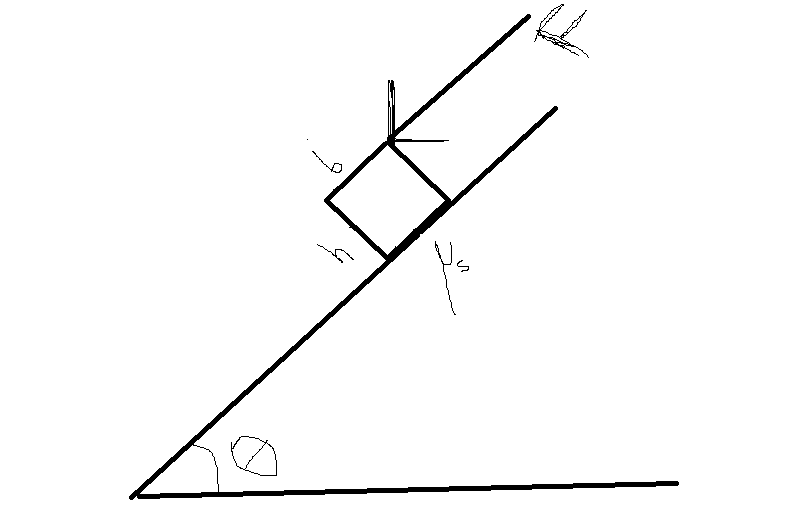
l5RXv.png

I have a doubt.About which point should the rotational equilibrium be applied?Should it be applied about centre of mass?Or should it be applied about the vertex opposite to the vertex where F is applied?Why?

**MY ATTEMPT:**

**Translational Equations**
$$F+mg\sin(\theta) \geq \mu N$$
and $$N=mgcos(\theta)$$

**Rotational Equations**
This is where I'm facing a problem.Depending upon which point the equilibrium is applied the required ratio will be obtained.

**MY VIEWS:**

Rotational equilibrium should hold at all points if no toppling/rotation happens.However the answer varies depending on the point of application of equilibrium.Strange.
 
Physics news on Phys.org
Sanchayan Dutta said:
However the answer varies depending on the point of application of equilibrium.Strange.
You are right that it would be strange. As long as you take all relevant forces into account properly, you should get the same answer. You must be making a mistake in one or other of your attempts.
Please post those attempts.
 

Similar threads

  • · Replies 48 ·
2
Replies
48
Views
10K
  • · Replies 66 ·
3
Replies
66
Views
5K
  • · Replies 4 ·
Replies
4
Views
2K
Replies
6
Views
2K
Replies
3
Views
3K
  • · Replies 9 ·
Replies
9
Views
3K
  • · Replies 4 ·
Replies
4
Views
2K
  • · Replies 6 ·
Replies
6
Views
4K
Replies
5
Views
2K