Determine whether limit is indeterminate or has a fixed value

  • Thread starter Thread starter songoku
  • Start date Start date
  • Tags Tags
    Limit Value
Click For Summary
SUMMARY

The discussion centers on identifying whether certain mathematical limits are indeterminate forms or have fixed values. Indeterminate forms include ##\frac{0}{0}##, ##\frac{\infty}{\infty}##, and ##1^{\infty}##. Specific examples provided indicate that forms like ##1^{\infty}## can lead to confusion, as they may yield a limit of 1 under certain conditions. The consensus is that while some forms always yield fixed values, others remain indeterminate depending on the context of the limit.

PREREQUISITES
  • Understanding of limits in calculus
  • Familiarity with indeterminate forms in mathematics
  • Knowledge of L'Hôpital's Rule for resolving limits
  • Basic algebraic manipulation of expressions involving infinity
NEXT STEPS
  • Study the application of L'Hôpital's Rule for resolving indeterminate forms
  • Explore the concept of limits involving exponential functions, particularly ##\lim_{x \to \infty} (1 + kx^{-1})^x##
  • Research the properties of indeterminate forms and their classifications
  • Practice solving various limit problems that involve indeterminate forms
USEFUL FOR

Students of calculus, mathematicians, and educators seeking to clarify the concept of indeterminate forms and their implications in limit calculations.

songoku
Messages
2,509
Reaction score
393
Homework Statement
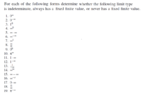
Please see below
Relevant Equations
Indeterminate forms
1665120885420.png


Indeterminate forms are: ##\frac{0}{0}, \frac{\infty}{\infty} , \infty - \infty, 0 . \infty , 1^{\infty}, 0^{0}, \infty^{0}##

My answer:
4, 9, 15, 17, 20 are inderterminate forms

1. always has a fixed finite value, which is zero

2. ##0^{-\infty}=\frac{1}{0^{\infty}}=\frac{1}{0}=\infty## so it never has a fixed finite value

3. always has a fixed finite value, which is one

5. ##\infty . \infty=\infty## so it never has a fixed finite value

6. ##\infty^{-\infty}=\frac{1}{\infty^{\infty}}=\frac{1}{\infty}=0## so it always has a fixed finite value

7. ##\infty^{1}=\infty## so it always has a fixed finite value

8. ##\frac{\infty}{0}=\infty## so it never has a fixed finite value

10. ##\pi^{\infty}=\infty## so it never has a fixed finite value

11. ##1.\infty=\infty## so it never has a fixed finite value

12. ##1^{-\infty}=\frac{1}{1^{\infty}}## , not sure about this one since ##1^{\infty}## is indeterminate form. My guess for this one is: ##\frac{1}{1^{\infty}}=\frac{1}{1}=1## so always has a fixed finite value

13. ##\frac{1}{-\infty}=0## so it always has a fixed finite value

14. ##\infty^{\infty}=\infty## so it never has a fixed finite value

16. ##\infty^{-e}=\frac{1}{\infty^{e}}=\frac{1}{\infty}=0## so it always has a fixed finite value

18. ##\frac{0}{\infty}=0## so it always has a fixed finite value

19. ##\pi^{-\infty}=\frac{1}{\pi^{\infty}}=0## so it always has a fixed finite value

Are my answers correct?

Thanks
 

Attachments

  • 1665120812389.png
    1665120812389.png
    13 KB · Views: 186
Physics news on Phys.org
Your answer to 12 is not right.
 
  • Like
Likes   Reactions: songoku
PeroK said:
Your answer to 12 is not right.
Would the answer be "indeterminate" because ##1^{\infty}## is indeterminate form?

Thanks
 
songoku said:
Would the answer be "indeterminate" because ##1^{\infty}## is indeterminate form?

Thanks
Why not?
 
PeroK said:
Why not?
I am not sure because in the explanation there is ##\lim_{x \rightarrow \infty} 1^{x} = 1## so I am confused whether it would be indeterminate form or 1
 
songoku said:
I am not sure because in the explanation there is ##\lim_{x \rightarrow \infty} 1^{x} = 1## so I am confused whether it would be indeterminate form or 1
Your confusion would be resolved if you found an example where it is not ##1##.

I fail to see how ##1^{\infty}## can be indeterminate, yet ##\dfrac 1 {1^{\infty}}## have a definite limit. That's a clear contradiction, is it not?
 
  • Like
Likes   Reactions: songoku
songoku said:
I am not sure because in the explanation there is ##\lim_{x \rightarrow \infty} 1^{x} = 1## so I am confused whether it would be indeterminate form or 1

What about \lim_{x \to \infty} (1 + kx^{-1})^x = e^{k}? Is that of the form 1^{\infty}?
 
  • Like
Likes   Reactions: songoku and SammyS
PeroK said:
Your confusion would be resolved if you found an example where it is not ##1##.
You mean the one given in post #7?

pasmith said:
What about \lim_{x \to \infty} (1 + kx^{-1})^x = e^{k}? Is that of the form 1^{\infty}?
I think I get your hint
 
Maybe a bit tricky, in that an indeterminate ##\frac {\infty}{\infty} ## may be resolved by, e.g., L' Hopital's rule.
 
  • Like
Likes   Reactions: songoku
  • #10
Thank you very much for the help and explanation PeroK, pasmith, WWGD
 

Similar threads

  • · Replies 8 ·
Replies
8
Views
2K
  • · Replies 1 ·
Replies
1
Views
2K
Replies
15
Views
2K
  • · Replies 3 ·
Replies
3
Views
1K
  • · Replies 1 ·
Replies
1
Views
1K
  • · Replies 3 ·
Replies
3
Views
2K
  • · Replies 9 ·
Replies
9
Views
2K
  • · Replies 1 ·
Replies
1
Views
2K
  • · Replies 19 ·
Replies
19
Views
2K
Replies
4
Views
2K