Calculating Tension, Moment of Inertia, and Angular Speed in a Rotating System

  • Thread starter Thread starter Ali0086
  • Start date Start date
  • Tags Tags
    Rope Tension
Click For Summary

Homework Help Overview

The discussion revolves around a physics problem involving a mass attached to a cord wrapped around a wheel, focusing on calculating tension, moment of inertia, and angular speed. The scenario includes a frictionless incline and involves concepts from dynamics and rotational motion.

Discussion Character

  • Exploratory, Conceptual clarification, Mathematical reasoning, Assumption checking

Approaches and Questions Raised

  • Participants discuss the importance of free body diagrams (FBDs) and the actual forces acting on the system, questioning the presence and role of forces in the context of the problem. There are attempts to derive equations based on Newton's laws, with some participants expressing confusion about the application of forces and acceleration.

Discussion Status

Participants are actively engaging with the problem, clarifying concepts related to forces and their representation in FBDs. Some have begun formulating equations to approach the problem, indicating a progression in understanding. However, there is no explicit consensus on the correct approach yet.

Contextual Notes

There is mention of confusion regarding the application of forces in free body diagrams and the distinction between real forces and derived quantities like m*a. Participants are also navigating the implications of the problem's setup, including the absence of friction.

Ali0086
Messages
14
Reaction score
0
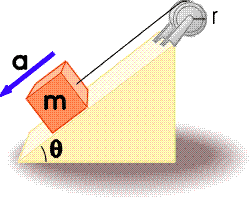
An m = 12.4kg mass is attached to a cord that is wrapped around a wheel of radius r = 10.0cm (see the figure below). The acceleration of the mass down the frictionless incline is measured to be a = 2.10m/s^2.
a) Assuming the axle of the wheel to be frictionless, and the angle to be θ = 36.2deg determine the tension in the rope.
b) Determine the moment of inertia of the wheel
c)Determine angular speed of the wheel 2.04s after it begins rotating, starting from rest.

All in all I just have a lot of trouble drawing free body diagrams and just figuring out how to approach a problem with my given set of known variables.

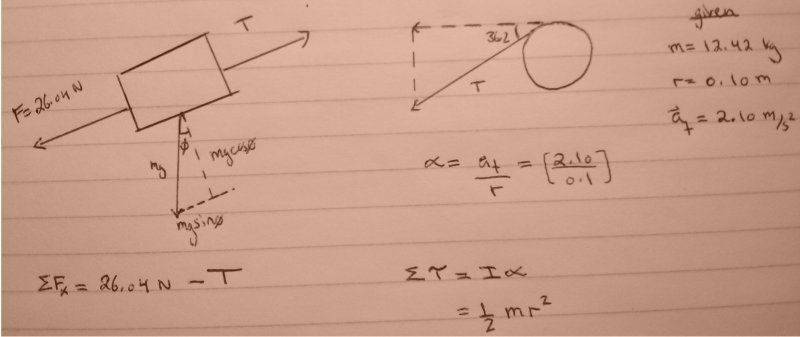
On my initial attempt for part a) I tried drawing a free body diagram but I didn't know if I should add the value I get from mgsin(theta) to the value that I got for F (I used m*a to get that value).

I've uploaded my attempt at a solution and I didn't get very far. I feel like there's a process at solving these questions but I just don't get it. Any help would be appreciated.
RoughWork.jpg
Inertia Image.png
 
Physics news on Phys.org
Why do you think that there is a force F? It is not mentioned in the problem statement.

I think you are a victim of Mr. d'Alembert!

Draw your FBDs with on the forces (the actual forces, not those you imagine) acting on the bodies. Then sum forces and set Sum F = m*a.
 
Dr.D said:
Why do you think that there is a force F? It is not mentioned in the problem statement.

I think you are a victim of Mr. d'Alembert!

Draw your FBDs with on the forces (the actual forces, not those you imagine) acting on the bodies. Then sum forces and set Sum F = m*a.

So there is no force at all acting on the block? If they give you an acceleration and a mass, wouldn't the product of those two be the force heading down the ramp? That's something that confuses me in FBDs. When is there actually a force present? When one is being constantly applied by an external object only?
 
No one said that there are no forces on the block. It is pretty clear that there are forces (1) normal to the ramp and acting on the block, ( 2) a force (tension) in the cord. If friction were involved, this would be yet another force. Oh, and don't forget the force of gravity (the weight). All of these are real forces; m*a is NEVER a force.

Read what Newton's law says: Sum F = m*a
All of the (real) forces go on the left side.
 
One more thing: For our purposes here, forces are either (1) contact forces, applied by a push or a pull through direct contact, or they are field forces, such as gravity. The first group, the contact forces, require that something be "attached" to the object to apply the force, such as a rope, a floor, or a hand, all of which are "in contact" with the object. Gravity, on the other hand, acts at a distance, without any direct agent to apply it. Thus a satellite in Earth orbit is subject to Earth's gravity, even though there is no agent (a rope, a hand, etc) to apply it.
 
Alright, so i got these two equations now, am I on the right track or did I go wrong somewhere?

ΣFx = m*a = mgSinθ - T
Σtorque = I*α = ½Mr^2*α= ½Mr^2*(a/r)edit: Nvm I got the correct answer

I used ΣFx = m*a = mgSinθ - T to find my tension and worked on from there

Thanks a lot for your help!
 
Last edited:

Similar threads

Replies
4
Views
1K
Replies
67
Views
4K
Replies
13
Views
2K
  • · Replies 4 ·
Replies
4
Views
2K
  • · Replies 9 ·
Replies
9
Views
2K
  • · Replies 13 ·
Replies
13
Views
3K
  • · Replies 3 ·
Replies
3
Views
2K
  • · Replies 7 ·
Replies
7
Views
7K
Replies
5
Views
8K
  • · Replies 7 ·
Replies
7
Views
2K