Device to check tension in wire ropes

Click For Summary

Discussion Overview

The discussion revolves around the design and implementation of a device to measure and equalize the tension in three wire ropes used in elevator systems. Participants explore various methods for achieving consistent tension, including the use of a torque wrench and considerations related to safety and accuracy.

Discussion Character

  • Exploratory
  • Technical explanation
  • Debate/contested
  • Experimental/applied

Main Points Raised

  • One participant proposes building a device using a torque wrench to measure the tension by adjusting the curvature of the wire ropes.
  • Another participant questions the clarity of the initial proposal, asking about the lengths of the ropes, their adjustability, and the method of applying torque.
  • It is noted that the ropes are not of standard length and are critical for the safety and longevity of the elevator system.
  • Some participants suggest measuring the natural frequency of vibration as an alternative method for assessing tension.
  • A participant shares a laboratory device used to achieve equal forces but acknowledges it cannot be used in the elevator context due to safety regulations.
  • Concerns are raised regarding the safety implications of a homemade device, with a recommendation to consider certified devices designed specifically for elevator cables.
  • One participant emphasizes the potential errors associated with using torque as a method for measuring tension, suggesting that a load cell would be more reliable.

Areas of Agreement / Disagreement

Participants express differing views on the feasibility and safety of the proposed homemade device versus commercially available solutions. There is no consensus on the best approach to measuring and equalizing the tension in the wire ropes.

Contextual Notes

Participants highlight the importance of accuracy and safety in the context of elevator systems, noting that the design and implementation of tension measuring devices must adhere to specific regulations.

caslor
Messages
4
Reaction score
0
Hi

i have 3 wire ropes that holding a weight and i want to have the same tension in all of them.

there are some devices all ready in the market bat costs a lot of money.. 500 dollars/euro and more

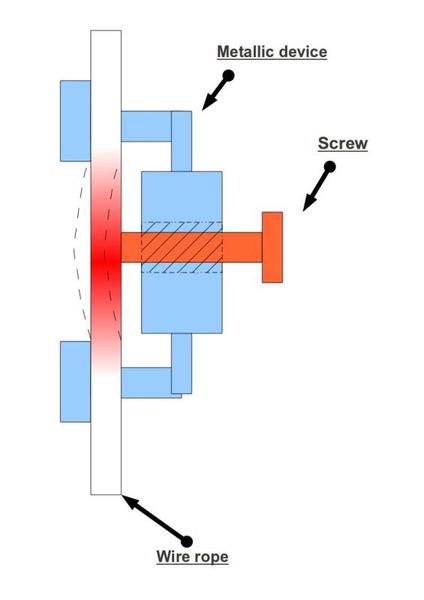
like this onei was thinking to build my own device..
like this one :
Untitled2.jpg


screw with my Torque wrench until a specific distance in wire rope curve...
after that i move the device to the other wire rope and torgue it until i have the same distance/curve
see how much torque needed to have the same curve and adjust the tension of the wire rope...

what do you think?
that will work?

Homework Statement


Homework Equations


The Attempt at a Solution

 
Last edited by a moderator:
Engineering news on Phys.org
You started by saying you had 3 wire ropes. Are they the same length, and can they be adjusted independently? If the holding device is such that tightening one rope causes a slack in the others, then the process is going to be more iterative. I didn't find your explanation clear enough.Are you applying the torque wrench to the rope or to the screw in your metallic device? When you speak of 'the other rope', which of the two remaining ropes are you speaking about? When you say 'distance/curve' do you mean for the rope or for the device? Have you considered the possibility of measuring the natural frequency of vibration? Whatever method you adopt, you need to think about the tolerances and accuracy of what you are doing. On the device, how will you measure lateral movement, and with what possible error (I prefer the word 'variation')?
 
Thanks for the reply my friend..

the 3 wire ropes have the same length
they can be adjusted independently
i am going to apply the torque wrench to the screw in my metallic device
When i speak about the other ropes... i refer to the other 2 ropes...

i know that accuracy will not be so good... but until know i was doing that by hand... checked witch rope is more tightened than the others..
 
how long are your ropes? Long ones can have their tension assessed by the amount of extension. You didn't say if you had considered period of vibration, which you might achieve by counting with a stop watch of the period is long enough. A sketch of your system would help a fuller understanding.
 
Hi my Friend..

the ropes are not standar in length .. depends from the building... is elevator ropes...here is the system

sistima.jpg
having the same tension all ropes is critical for the life of the pulley that moves them.. that's why i want to make them having the same tension as more accurate i can

Thanks in Advance for the interesting
 
Here is a device we use in the laboratory to get three equal forces. In the figure, the verticals are cables and the horizontals are beams. Do you get it?
 

Attachments

Yes i understand but i can't use this kind of connection in the elevators...

In Elevators/lifts hoisting have to made in a certain way that iso describes .
each wire rope should be connect to the frame of the car independent from the other wire ropes.. for safety


so that's is why i need a device to check the wire ropes tension... each wire rope has at the end a system with a big screw to connect them to the chassis...

so with the screw you can tight or loosen it in order to have the right tension..
 
(Thread moved to ME for more views)
 
Since this is a safety significant application, I would highly recommend you look into the laws governing safety requirements on elevator cables. I doubt a hodge-podged design like you're describing would be preferrable to a certified device designed for use on elevator cables specifically.

In addition, that tension measuring device you found is cheap compared to what it will cost your company to pay you to re-invent the wheel. Torque is a notoriously error-prone method for measuring bolt preload, which is why the device you found uses a load cell. Just suck it up and buy the thing.
 

Similar threads

  • · Replies 1 ·
Replies
1
Views
4K
  • · Replies 5 ·
Replies
5
Views
2K
  • · Replies 5 ·
Replies
5
Views
3K
  • · Replies 2 ·
Replies
2
Views
2K
  • · Replies 7 ·
Replies
7
Views
9K
  • · Replies 13 ·
Replies
13
Views
2K
  • · Replies 16 ·
Replies
16
Views
3K
  • · Replies 1 ·
Replies
1
Views
3K
  • · Replies 8 ·
Replies
8
Views
10K
  • · Replies 32 ·
2
Replies
32
Views
5K