Hello Dexter,
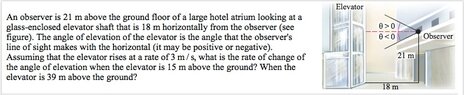
I would let $E$ be the elevation of the observer, $h$ be the height of the elevator above the ground, and $w$ be the horizontal distance of the observer from the elevator shaft.
From the diagram, we see we mat then state:
$$\tan(\theta)=\frac{h-E}{w}$$
Differentiating with respect to time $t$ (recognizing that $\theta$ and $h$ are the only variables that change with time), we find:
$$\sec^2(\theta)\frac{d\theta}{dt}=\frac{1}{w}\frac{dh}{dt}$$
Multiplying through by $$\cos^2(\theta)$$, we get:
$$\frac{d\theta}{dt}=\frac{\cos^2(\theta)}{w}\frac{dh}{dt}$$
By Pythagoras, we know:
$$\cos^2(\theta)=\frac{w^2}{(h-E)^2+w^2}$$
and thus we may state:
$$\frac{d\theta}{dt}=\frac{w}{(h-E)^2+w^2}\frac{dh}{dt}$$
Plugging in the given data, we have (in radians per second):
$$\frac{d\theta}{dt}=\frac{54}{(h-21)^2+18^2}$$
And so to answer the questions, we find:
$$\left.\frac{d\theta}{dt} \right|_{h=15}=\frac{54}{(15-21)^2+18^2}=\frac{3}{20}$$
$$\left.\frac{d\theta}{dt} \right|_{h=39}=\frac{54}{(39-21)^2+18^2}=\frac{1}{12}$$