DFA that accepts either ab or ba as substring?

  • Context: Comp Sci 
  • Thread starter Thread starter shivajikobardan
  • Start date Start date
  • Tags Tags
    Computation Dfa
Click For Summary
SUMMARY

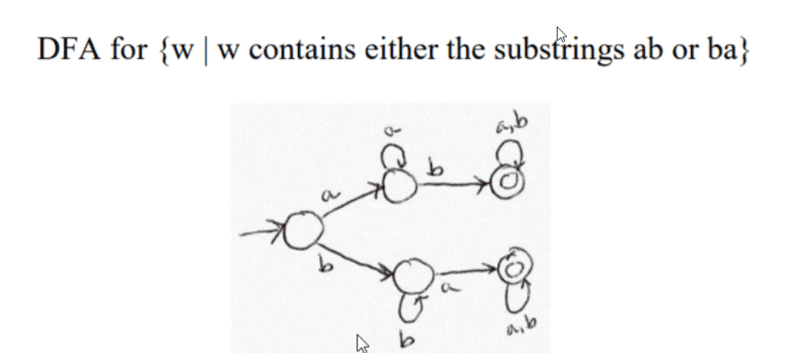
The discussion revolves around the construction of a Deterministic Finite Automaton (DFA) that accepts strings containing either the substring "ab" or "ba". The confusion arises from the interpretation of the English phrase "contains either the substrings ab or ba" as either inclusive or exclusive. The DFA presented accepts the string "abba", which is acceptable under the inclusive interpretation but not under the exclusive interpretation. Participants are encouraged to explore both interpretations and submit their findings for academic evaluation.

PREREQUISITES
  • Understanding of Deterministic Finite Automata (DFA)
  • Familiarity with string theory and substring concepts
  • Knowledge of formal language definitions
  • Basic comprehension of logical operators, specifically inclusive and exclusive "or"
NEXT STEPS
  • Research the construction of DFAs for exclusive substring acceptance
  • Study the implications of inclusive vs. exclusive logical operators in automata theory
  • Explore variations of DFAs that handle multiple substring conditions
  • Learn about the minimization of DFAs and its impact on substring acceptance
USEFUL FOR

This discussion is beneficial for computer science students, automata theorists, and anyone involved in formal language processing or DFA design.
shivajikobardan
Messages
637
Reaction score
54
Homework Statement
I need to create a DFA that contains substrings either ab or ba
Relevant Equations
Deterministic finite automata no equations
Attempt at solution-:

1635769064071.png

Now this dfa will also accept abba which in my inituition it should not accept. But it does accept it. What is going here? Please guide
 
Physics news on Phys.org
The English language statement "contains either the substrings ab or ba" is the issue. If you read this as an "inclusive or" then your DFA looks okay. If you read it as an "exclusive or" then it is not okay. Since you are a student and you recognize this potential ambiguity, figure out the "exclusive or" case. Submit both variations and your professor will be delighted!

Is the alphabet { a, b } ?
 
Last edited:

Similar threads

  • · Replies 1 ·
Replies
1
Views
2K
  • · Replies 17 ·
Replies
17
Views
3K
  • · Replies 3 ·
Replies
3
Views
2K
  • · Replies 20 ·
Replies
20
Views
4K
  • · Replies 2 ·
Replies
2
Views
1K
Replies
8
Views
2K
  • · Replies 140 ·
5
Replies
140
Views
12K
  • · Replies 5 ·
Replies
5
Views
2K
  • · Replies 2 ·
Replies
2
Views
2K
  • · Replies 5 ·
Replies
5
Views
2K