Dietary supplements database from NIH

  • Thread starter Thread starter jim mcnamara
  • Start date Start date
  • Tags Tags
    Database
Click For Summary

Discussion Overview

The discussion revolves around the NIH dietary supplements database, focusing on the analysis of supplement contents, particularly omega-3 fatty acids and their conversion in the human body. Participants explore the implications of dietary supplement regulation, the efficiency of nutrient conversion, and the characteristics of various oils used in cooking.

Discussion Character

  • Exploratory
  • Technical explanation
  • Debate/contested

Main Points Raised

  • Some participants highlight the lack of regulation in dietary supplements in the US, noting that the NIH database provides a way to estimate the actual contents of supplements.
  • One participant discusses the conversion inefficiency of ALA to EPA and DHA, stating that only a small percentage is converted and that this process depends on the presence of other nutrients.
  • Another participant mentions that high levels of omega-6 fatty acids in the modern diet can hinder the conversion of ALA to its active forms.
  • A participant shares insights on polyunsaturated fatty acids (PUFAs) found in cooking oils, noting the efficiency of ALA to DHA conversion and the impact of trans fats being disallowed in the US market.
  • There is mention of the smoke point of various oils and how it affects their use in cooking, with specific oils like flax and canola being discussed for their omega-6 to omega-3 ratios.

Areas of Agreement / Disagreement

Participants express differing views on the efficiency of nutrient conversion and the implications of dietary choices. There is no consensus on the best sources of omega-3 fatty acids or the overall effectiveness of dietary supplements.

Contextual Notes

Participants note that the conversion rates of ALA to EPA and DHA can vary significantly based on individual dietary habits and nutrient availability, which remains unresolved in the discussion.

jim mcnamara
Mentor
Messages
4,789
Reaction score
3,852
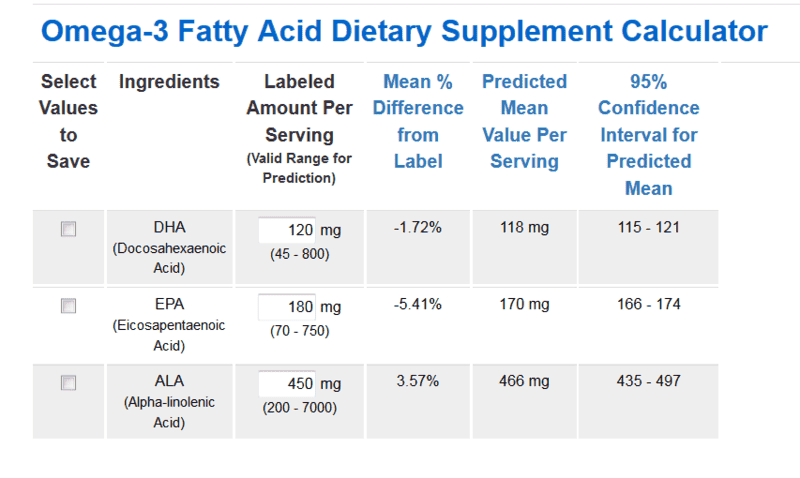
Here is nice data set and analysis - example analysis:
https://dietarysupplementdatabase.usda.nih.gov/ingredient_calculator/calc_omega3.php
screenshot.png


In the US there is little regulation of the contents of dietary supplements. As a result NIH created a supplements database which has analysis results for groups of supplements. The idea is:
How much stuff do I have in this pill? And you get a 'more or less' kind of answer.

If you open the example page, click the 95%CI button. What you get is the expected value of some supplement as a confidence interval. The example is for omega3 fatty acids, In the example, if the label on your supplement says DHA 120mg, then you have a reasonably good chance (95%) that you have somewhere between 115 and 121 mg. Probably.

There are sets of screens, one for multivitamins (MVM), and others. All are very like the example in terms of design.

The MVM data is "interesting". Some mineral supplements have a huge CI, translation:
"Good luck on getting what you think you bought."

Other times things like mcg, IU, and so on are NOT the same thing, they vary by vitamin molecule, and it confuses people, mostly when it comes to vitamins A, D, E, K. ...for lots of reasons beyond the scope of this little message. Example for vitamin A:
https://ods.od.nih.gov/factsheets/VitaminA-HealthProfessional/

From the example link to the database you can click around the site and see what is available.

Again, this is US only. Some countries are very good on supplement labels, New Zealand. Others are worse than the US. India comes to mind.

Have fun.
 

Attachments

  • screenshot.png
    screenshot.png
    26.8 KB · Views: 1,205
  • Like
Likes   Reactions: BillTre and Evo
Biology news on Phys.org
Also, ALA is not easily converted by the human body.

ALA, the most common omega-3 fat, needs to be converted into EPA or DHA to become "active" (3).

Unfortunately, this conversion process is inefficient in humans. On average, only 1–10% is converted into EPA and 0.5–5% is converted into DHA (4, 5, 6, 22).

Furthermore, the conversions are dependent on adequate levels of other nutrients, such as vitamins B6 and B7, copper, calcium, magnesium, zinc and iron. Many of these are lacking in the modern diet, especially among vegetarians (23).

The low conversion rate is also because omega-6 fatty acids compete for the same enzymes needed for the conversion process. Therefore, the high amount of omega-6 in the modern diet can reduce the conversion of ALA to EPA and DHA (5, 24).

BOTTOM LINE:ALA is not biologically active in the body. It needs to be converted into EPA and/or DHA in order to become active, but this conversion process is inefficient in humans.

https://www.healthline.com/nutrition/3-types-of-omega-3#section5

And you should try to get your Omega-3 from natural food, not fish oil supplements as research does not tend to support the claims.

https://well.blogs.nytimes.com/2015/03/30/fish-oil-claims-not-supported-by-research/

So before you decide to pop a few pills or change your diet to what you think is healthy, do some research.
 
  • Like
Likes   Reactions: Janosh89, jim mcnamara and berkeman
Oh dear. @Evo peeked into can the can of worms. I gave a talk on polyunsaturated (PUFA) which are found in cooking oils. Natural artists drying oils, like rosemary oil, could go here but cooking with them gives really bad results.

See the table below (cntl/z on browsers makes images larger) Any errors are mine. Corrections welcome. Click on the image to enlarge it
1. ALA->DHA in humans is ~15% efficient
2. Trans fats (partially hydrogenated oils) as of April are pretty much disallowed in the US prepared food market. They are not in the list.
3. Plant oils are mixtures, sometimes with other fat soluble components, so the table columns do not add to 100%. Refined oils are purer.
4. Interesterfied oils have "rearranged" triglycerides, i.e., sort of musical chairs with PUFA's. Not in the list. Good link for manager types:
https://www.westonaprice.org/health-topics/know-your-fats/interesterification/
5. Smoke point is the primary reason you seldom find some of the oils used for frying. Acrolein (smoke component, aka propenal) has some undesirable properties:
https://en.wikipedia.org/wiki/Acrolein

Fatty acid ratios are very important - Evo provided links above.
Two commonly available oils with good ratios of omega6/omega3: flax oil(Linum spp. seed) & canola oil(Brassica napus L., rapeseed)
Canola has a reasonable smoke point, flax seed oil does not.

Screenshot-2018-5-27 Screenshot.png
 

Attachments

  • Screenshot-2018-5-27 Screenshot.png
    Screenshot-2018-5-27 Screenshot.png
    25.5 KB · Views: 607
Last edited:
  • Like
Likes   Reactions: Evo
Last edited:

Similar threads

  • · Replies 6 ·
Replies
6
Views
4K