Difference between time / length equations for time dilation

Click For Summary
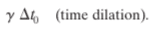
The discussion clarifies the distinction between time dilation equations for stationary and moving reference frames. The first equation measures time intervals between events in a stationary frame, while the second relates spacetime coordinates of a single event as perceived by observers in different inertial frames. An event is defined as a specific point in spacetime, not merely a point in time or space. The conversation emphasizes avoiding the term "moving frame of reference" to prevent confusion, as frames themselves do not move; rather, it is the objects within those frames that do. Understanding these concepts is crucial for accurately applying the equations in physics.
Pochen Liu
Messages
52
Reaction score
2
Homework Statement
What makes an event and when do I apply each equation to their respective situations
Relevant Equations
*attached
What is the difference between time dilation (t is the stationary reference frame)
t =
245239

Description:
If two successive events occur at the same place in an inertial reference frame, the time interval 􏰋t0 between them, measured on a single clock

And this equation for time, if we take t' as the moving reference frame.

245241

Description:
Relate the spacetime coordinates of a single event as seen by observers in two inertial frames, S and S' In terms of events, because I'm now confused as what classifies as an event. If you could provide a distinct example of when to use either equation that would be so helpful!
 

Attachments

  • 1560741583702.png
    1560741583702.png
    809 bytes · Views: 310
Last edited by a moderator:
Physics news on Phys.org
An event is simply a single point in space-time. Note that this is NOT a single point in space and it is NOT a single point in time.

Also be aware that the terminology "moving frame of reference" should NOT be used since it leads to confusion. Frames of reference don't move, objects do.
 
The book claims the answer is that all the magnitudes are the same because "the gravitational force on the penguin is the same". I'm having trouble understanding this. I thought the buoyant force was equal to the weight of the fluid displaced. Weight depends on mass which depends on density. Therefore, due to the differing densities the buoyant force will be different in each case? Is this incorrect?

Similar threads

  • · Replies 8 ·
Replies
8
Views
2K
  • · Replies 12 ·
Replies
12
Views
3K
  • · Replies 22 ·
Replies
22
Views
1K
Replies
6
Views
3K
  • · Replies 21 ·
Replies
21
Views
5K
  • · Replies 1 ·
Replies
1
Views
1K
  • · Replies 11 ·
Replies
11
Views
1K
  • · Replies 2 ·
Replies
2
Views
1K
  • · Replies 4 ·
Replies
4
Views
2K
  • · Replies 4 ·
Replies
4
Views
2K