Different speed of light at different milky way radius?

Click For Summary
SUMMARY

The discussion centers on the differing rotation speeds of stars in the Milky Way compared to the predictable orbital mechanics observed in the solar system. It highlights that while the rotation speed of planets around the sun decreases with distance, the same does not apply to stars in the Milky Way due to mass distribution. The conversation speculates on the potential influence of the interstellar medium's temperature on the speed of light, referencing Lene Vestergaard Hau's work on slowing light using Bose-Einstein condensates. Ultimately, the consensus is that while these ideas are intriguing, they lack substantial empirical support.

PREREQUISITES
  • Understanding of Kepler's laws of planetary motion
  • Familiarity with the concept of mass distribution in galaxies
  • Basic knowledge of light propagation in different media
  • Awareness of Bose-Einstein condensates and their properties
NEXT STEPS
  • Research Vera Rubin's contributions to galaxy rotation and dark matter
  • Explore the effects of temperature on light speed in various media
  • Study the dynamics of mass distribution in spiral galaxies
  • Investigate the implications of gravitational effects on star motion in galaxies
USEFUL FOR

Astronomers, astrophysicists, and students of cosmology interested in the dynamics of galaxies and the fundamental principles of motion and light in astrophysical contexts.

Juanma
Messages
3
Reaction score
0
The rotation speed of planets around the sun follows a simple rule: if you double the distance to the sun the rotation speed is reduced by the square root of 2. No matter the mass of the planet. If Earth mass was different the period of rotation around the sun will be exactly the same.

But in the milky way the rotation speed of stars around it's center does not follow this rule.
This is a map of velocities of stars around the milky way:
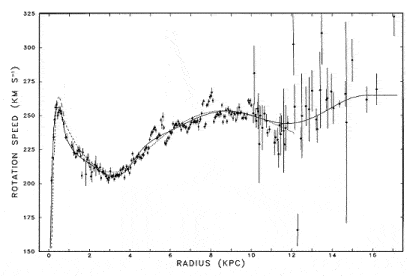
galrot.gif


May this variance of speed be an effect and not the real motion?

You may have heard that light slows down when passing throuhg superfluids. By use of a Bose-Einstein condensate, Danish physicist Lene Vestergaard Hau (Harvard University) succeeded in slowing a beam of light to about 17 metres per second, and, in 2001, was able to momentarily stop a beam. ()

So what if the temperature of the interestelar medium is different at different radius? So the speed of light at our radius could be 299792458 m/s but the light coming from different radius may travel through a medium at lower temperature and slower speed. This could explain why we see that the radial motion of the milky does not follow Kepler's third law.
 
Last edited by a moderator:
Physics news on Phys.org
In the solar system, more than 99% of the total mass is located in the center (the sun), this gives the simple relation between distance and orbital velocity.
In the milky way, most of the mass is located in the disk, spread out over the whole galaxy. This leads to a more complicated distance<->orbital velocity relation.

May this variance of speed be an effect and not the real motion?
An effect of what?
The speed of light has nothing to do with that. While its speed does depend on the medium, the variations are extremely small in the interstellar medium, and it does not influence gravity at all.
 
This could explain why we see that the radial motion of the milky does not follow Kepler's third law.

Only as a pie in the sky speculation...try some calculations and you'll find the hypothesis
would not work under some reasonable temperature variation assumptions. Nevertheless,
such dream scenarios can be fun to contemplate.

You might find the work astronomer Vera Rubin of interest.
 

Similar threads

  • · Replies 93 ·
4
Replies
93
Views
6K
  • · Replies 42 ·
2
Replies
42
Views
2K
  • · Replies 6 ·
Replies
6
Views
1K
  • · Replies 36 ·
2
Replies
36
Views
3K
  • · Replies 25 ·
Replies
25
Views
5K
  • · Replies 10 ·
Replies
10
Views
1K
  • · Replies 52 ·
2
Replies
52
Views
6K
  • · Replies 146 ·
5
Replies
146
Views
10K
  • · Replies 2 ·
Replies
2
Views
2K
  • · Replies 45 ·
2
Replies
45
Views
6K