MHB Differential equation for draining a pool

Click For Summary
The discussion revolves around solving a differential equation related to draining a pool, specifically addressing parts (a), (b), and (c) of the problem. The correct formulation for the rate of change of water depth is established as dD/dt = (k - √D)/100, leading to an equilibrium solution of D = k², which is stable. Participants clarify that for k > 2, the pool will overflow, while for 0 < k ≤ 2, it will eventually empty. The importance of the initial condition D₀ being in the range (0, 4) is emphasized, as it impacts the equilibrium point. The discussion concludes with a clear understanding of how the flow rates affect the pool's water level over time.
Vishak95
Messages
19
Reaction score
0
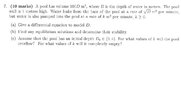
Hi MHB. Can someone help me with this one please? I don't understand what the question is really saying...in particular part (c).

I tried to set up dD/dt = k - D^1/2 but it doesn't seem correct. Thanks.

View attachment 1589
 

Attachments

  • Differential equation.jpg
    Differential equation.jpg
    45.9 KB · Views: 116
Physics news on Phys.org
I have moved this topic to our Differential Equations sub-forum, as it is a better fit.
 
Your answer to part (a) is not quite correct. We know:

(1) $$\frac{dV}{dt}=\text{flow in}-\text{flow out}$$

We are given:

$$V=100D,\,\text{flow in}=k,\,\text{flow out}=\sqrt{D}$$

So, substituting these given values into (1), what do we obtain?
 
Ok, now I've got this:

$$\frac{dV}{dD}= 100$$

$$\frac{dV}{dt} = \frac{dV}{dD}\cdot \frac{dD}{dt}$$

Leading to:

$$\frac{dD}{dt}= \frac{k-\sqrt{D}}{100}$$
 
Looks good. :D
 
Okay, thanks :)

So now for part (b) I've got the only equilibrium solution:

$$D = k^{2}$$

Which is stable.

But I'm completely lost looking at part (c) :(
 
Your equilibrium point is correct, and is stable since:

i) For $$D<k^2$$ we have:

$$\frac{dD}{dt}>0$$

ii) For $$D>k^2$$ we have:

$$\frac{dD}{dt}<0$$

which shows that for all values of $D$, we must have:

$$\lim_{t\to\infty}D(t)=k^2$$

So, for part (c) you want to look at what values of $k$ cause the equilibrium point to satisfy the condition that the pool overflows or empties. Where would these equilibrium points be?
 
Ok, thanks.

The thing that's still tripping me up is this part:

$$D_{0} \in (0,4)$$

And the fact that right now D0 isn't in the equation...
 
Vishak said:
Ok, thanks.

The thing that's still tripping me up is this part:

$$D_{0} \in (0,4)$$

And the fact that right now D0 isn't in the equation...

$$D_0=D(0)$$

and we are given that:

$$0<D_0<4$$

Can you now state what values of $k$ will cause the pool to empty and overflow?
 
  • #10
I'm guessing that for k > 2, it will overflow and for 0 <or= k < 2 it will empty?
 
  • #11
Vishak said:
I'm guessing that for k > 2, it will overflow and for 0 <or= k < 2 it will empty?

You are correct that for $2<k$ the pool will overflow, since the equilibrium point will be greater than the depth of the pool.

In order for the pool to empty, we require the equilibrium point to be $D=0$, so we require $k=0$.

In other words, in order for the pool to completely empty, there can be no water flowing into the pool, given that the initial amount of water is greater than zero. If there is any water flowing into the pool, no matter how slowly, then the equilibrium point will be greater than zero. Because the rate at which the water leaks out varies as the square root of the depth, as the level of the water decreases, the rate at which it leaks out will decreases as well, until at some point the rate at which it leaks approaches the rate at which it is being pumped in, and we approach equilibrium.
 
  • #12
Thank you so much for that explanation! I understand it now :)
 

Similar threads

  • · Replies 52 ·
2
Replies
52
Views
8K
  • · Replies 25 ·
Replies
25
Views
3K
  • · Replies 5 ·
Replies
5
Views
3K
  • · Replies 1 ·
Replies
1
Views
2K
  • · Replies 2 ·
Replies
2
Views
3K
  • · Replies 4 ·
Replies
4
Views
2K
  • · Replies 6 ·
Replies
6
Views
2K
  • · Replies 1 ·
Replies
1
Views
2K
  • · Replies 12 ·
Replies
12
Views
2K
  • · Replies 1 ·
Replies
1
Views
3K