Undergrad Differential equation using power series method

Click For Summary
SUMMARY

This discussion focuses on solving a differential equation using the power series method, specifically addressing the equation \((x + 3)y' + 2y = 0\). The participants analyze the recurrence relation for coefficients \(c_k\) derived from the series expansion \(y(x) = \sum_{k=0}^\infty c_k(x - 1)^k\). The correct recurrence relation is established as \(c_{k+1} = -\frac{k+2}{4(k+1)}c_k\), leading to the general solution \(y = A(x + 3)^{-2}\). The conversation emphasizes the importance of correctly manipulating series terms and comparing coefficients to derive valid solutions.

PREREQUISITES
  • Understanding of differential equations, specifically first-order linear equations.
  • Familiarity with power series and their convergence properties.
  • Knowledge of recurrence relations and their solutions.
  • Proficiency in manipulating series expansions and comparing coefficients.
NEXT STEPS
  • Study the method of power series solutions for differential equations.
  • Learn about recurrence relations and their applications in solving series.
  • Explore convergence criteria for power series, particularly in the context of differential equations.
  • Investigate the general solution techniques for first-order linear differential equations.
USEFUL FOR

Mathematicians, students studying differential equations, and educators looking to deepen their understanding of power series methods in solving ODEs.

Graham87
Messages
72
Reaction score
16
TL;DR
Differential equation using power series method
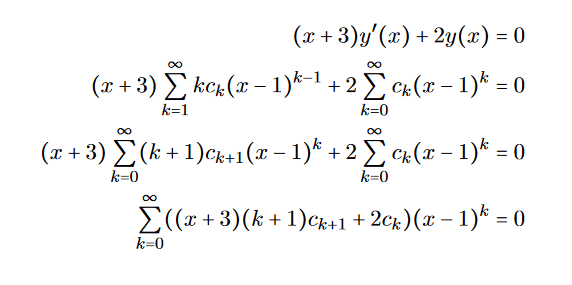
I am attempting to solve this differential equation with power series
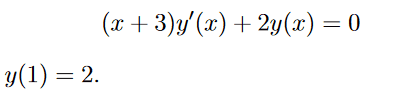
Screenshot 2023-12-20 135848.png


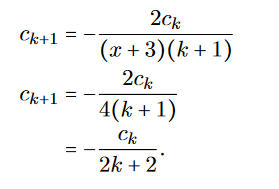
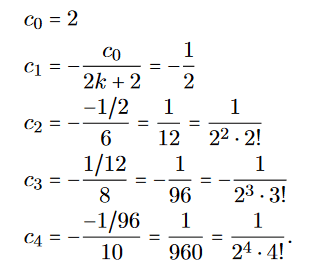
I came with the following solution but I doubt it is correct.
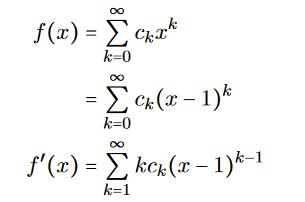
Screenshot 2023-12-20 140010.png

Screenshot 2023-12-20 140022.png


Since x=1 we get:
Screenshot 2023-12-20 140039.png

Screenshot 2023-12-20 140053.png

Screenshot 2023-12-20 140111.png

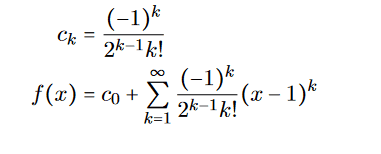
I doubt its correctness because it looks messy. Also the convergence radian R goes to 0, giving only a solution for x=0 which is not correct, since the beginning condition states y(1)=2.
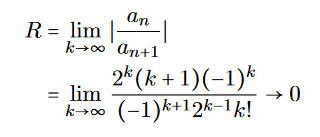
Screenshot 2023-12-20 140120.png
 

Attachments

  • Screenshot 2023-12-20 140022.png
    Screenshot 2023-12-20 140022.png
    9.4 KB · Views: 105
Last edited:
Physics news on Phys.org
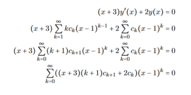
If you set y(x) = \sum_{k=0}^\infty c_k(x - 1)^k then x cannot appear in the recurrence relation for c_k; the c_k are supposed to be independent of x. You need to write \begin{split}(x + 3)y&#039; &amp;= <br /> (x - 1 + 4)\sum_{k=1}^\infty kc_k (x-1)^{k-1} \\<br /> &amp;= \sum_{k=1}^\infty kc_k (x - 1)^k + 4\sum_{k=1}^\infty kc_k (x- 1)^{k-1} \end{split} and then compare coefficients of (x-1)^k.
 
pasmith said:
If you set y(x) = \sum_{k=0}^\infty c_k(x - 1)^k then x cannot appear in the recurrence relation for c_k; the c_k are supposed to be independent of x. You need to write \begin{split}(x + 3)y&#039; &amp;=<br /> (x - 1 + 4)\sum_{k=1}^\infty kc_k (x-1)^{k-1} \\<br /> &amp;= \sum_{k=1}^\infty kc_k (x - 1)^k + 4\sum_{k=1}^\infty kc_k (x- 1)^{k-1} \end{split} and then compare coefficients of (x-1)^k.
Oh, I tried that too but did not go through it completely. So I get thefollowing:
Screenshot 2023-12-20 162206.png

Screenshot 2023-12-20 162211.png

Screenshot 2023-12-20 162217.png

However the general solution formula does not seem obvious. Where might I have gone wrong?
 
Last edited:
You can write the ODE as <br /> \sum_{k=0}^\infty ( kc_k + 4(k+1)c_{k+1} + 2c_k )(x-1)^k = 0 from which it follows that <br /> c_{k+1} = -\frac{k+2}{4(k+1)}c_k, \quad k \geq 0. This linear first-order recurrence can be easily solved, since the general solution of <br /> a_{k+1} = f(k)a_k is <br /> a_k = a_0 \prod_{r=0}^{k-1} f(r). Note that by inspection y = A(x + 3)^{-2} is the general solution of (x + 3)y&#039; + 2y = 0 so that you can check your answer against \begin{split}<br /> y(x) &amp;= 16y(1)(x + 3)^{-2} \\<br /> &amp;= 16y(1)(x - 1 + 4)^{-2} \\<br /> &amp;= y(1) \left(1 + \frac{x-1}{4}\right)^{-2} \\<br /> &amp;= y(1) \left(1 - 2\frac{x-1}4 + \dots<br /> + \frac{(-2)(-3) \cdots (-n - 1)}{n!}\left(\frac{x-1}4\right)^n + \dots \right)\end{split}
 
pasmith said:
You can write the ODE as <br /> \sum_{k=0}^\infty ( kc_k + 4(k+1)c_{k+1} + 2c_k )(x-1)^k = 0 from which it follows that <br /> c_{k+1} = -\frac{k+2}{4(k+1)}c_k, \quad k \geq 0. This linear first-order recurrence can be easily solved, since the general solution of <br /> a_{k+1} = f(k)a_k is <br /> a_k = a_0 \prod_{r=0}^{k-1} f(r). Note that by inspection y = A(x + 3)^{-2} is the general solution of (x + 3)y&#039; + 2y = 0 so that you can check your answer against \begin{split}<br /> y(x) &amp;= 16y(1)(x + 3)^{-2} \\<br /> &amp;= 16y(1)(x - 1 + 4)^{-2} \\<br /> &amp;= y(1) \left(1 + \frac{x-1}{4}\right)^{-2} \\<br /> &amp;= y(1) \left(1 - 2\frac{x-1}4 + \dots<br /> + \frac{(-2)(-3) \cdots (-n - 1)}{n!}\left(\frac{x-1}4\right)^n + \dots \right)\end{split}
I tried that, but I get stuck in the manipulation on the most left sum to k=0?
Screenshot 2023-12-20 162206.png

From your answer it turned to this somehow?
Screenshot 2023-12-20 181951.png

Shouldn't the most left term be
Screenshot 2023-12-20 183210.png
 
Last edited:
No; <br /> (x-1)y&#039; = \sum_{k=1}^\infty kc_k(x-1)^k = \sum_{k=0}^\infty kc_k(x-1)^k because 0c_0(x-1)^0 = 0.
 
pasmith said:
No; <br /> (x-1)y&#039; = \sum_{k=1}^\infty kc_k(x-1)^k = \sum_{k=0}^\infty kc_k(x-1)^k because 0c_0(x-1)^0 = 0.
Yeah, I realised that too! Thanks a lot!
 
pasmith said:
No; <br /> (x-1)y&#039; = \sum_{k=1}^\infty kc_k(x-1)^k = \sum_{k=0}^\infty kc_k(x-1)^k because 0c0(x−1)0=0.
Are you sure about this?
I did like this:
Screenshot 2023-12-20 192440.png

And since x=1 we get the following
Screenshot 2023-12-20 192448.png

And eventually
Screenshot 2023-12-20 192615.png

Screenshot 2023-12-20 192625.png
 
The fundamental issue here is that (x- 1)\sum_{k=1}^\infty kc_k(x-1)^{k-1} = \sum_{k=1}^\infty kc_k(x-1)^{k} = \sum_{k=0}^\infty kc_k(x-1)^k.
 

Similar threads

  • · Replies 3 ·
Replies
3
Views
1K
  • · Replies 7 ·
Replies
7
Views
3K
  • · Replies 2 ·
Replies
2
Views
3K
  • · Replies 2 ·
Replies
2
Views
4K
  • · Replies 52 ·
2
Replies
52
Views
8K
  • · Replies 1 ·
Replies
1
Views
3K
  • · Replies 1 ·
Replies
1
Views
3K
  • · Replies 4 ·
Replies
4
Views
2K
  • · Replies 10 ·
Replies
10
Views
3K
  • · Replies 2 ·
Replies
2
Views
2K