Differentiation formula: Is this a typo?

5 replies · 2K views · last reply
maistral
Messages
235
Reaction score
17
TL;DR
Resource found in the 'net, trying to know if this is a typo or not.
Red arrows.
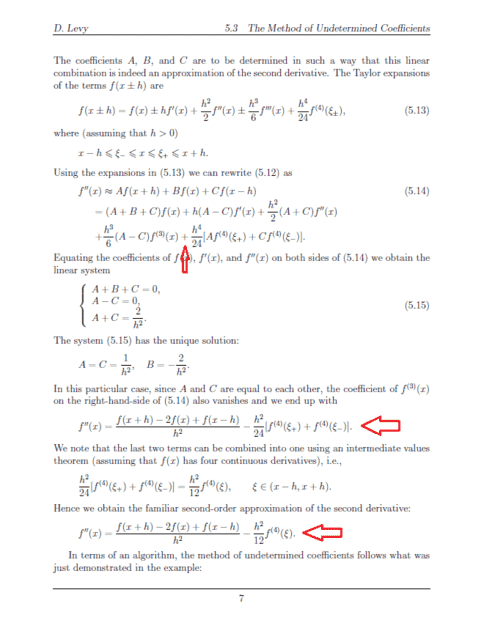
Page 7 of lecture notes by D. Levy showing the method of undetermined coefficients, with equations 5.13 to 5.15 and the central difference formula for f''(x) with its error term. Red arrows mark the error term signs.


The notes initially say that the error term is positive. After substitution of A and C which are clearly positive, the term suddenly became negative...? Is this a typo, or is there a theory behind this?
 
anuttarasammyak said:
It seems OK observing that the third term of (5.14) is f”(x).
What does this imply? That either positive or negative will work?
 
maistral said:
Summary:: Resource found in the 'net, trying to know if this is a typo or not.

Red arrows.
View attachment 287254

The notes initially say that the error term is positive. After substitution of A and C which are clearly positive, the term suddenly became negative...? Is this a typo, or is there a theory behind this?
It would seem to be the formula for an estimate of the error term in the Taylor series. Is this what your question was?
 
I finally got it! The notation was so confusing, sorry.

Handwritten-style derivation of a finite difference formula for the second derivative f''(x) using Taylor expansions of f(x+h) and f(x-h) with coefficients A, B, C, ending with a system of linear equations: 0 = [A+B+C], 0 = [A-C]h, 1 = [A+C]h^2/2, 0 = [A-C]h^3/6.


Handwritten-style derivation of the central difference formula for the second derivative, f''(x) = (f(x+h) - 2f(x) + f(x-h))/h^2, with error term, using Taylor expansions and cancellation of terms.
 
  • Like
Likes   Reactions: anuttarasammyak and WWGD