Differentiation on R^n ....need/ use of norms ....

  • Context: Undergrad 
  • Thread starter Thread starter Math Amateur
  • Start date Start date
  • Tags Tags
    Differentiation
Click For Summary

Discussion Overview

The discussion revolves around the use of norms in the context of differentiation on Rn, specifically focusing on Theorem 9.1.10 from Hugo D. Junghenn's "A Course in Real Analysis." Participants are examining the implications of norm signs in the proof and definitions related to vector-valued functions of several variables, exploring the conditions under which norms are necessary or can be omitted.

Discussion Character

  • Technical explanation
  • Conceptual clarification
  • Debate/contested
  • Mathematical reasoning

Main Points Raised

  • Peter questions the necessity of norm signs in the numerator of the expression related to the derivative and contrasts it with their presence in another part of the proof.
  • Some participants suggest that the norm signs in the numerator are not needed and that the zero referred to is the zero of the vector space Rm, not the scalar zero.
  • There is a proposal that the author may have included the norm signs to align with the definition of differentiability.
  • One participant asserts that the continuity of the norm allows for the swapping of limit and norm, making the statement trivial.
  • Peter seeks clarification on how to apply the theorem for the limit of the composition of functions to prove the implications regarding limits and norms.
  • Another participant outlines a more general statement regarding limits and provides a proof structure, indicating that if a function approaches a limit, the norm of that function also approaches the norm of the limit.

Areas of Agreement / Disagreement

Participants express differing views on the necessity of norm signs in specific contexts, with some arguing they are unnecessary while others suggest they serve a purpose in aligning with definitions. The discussion remains unresolved regarding the implications of these observations on the proof and definitions involved.

Contextual Notes

There are unresolved questions regarding the assumptions made about the use of norms and the definitions involved in the differentiation process. The discussion also touches on the epsilon-delta definition and the reverse triangle inequality, but these concepts are not fully explored or resolved.

Math Amateur
Gold Member
MHB
Messages
3,920
Reaction score
48
I am reading Hugo D. Junghenn's book: "A Course in Real Analysis" ...

I am currently focused on Chapter 9: "Differentiation on Rn" role="presentation">Rn"

I need some help with an aspect of Theorem 9.1.10 ...

Theorem 9.1.10 reads as follows:
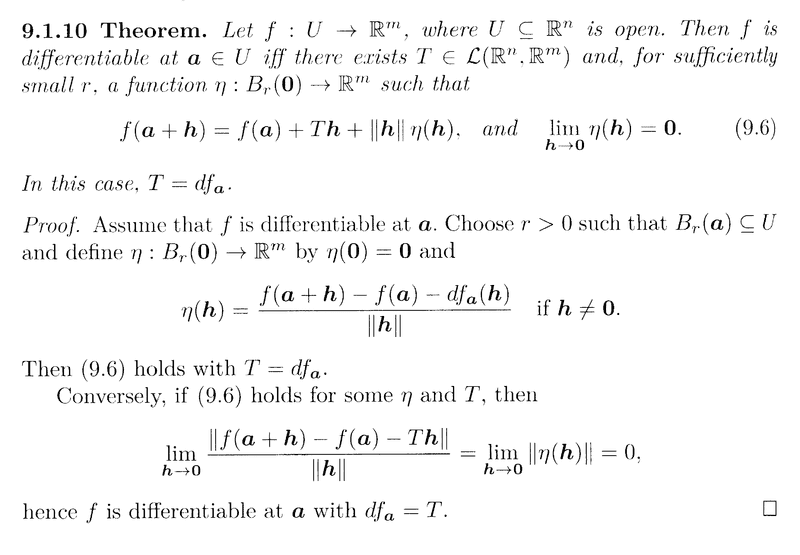
Junghenn - Theorem 9.1.10   ...  ... .png

The proof of Theorem 9.1.10 relies on the definition of the derivative of a vector-valued function of several variables ... that is, Definition 9.1.6 ... so I am providing the same ... as follows:
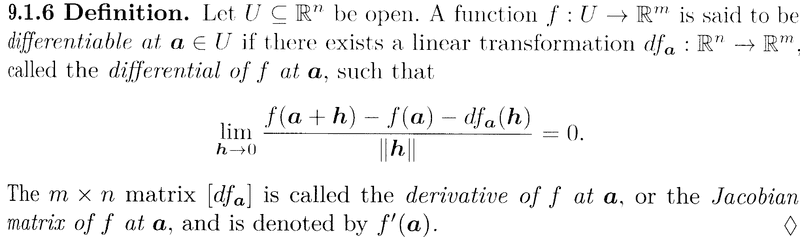
Junghenn - Definition 9.1.6   ...  ... .png

In Junghenn's proof of Theorem 9.1.10 above, we read the following:

" ... ... and

##\eta (h) = \frac{ f(a + h ) - f(a) - df_a (h) }{ \| h \| }## if ##h \neq 0##

... ... "Now there are no norm signs around this expression (with the exception of around ##h## in the denominator ...) ... and indeed no norm signs around the expression ##\lim_{ h \rightarrow 0 } \eta(h) = 0## ... nor indeed are there any norm signs in the limit shown in Definition 9.1.6 above (with the exception of around ##h## in the denominator ...) ...

... BUT ...

... ... this lack of norm signs seems in contrast to the last few lines of the proof of Theorem 9.1.10 as follows ... where we read ...

" ... ... Conversely if (9.6) holds for some ##\eta## and ##T##, then##\lim_{ h \rightarrow 0 } \frac{ \| f( a + h ) - f(a) - Th \| }{ \| h \| } = \lim_{ h \rightarrow 0 } \| \eta(h) \| = 0##... ... "Here, in contrast to the case above, there are norm signs around the numerator and indeed around ##\eta(h)## ... ...
Can someone please explain why norm signs are used in the numerator and, indeed, around ##\eta(h)## in one case ... yet not the other ...
Help will be appreciated ...

Peter
 

Attachments

  • Junghenn - Theorem 9.1.10   ...  ... .png
    Junghenn - Theorem 9.1.10 ... ... .png
    30.5 KB · Views: 1,289
  • Junghenn - Definition 9.1.6   ...  ... .png
    Junghenn - Definition 9.1.6 ... ... .png
    17.9 KB · Views: 638
Physics news on Phys.org
The norm signs are not needed in the numerator. The line that contains those is still true if they are removed. It's just that the 0 being referred to is the zero of the vector space ##\mathbb R^m## rather than the scalar 0 of ##\mathbb R_+##.

It may be that the author put the norm signs in the numerator in order to exactly match what was used in the definition of 'differentiable'.

You should satisfy yourself that, if ##g:\mathbb R^n\to \mathbb R^m##, then:
$$\lim_{\mathbf x\to \mathbf a}g(\mathbf x) = \mathbf 0 \Rightarrow
\lim_{\mathbf x\to \mathbf a}\|g(\mathbf x)\| = 0
$$
You can use the theorem for the limit of the composition of two functions, each of which have certain limits.
 
  • Like
Likes   Reactions: Math Amateur
andrewkirk said:
The norm signs are not needed in the numerator. The line that contains those is still true if they are removed. It's just that the 0 being referred to is the zero of the vector space ##\mathbb R^m## rather than the scalar 0 of ##\mathbb R_+##.

It may be that the author put the norm signs in the numerator in order to exactly match what was used in the definition of 'differentiable'.

You should satisfy yourself that, if ##g:\mathbb R^n\to \mathbb R^m##, then:
$$\lim_{\mathbf x\to \mathbf a}g(\mathbf x) = \mathbf 0 \Rightarrow
\lim_{\mathbf x\to \mathbf a}\|g(\mathbf x)\| = 0
$$
You can use the theorem for the limit of the composition of two functions, each of which have certain limits.
Hi Andrew ... thanks for the help ...

But, your post has really got me thinking ...

I think I need some more help, though ...

You write:

" ... ...
You should satisfy yourself that, if ##g:\mathbb R^n\to \mathbb R^m##, then:
$$\lim_{\mathbf x\to \mathbf a}g(\mathbf x) = \mathbf 0 \Rightarrow
\lim_{\mathbf x\to \mathbf a}\|g(\mathbf x)\| = 0
$$
You can use the theorem for the limit of the composition of two functions, each of which have certain limits. ... ... "Can you explain how the theorem for the limit of the composition of two functions, each of which have certain limits. ... ... could be used to prove the above ..

Peter
 
Last edited by a moderator:
Math Amateur said:
Hi Andrew ... thanks for the help ...

But, your post has really got me thinking ...

I think I need some more help, though ...

You write:

" ... ...
You should satisfy yourself that, if ##g:\mathbb R^n\to \mathbb R^m##, then:
$$\lim_{\mathbf x\to \mathbf a}g(\mathbf x) = \mathbf 0 \Rightarrow
\lim_{\mathbf x\to \mathbf a}\|g(\mathbf x)\| = 0
$$
You can use the theorem for the limit of the composition of two functions, each of which have certain limits. ... ... "Can you explain how the theorem for the limit of the composition of two functions, each of which have certain limits. ... ... could be used to prove the above ..

Peter

The norm is continuous. Therefore, you can swap limit and norm. The statement becomes trivial then. It is also not difficult to prove this implication starting from the epsilon-delta definition, using the reverse triangle inequality
 
  • Like
Likes   Reactions: Math Amateur
andrewkirk said:
The norm signs are not needed in the numerator. The line that contains those is still true if they are removed. It's just that the 0 being referred to is the zero of the vector space ##\mathbb R^m## rather than the scalar 0 of ##\mathbb R_+##.

It may be that the author put the norm signs in the numerator in order to exactly match what was used in the definition of 'differentiable'.

You should satisfy yourself that, if ##g:\mathbb R^n\to \mathbb R^m##, then:
$$\lim_{\mathbf x\to \mathbf a}g(\mathbf x) = \mathbf 0 \Rightarrow
\lim_{\mathbf x\to \mathbf a}\|g(\mathbf x)\| = 0
$$
You can use the theorem for the limit of the composition of two functions, each of which have certain limits.
Math_QED said:
The norm is continuous. Therefore, you can swap limit and norm. The statement becomes trivial then. It is also not difficult to prove this implication starting from the epsilon-delta definition, using the reverse triangle inequality
Thanks Math_QED ...

You write:

" ... ... It is also not difficult to prove this implication starting from the epsilon-delta definition, using the reverse triangle inequality ... ... "

Cannot quite see how to do this ... but to start the process ... ...We want to show that if
##g:\mathbb R^n\to \mathbb R^m##, then:

##\lim_{\mathbf x\to \mathbf a} \mathbf g (\mathbf x) = \mathbf 0 \Rightarrow
\lim_{\mathbf x\to \mathbf a}\| \mathbf g (\mathbf x)\| = 0##

Now ...

##\lim_{\mathbf x\to \mathbf a} \mathbf g (\mathbf x) = \mathbf 0##

##\Longrightarrow## ... for every ##\epsilon \gt 0## there exists a ##\delta \gt 0## such that ...

## \| \mathbf{g} ( \mathbf{x} ) - \mathbf{0} \| = \| \mathbf{g} ( \mathbf{x} ) \| \lt \epsilon ##

where ##0 \lt \| \mathbf{x} - \mathbf{a} \| \lt \delta ##

... ... ... But ... where do we go from here ... how do we get a situation where we can use the reverse triangle inequality ...?

Can you help ...?

Peter
 
Math Amateur said:
Thanks Math_QED ...

You write:

" ... ... It is also not difficult to prove this implication starting from the epsilon-delta definition, using the reverse triangle inequality ... ... "

Cannot quite see how to do this ... but to start the process ... ...We want to show that if
##g:\mathbb R^n\to \mathbb R^m##, then:

##\lim_{\mathbf x\to \mathbf a} \mathbf g (\mathbf x) = \mathbf 0 \Rightarrow
\lim_{\mathbf x\to \mathbf a}\| \mathbf g (\mathbf x)\| = 0##

Now ...

##\lim_{\mathbf x\to \mathbf a} \mathbf g (\mathbf x) = \mathbf 0##

##\Longrightarrow## ... for every ##\epsilon \gt 0## there exists a ##\delta \gt 0## such that ...

## \| \mathbf{g} ( \mathbf{x} ) - \mathbf{0} \| = \| \mathbf{g} ( \mathbf{x} ) \| \lt \epsilon ##

where ##0 \lt \| \mathbf{x} - \mathbf{a} \| \lt \delta ##

... ... ...But ... where do we go from here ... how do we get a situation where we can use the reverse triangle inequality ...?

Can you help ...?

Peter

We prove a more general statement: Let ##a## be a limit point of ##A \subseteq \mathbb{R}^n## (your case is ##A = \mathbb{R}^n## with ##0 = a \in A)##

Let ##f: A \subseteq \mathbb{R}^n \to \mathbb{R}^m## be a function. If ##\lim_{x \to a} f(x) = b##, then ##\lim_{x \to a} \Vert f(x) \Vert = \Vert b \Vert##

Proof: Let ##\epsilon > 0##. Choose ##\delta>0## such that for all ##x \in A## satisfying ##0 < \Vert x-a \Vert < \delta##, we have that ##\Vert f(x) - b \Vert < \epsilon##. Then, whenever ##x \in A## satisfies ##0 <\Vert x - a \Vert < \delta##, we have:

##|\Vert f(x) \Vert - \Vert b \Vert | \leq \Vert f(x) - b \Vert < \epsilon##

Hence, we have proven:

##\forall \epsilon > 0: \exists \delta > 0: \forall x \in A: 0 < \Vert x - a \Vert < \delta \implies |\Vert f(x) \Vert - \Vert b \Vert | < \epsilon##, which is what we wanted to show.
 
  • Like
Likes   Reactions: Math Amateur
Math_QED said:
We prove a more general statement: Let ##a## be a limit point of ##A \subseteq \mathbb{R}^n## (your case is ##A = \mathbb{R}^n## with ##0 = a \in A)##

Let ##f: A \subseteq \mathbb{R}^n \to \mathbb{R}^m## be a function. If ##\lim_{x \to a} f(x) = b##, then ##\lim_{x \to a} \Vert f(x) \Vert = \Vert b \Vert##

Proof: Let ##\epsilon > 0##. Choose ##\delta>0## such that for all ##x \in A## satisfying ##0 < \Vert x-a \Vert < \delta##, we have that ##\Vert f(x) - b \Vert < \epsilon##. Then, whenever ##x \in A## satisfies ##0 <\Vert x - a \Vert < \delta##, we have:

##|\Vert f(x) \Vert - \Vert b \Vert | \leq \Vert f(x) - b \Vert < \epsilon##

Hence, we have proven:

##\forall \epsilon > 0: \exists \delta > 0: \forall x \in A: 0 < \Vert x - a \Vert < \delta \implies |\Vert f(x) \Vert - \Vert b \Vert | < \epsilon##, which is what we wanted to show.
Thanks Math_QED ... appreciate your help...

Peter
 
  • Like
Likes   Reactions: member 587159

Similar threads

  • · Replies 4 ·
Replies
4
Views
2K
  • · Replies 2 ·
Replies
2
Views
1K
  • · Replies 1 ·
Replies
1
Views
3K
  • · Replies 3 ·
Replies
3
Views
2K
Replies
2
Views
2K
  • · Replies 2 ·
Replies
2
Views
3K
  • · Replies 2 ·
Replies
2
Views
3K
  • · Replies 8 ·
Replies
8
Views
2K
Replies
1
Views
1K
  • · Replies 2 ·
Replies
2
Views
2K